The Lazy Girl’s Guide to Beginner Weight Training for Women at Home
You Can Start Strength Training at Home Today — Here’s How
Beginner strength training for women at home is one of the most effective ways to build muscle, boost your metabolism, and feel stronger — no gym required. If you’re short on time, unsure where to start, or just want to work out in your living room, this guide has you covered.
Here’s what you need to get started:
| What You Need | Details |
|---|---|
| Space | About 6×6 feet (yoga mat size) |
| Equipment | Bodyweight only, or light dumbbells (5-10 lbs) |
| Time | 20-30 minutes per session |
| Frequency | 2-3 days per week |
| Experience needed | None |
The basics in 30 seconds:
- Start with bodyweight exercises like squats, glute bridges, and wall push-ups
- Train 2-3 times per week, with at least one rest day between sessions
- Focus on slow, controlled movements — form matters more than weight
- Add more reps or resistance gradually over time (this is called progressive overload)
- Pair your workouts with enough protein, sleep, and recovery
Many women feel noticeably stronger within just two weeks of consistent training. Visible changes typically follow around the 4-6 week mark — but the energy boost and confidence often show up first.
The biggest mistake most beginners make? Waiting until they feel “ready.” You don’t need a gym membership, expensive equipment, or a perfect schedule. You just need a place to start.
I’m Jennifer Rapchak, Fitness Director at Results Fitness Alexandria and a certified personal trainer with over 14 years of experience helping women build real, lasting strength — including through beginner strength training for women at home. In this guide, I’ll walk you through exactly what to do, how to do it safely, and how to keep making progress week after week.
Beginner strength training for women at home helpful reading:
Why Beginner Strength Training for Women at Home is Your Ultimate Secret Weapon
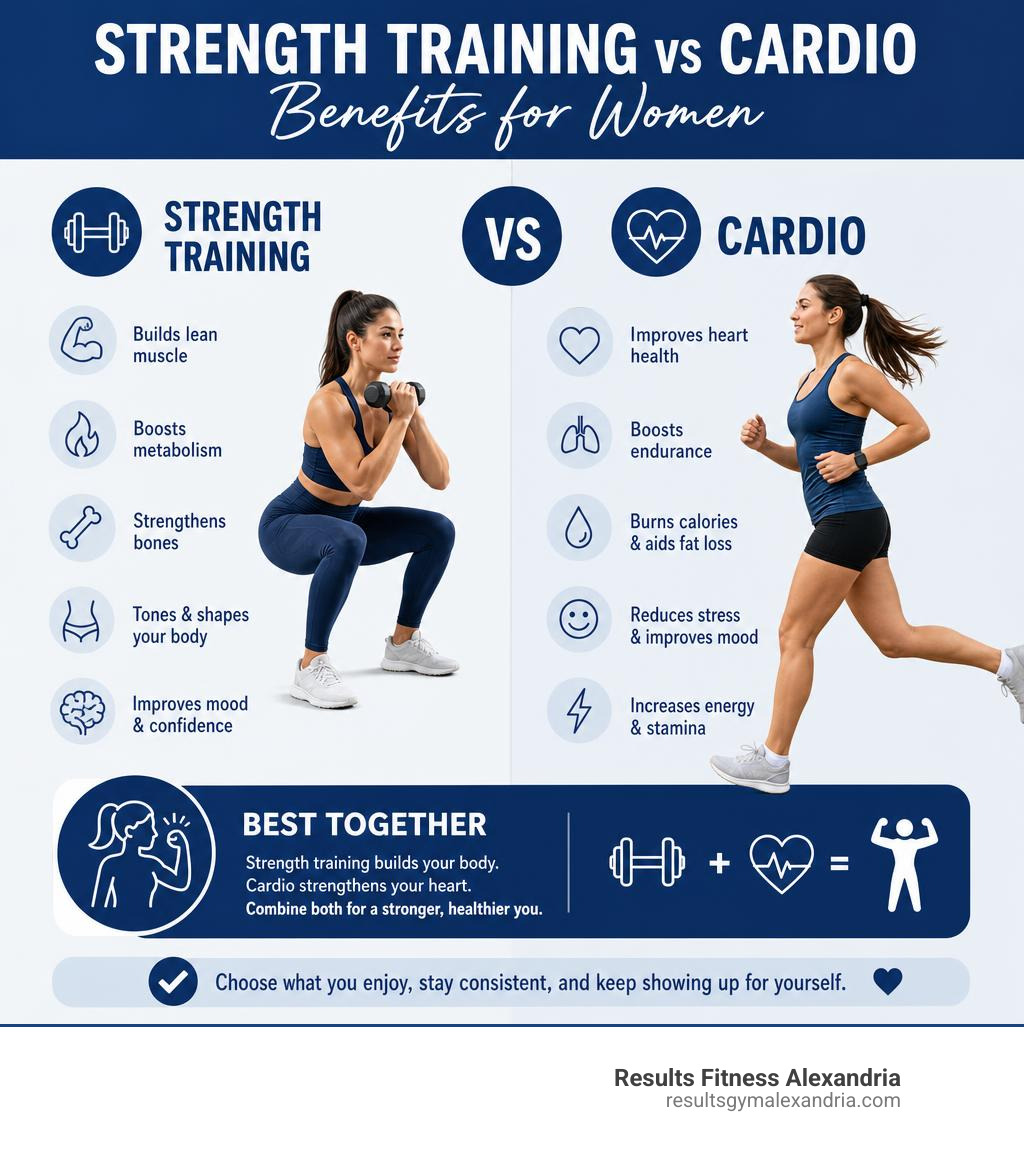
If you have spent years believing that endless hours of cardio are the only way to stay fit, healthy, and lean, we are here to let you in on a life-changing secret: strength training is your actual superpower. While running on a treadmill burns calories while you are moving, lifting weights turns your body into a round-the-clock calorie-burning machine.
As we navigate life in 2026, the scientific consensus has never been clearer. Strength training is not just about building visible muscle; it is a fundamental pillar of health, longevity, and mental well-being, especially for women as they navigate their 30s, 40s, and beyond.
Fighting Sarcopenia and Rebuilding Muscle
After the age of 30, women can lose between 3% and 8% of their muscle mass per decade. This natural decline is known as sarcopenia. When you lose muscle, your metabolic rate drops, which is why many women find it easier to gain weight as they age even if their diet remains unchanged. By incorporating beginner strength training for women at home, you actively combat this decline, preserving and rebuilding lean muscle tissue that keeps your metabolism firing at rest.
Protecting Your Bones
Muscle mass and bone density go hand in hand. Bones peak in density during your 20s and gradually decline afterward, a process that accelerates significantly during perimenopause and menopause. When your muscles contract against resistance, they pull on your bones, signaling your body to deposit more minerals and strengthen the bone structure.
In fact, research shows that as little as 30 minutes of high-intensity resistance training twice a week can significantly improve bone density, structure, and strength in postmenopausal women with low bone mass. Starting early builds a “bone bank” that protects you from osteoporosis and fractures later in life. You can read more about this in the Scientific research on bone health.
The “Bulky” Myth and Testosterone
Let’s address the elephant in the living room: the fear of getting “bulky.” Many women avoid lifting weights because they worry they will wake up looking like a professional bodybuilder. We promise you, this will not happen.
Women have significantly lower levels of testosterone than men — the primary hormone responsible for building large, dense muscle mass. Achieving a bulky physique requires years of highly specific, high-volume heavy lifting paired with an immense caloric surplus. For everyday women, strength training simply creates a firm, toned, and athletic appearance while dropping body fat.
Longevity and Mental Well-Being
Did you know that muscle mass and strength are the number one predictors of longevity in humans? Research indicates that individuals in the strongest third of the population during midlife are two and a half times more likely to celebrate their 100th birthday. Strength training keeps you independent, improves your balance, and reduces your risk of falls.
The benefits are equally powerful for your mind. A meta-analysis of 33 clinical trials found that strength training significantly reduces symptoms of depression and anxiety. Lifting weights releases endorphins, lowers stress hormones, and builds a sense of physical empowerment that transfers directly into your daily life. When you realize you can lift a heavy box or carry all your groceries in one trip, your self-efficacy skyrockets.
Beyond Cardio: Fat Loss and Metabolism
While cardio is wonderful for your heart, it can sometimes lead to muscle loss if overdone without resistance training. When you lose weight through cardio alone, a portion of that weight comes from active muscle tissue.
By contrast, women who incorporate strength training lose significantly more pure body fat while preserving their metabolism-boosting muscle. To understand how resistance training reshapes your body composition far better than jogging ever could, check out this guide on More info about fat loss benefits.
Setting Up Your Living Room Sanctuary: No-Equipment & Dumbbell Essentials
You do not need a garage full of expensive gym equipment or a dedicated home gym room to start your strength journey. Your living room, bedroom, or patio is more than enough. All you really need is about a 6×6 foot area — essentially the size of a standard yoga mat.
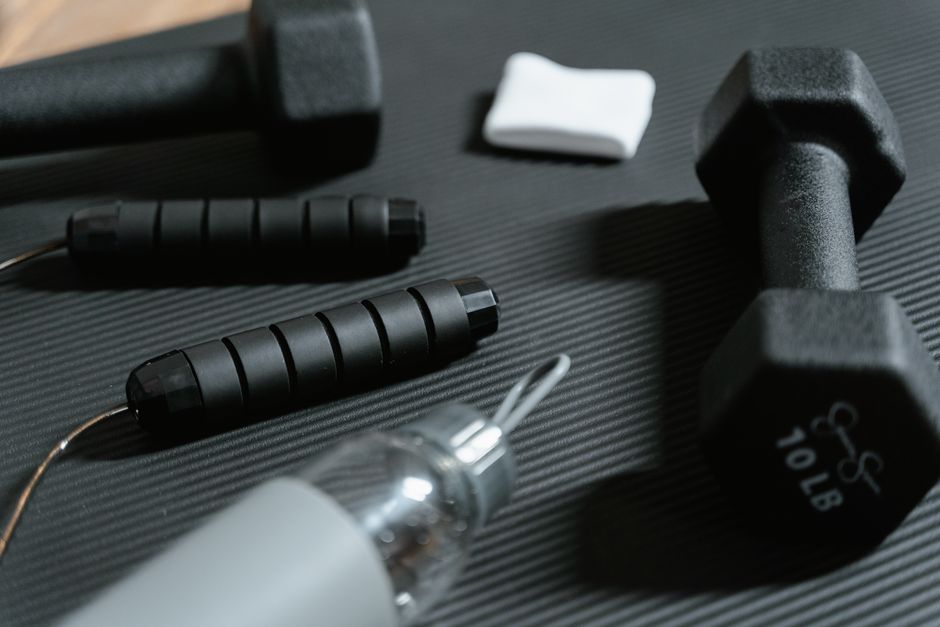
When you are starting out, your own body weight is your best tool. It allows you to master movement patterns safely before adding external loads. However, as you get stronger, having a few simple tools can help you keep making progress.
- A High-Quality Yoga Mat: This provides traction so your feet do not slip during squats or lunges, and cushions your knees and spine during floor work.
- Adjustable Dumbbells: If you want to invest in equipment, a single pair of adjustable dumbbells is incredibly space-efficient. They allow you to change the weight from light (for upper body moves) to heavy (for lower body moves) with the turn of a dial.
- Fixed Dumbbells: Alternatively, buying a couple of pairs of fixed dumbbells (such as a light pair of 5 lbs and a medium/heavy pair of 8 or 10 lbs) is a perfect starting point.
Creative Household Alternatives
If you are not ready to purchase equipment yet, do not let that stop you! Your home is packed with excellent resistance tools:
- Water Bottles or Soup Cans: Perfect for light upper body exercises like bicep curls or shoulder presses.
- Laundry Detergent Jugs: The built-in handle makes these amazing substitutes for kettlebells or dumbbells. You can use them for squats, deadlifts, and rows.
- A Sturdy Backpack: Fill a backpack with books or water bottles, zip it up, and wear it while squatting or lunging to add hands-free resistance.
- A Firm Chair or Couch: Excellent for assisted squats, incline push-ups, or tricep dips.
No matter what you choose, the key is simply to create resistance. For a deep dive into how to use your home environment to get a killer workout, explore More info about bodyweight workouts.
How to Choose Your Starting Weight for Beginner Strength Training for Women at Home
Choosing the right weight is a balancing act. If a weight is too light, your muscles won’t adapt and grow stronger. If it is too heavy, your form will break down, putting you at risk of injury.
For complete beginners, we recommend starting with your own body weight for the first week or two. Once you can perform the movements with perfect form and zero joint pain, it is time to add resistance.
The “Reps in Reserve” (RIR) Rule
When selecting a dumbbell or household item, use the Reps in Reserve rule. If your workout plan calls for 10 repetitions of an exercise, you should choose a weight where reps 8, 9, and 10 feel challenging, but you could still perform 1 or 2 more reps with perfect form if you absolutely had to. If you finish 10 reps and feel like you could easily do another 15, the weight is too light. If your form starts shaking or your back starts arching by rep 6, the weight is too heavy.
Prioritize the Eccentric Phase
One of the best ways to protect your joints — especially for women over 35 — is to focus on the eccentric (lowering) phase of your movements. Instead of letting gravity drop the weight, control it.
We recommend a tempo of 3 seconds down, 1 second up. For example, when lowering yourself into a squat, count to three on the way down, pause for a split second at the bottom, and then stand up powerfully in one second. This controlled tempo builds incredible strength, improves mind-muscle connection, and keeps the stress on your muscles rather than your joints. To learn more about this joint-friendly approach, read the Scientific research on training over 35.
The Lazy Girl’s 4-Week Full-Body Home Workout Plan
We call this the “Lazy Girl’s” plan because it is designed for maximum efficiency with minimal complexity. You do not need to spend hours exercising every day. Training just two to three times a week for 20 to 30 minutes can increase your strength by around 10% in just a fortnight, with massive 20% to 30% increases after a few consistent months.
We recommend scheduling your workouts on non-consecutive days (for example, Monday, Wednesday, and Friday) to give your muscles a full day to recover and rebuild. NHS physical activity guidelines specifically recommend doing strength-based exercise at least twice a week, spread out with recovery days in between.
Your 4-Week Progression Table
| Week | Target Sets | Target Reps | Rest Period | Focus |
|---|---|---|---|---|
| Week 1 | 2 sets | 10 reps | 60 seconds | Mastering form and tempo (3s down, 1s up) |
| Week 2 | 2 sets | 12 reps | 60 seconds | Increasing muscular endurance |
| Week 3 | 3 sets | 10 reps | 45 seconds | Adding volume and reducing rest to challenge the heart |
| Week 4 | 3 sets | 12 reps | 45 seconds | Maximizing work capacity before recovery |
Note: For a library of time-saving routines tailored for busy lifestyles, check out More info about beginner routines.
The 5-Minute Warm-Up (Do This Every Time)
Never skip your warm-up! Cold muscles are less pliable and more prone to strains. A dynamic warm-up prepares your nervous system and increases blood flow to your joints.
- March in Place (1 minute): Pump your arms and lift your knees comfortably high.
- Arm Circles (1 minute): 30 seconds forward, 30 seconds backward to warm up the shoulders.
- Hip Circles (1 minute): Stand with hands on hips and make wide circles, as if using a hula hoop.
- Bodyweight Half-Squats (1 minute): Gently lower your hips halfway down to wake up your glutes and thighs.
- Cat-Cow Stretch (1 minute): On your hands and knees, gently arch your back toward the ceiling, then let your belly dip toward the floor.
The 5-Minute Cool-Down
After your workout, spend a few minutes lowering your heart rate and stretching out the muscles you just worked. Hold each stretch for 20-30 seconds while taking deep, slow breaths.
- Hamstring Stretch: Sit on the floor with one leg straight and reach gently toward your toes.
- Quad Stretch: Stand (hold a wall for balance) and pull one heel toward your glutes.
- Chest Opener: Interlace your fingers behind your back and gently pull your shoulders back and down.
- Child’s Pose: Kneel on the floor, sit your hips back onto your heels, and reach your arms forward on the mat.
Effective Exercises for Beginner Strength Training for Women at Home
Here are the five core movements that make up your full-body routine. These exercises cover all the major muscle groups (legs, glutes, chest, back, and core) to give you a balanced, highly effective workout.
1. Bodyweight Squats (Targets: Glutes, Quads, Core)
- How to do it: Stand with your feet slightly wider than hip-width apart, toes pointed slightly outward. Keep your chest lifted and your core engaged. Push your hips back and bend your knees as if sitting down in an invisible chair. Lower down until your thighs are parallel to the floor (or as deep as your flexibility allows). Push through your heels to return to the starting position.
- Beginner Modification: The Sit-to-Stand. Sit on a sturdy chair, lean slightly forward, and stand up using your leg strength. Lower yourself back down to the chair with control.
- Advanced Progression: Hold a dumbbell or a laundry detergent jug close to your chest (goblet style).
2. Wall Push-Ups (Targets: Chest, Shoulders, Triceps, Core)
- How to do it: Stand arm’s length away from a flat wall. Place your hands flat on the wall at shoulder height and slightly wider than shoulder-width apart. Keep your body in a straight line from head to heels. Bend your elbows and lower your chest toward the wall, keeping your elbows tucked at a 45-degree angle (not flared straight out). Push yourself back to the starting position.
- Beginner Modification: Step closer to the wall to reduce the resistance.
- Advanced Progression: Move to an elevated surface like a couch or kitchen counter (incline push-up), or perform them on your knees on the floor.
3. Glute Bridges (Targets: Glutes, Hamstrings, Lower Back)
- How to do it: Lie on your back with your knees bent and feet flat on the floor, hip-width apart. Keep your arms flat by your sides. Squeeze your glutes and push through your heels to lift your hips toward the ceiling until your body forms a straight line from your knees to your shoulders. Hold for one second at the top, then slowly lower your hips back to the floor.
- Beginner Modification: Keep the range of motion small and focus entirely on squeezing your glutes at the top.
- Advanced Progression: Place a light dumbbell across your hips for added resistance, or try lifting one leg off the floor at a time (single-leg glute bridge).
4. Modified Planks (Targets: Deep Core, Shoulders, Back)
- How to do it: Lie on your stomach, then prop yourself up on your forearms and knees. Your elbows should be directly underneath your shoulders. Pull your belly button in toward your spine and tuck your pelvis slightly to engage your core. Keep your neck relaxed and look down at the floor. Avoid letting your lower back sag or your hips hike up. Hold for 15 to 30 seconds.
- Beginner Modification: Hold the position for 5-10 seconds, rest for 5 seconds, and repeat.
- Advanced Progression: Lift your knees off the floor and hold a full plank on your toes.
5. One-Arm Dumbbell Rows (Targets: Upper Back, Lats, Biceps)
- How to do it: Place your left knee and left hand flat on a sturdy chair or couch for support. Your torso should be parallel to the floor. Hold a dumbbell or water bottle in your right hand, letting it hang straight down. Keeping your elbow tucked close to your side, pull the weight up toward your hip. Squeeze your shoulder blade at the top, then slowly lower the weight back down. Do all reps on one side, then switch.
- Beginner Modification: Perform a Doorway Row by standing in a door frame, holding the frame with your hands, leaning back slightly, and pulling your chest toward the frame.
- Advanced Progression: Increase the weight of your dumbbell or slow down the lowering phase to 4 seconds.
For more guidance on structuring these moves into a seamless flow, read the Scientific research on beginner plans.
Frequently Asked Questions about At-Home Strength Training
Will lifting weights make me look bulky?
No, lifting weights will not make you look bulky. As mentioned earlier, women do not produce enough testosterone to naturally build massive, bulky muscles. Instead, strength training stimulates muscle hypertrophy (muscle growth) on a lean scale. This means you replace soft tissue with dense, active muscle tissue. This process actually decreases your physical size because muscle occupies about 18% less space than fat of the same weight. You will look leaner, firmer, and more toned, not larger.
How quickly will I see results from home workouts?
You will likely feel results within the first two weeks. Most women notice an immediate increase in their daily energy, better sleep quality, and a feeling of physical stability. Neurological strength gains happen rapidly; your brain gets better at communicating with your muscles, which can boost your strength by 10% in just a fortnight. Visible muscle tone and changes in body composition typically begin to appear around the 4 to 6-week mark, assuming you are consistent with your training and eating a balanced diet.
Should I do cardio or strength training first?
If you are doing both in the same workout session, we highly recommend doing strength training first. Lifting weights requires a high level of mental focus, core stability, and explosive energy. If you run or do intense cardio first, you will drain your muscle glycogen stores and fatigue your stabilizing muscles, which can cause your lifting form to break down and increase your risk of injury. Save your cardio for after your strength session, or perform it on separate active recovery days (like a brisk 30-minute walk).
Conclusion
Starting your strength journey in the comfort of your own home is one of the most empowering choices you can make for your body, mind, and future. Consistency will always beat intensity. You do not need to perform grueling, painful workouts to see incredible benefits. A simple, structured routine done two or three times a week will completely transform how you look, move, and feel.

To get the absolute best results from your at-home workouts, make sure you are supporting your body off the mat:
- Prioritize Protein: Aim to consume adequate protein (roughly 0.8 to 1 gram of protein per kilogram of body weight) to help your muscles repair and rebuild.
- Stay Hydrated: Drink plenty of water throughout the day to keep your joints lubricated and your energy levels high.
- Listen to Your Body: Mild muscle soreness is normal, but sharp joint pain is a sign to stop and rest.
While home workouts are an amazing, convenient way to build a foundation, there may come a time when you want to take your fitness to the next level, get personalized feedback on your form, or enjoy the energy of a supportive, in-person community.
When you are ready to transition or simply want to try out professional equipment under the guidance of expert trainers, we would love to welcome you to Results Fitness Alexandria. We offer a welcoming, intimidation-free environment designed specifically to help women of all fitness levels thrive.
Come visit us in Alexandria, Virginia, and claim your free 1-day pass to try our premium amenities, exciting classes, and childcare services.
Start your journey with our Women’s Workout Program today, and let’s build a stronger, healthier version of you together!