The Best Mindful Movement Classes for Stress Relief
Why Mindful Movement Classes Are Worth Your Attention
Mindful movement classes combine physical exercise with present-moment awareness — giving your body and mind a workout at the same time.
Here’s a quick overview of what they offer:
| What You Get | Why It Matters |
|---|---|
| Stress relief through breath and movement | Lowers cortisol and calms the nervous system |
| Improved sleep quality | Slow breathing and gentle movement reduce arousal |
| Greater body awareness | Helps prevent injury and builds resilience |
| Emotional balance | Shifts your mood by changing how you move |
| Accessible to all fitness levels | No experience or flexibility required |
Whether you’re dealing with a packed schedule, low energy, or just feeling stuck — mindful movement is one of the most practical tools for feeling better fast.
It’s not about being flexible or “good at yoga.” It’s about paying attention while you move. That small shift makes a surprisingly big difference.
Research backs this up. A review of over 1,000 studies found that mindful movement practices like yoga, tai chi, and qigong significantly improve sleep quality. Even two minutes of open, expansive posture can increase feelings of energy and confidence.
I’m Jennifer Rapchak, Fitness Director at Results Fitness Alexandria, and with over 14 years of experience designing group fitness and personal training programs, I’ve seen how mindful movement classes can transform not just how people move, but how they feel. In this guide, I’ll help you find the right class for your goals — whether that’s less stress, better sleep, or simply more ease in your body.
Relevant articles related to Mindful movement classes:
Understanding Mindful Movement Classes
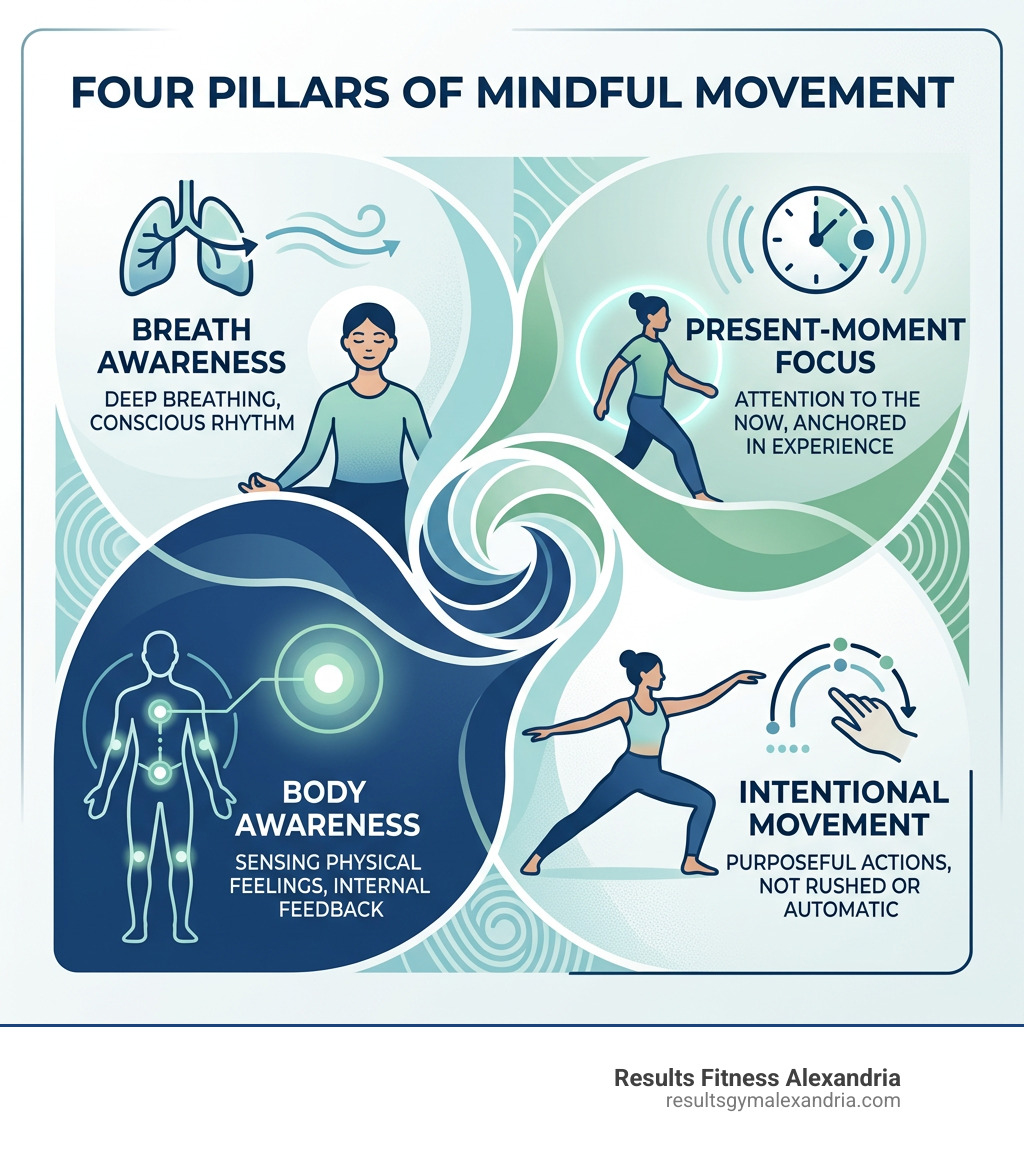
At its simplest, mindful movement is “meditation in motion.” While a standard gym session might involve scrolling through your phone on the treadmill or zoning out during reps, mindful movement classes require you to be fully “checked in.”
The goal isn’t just to burn calories; it’s to develop a deep mind-body fitness connection. This practice involves bringing full attention to the present moment, focusing on your breath, and noticing body sensations as they happen. When your mind inevitably wanders to your grocery list or a work deadline, you gently redirect it back to the physical sensation of the movement.
This shift in focus actually changes how your nervous system functions. By moving intentionally, you can influence your autonomic nervous system, shifting from a “fight or flight” state into a “rest and digest” state. This is why you often leave these classes feeling energized rather than exhausted.
| Feature | Traditional Exercise | Mindful Movement |
|---|---|---|
| Primary Goal | Physical performance/Weight loss | Mind-body connection/Awareness |
| Mental State | Often distracted (music/TV) | Present-moment focus |
| Breathing | Secondary to movement | The foundation of movement |
| Pace | Often fast or high-intensity | Deliberate and controlled |
| Feedback | External (reps/weight/time) | Internal (sensations/feelings) |
Differentiating Mindful Movement Classes from Standard Workouts
The biggest difference lies in the why and the how. In a standard workout, you might push through pain to hit a specific number. In a mindful class, the focus is on how the movement feels. You learn to listen to your body’s signals, which is a key part of how yoga can help improve your flexibility. Instead of forcing a stretch, you move to the point of tension and use your breath to create space. This builds mental clarity and emotional resilience because you aren’t wishing the present moment were different—you are accepting it as it is.
The Role of Breath in Mindful Movement Classes
Breath is the “remote control” for your nervous system. In our classes, we focus on diaphragmatic breathing, which stimulates the vagus nerve. Research from Harvard Medical School suggests that slow, meditative breathing (about 3–6 breaths per minute) can significantly decrease arousal and aid sleep compared to the normal 15–20 breaths per minute.
By training your breathing, you improve your CO2 tolerance and Oxygen exchange. This also improves your Heart Rate Variability (HRV), a key measure of nervous system resilience. A higher HRV means your body is better at handling stress and recovering from physical effort.
The Science-Backed Benefits of Mindful Movement
Mindful movement isn’t just “woo-woo”—it’s backed by rigorous science. One of the most significant areas of research is sleep quality. A high-quality research review of over 1,000 studies highlighted that mindful movement interventions like yoga and tai chi lead to significantly better sleep outcomes. By settling the mind and body before bed, you can fall asleep faster and stay asleep longer.
Beyond sleep, these practices are powerful tools for cortisol reduction. When we are chronically stressed, our bodies are flooded with cortisol, which can lead to weight gain and anxiety. Mindful movement helps flush these stress hormones out, building emotional resilience through increased body awareness.
Improving Confidence Through Posture
Did you know that how you stand can change how you feel? A study on open and expansive postures found that practicing “power poses” for as little as two minutes can increase a subjective sense of being energetic, empowered, and in control. When we hold our bodies in an upright, open position, it sends a signal to our brain that we are safe and confident. This is a core principle in many mindful movement classes—using the body to shift the mind out of self-doubt.
Enhancing Sleep with Meditative Breathing
If you struggle with “tired but wired” syndrome, mindful breathing is your best friend. Research on meditative breathing shows that focusing on the breath activates the parasympathetic nervous system. This activation acts as a natural sedative, lowering your heart rate and preparing your brain for restful sleep. It’s a practical tool you can use both in class and in bed.
Popular Types of Mindful Movement Classes
There isn’t a “one size fits all” approach to mindfulness. Depending on your goals, you might prefer the flow of yoga or the precision of Pilates.
Yoga and Flexibility-Based Mindful Movement Classes
Yoga is perhaps the most well-known mindful practice. However, there are many different types of yoga to choose from.
- Hatha Yoga: Great for beginners, focusing on basic postures and breath.
- Yin Yoga: A slow-paced style where poses are held for several minutes to target deep connective tissues.
- Trauma-Sensitive Practice: These classes use non-triggering language and prioritize safety and choice, making them excellent for those recovering from high stress or injury.
At Results Fitness Alexandria, our group fitness yoga options are designed to be inclusive, ensuring everyone feels welcome regardless of their experience level.
Pilates and Core-Centric Mindfulness
Many people think Pilates is just about “abs,” but it is actually a deeply mindful practice. It focuses on spine stabilization and engaging the “inner core”—the muscles that automatically protect your spine. Whether you are working with private Pilates instructors or joining a pilates circuit class, the focus is on functional strength and precision.
True core strength goes beyond a six-pack; it’s about how your midsection stabilizes your body during daily life. For those with busy schedules, our early morning Pilates classes provide a perfect mindful start to the day.
How to Get Started with Mindful Practice
Starting a new routine can feel overwhelming, but mindful movement is designed to meet you where you are. You don’t need expensive equipment—usually, just a mat and comfortable clothes will do.
If you’re unsure which direction to take, check out our ultimate guide to group fitness classes. The key to success is consistency. It’s better to do 10 minutes of mindful movement every day than a 90-minute class once a month.
Transitioning from Autopilot to Awareness
Most of us spend our days on “autopilot,” reacting to emails and notifications without checking in with ourselves. You can break this cycle by practicing sensory walking—noticing the feel of your feet on the ground—or doing a quick body scan to see where you’re holding tension. One of the best ways to benefit from different types of group fitness is to unplug. Leave the headphones in your locker and actually listen to your breath and the environment around you.
Integrating Mindfulness into Daily Workouts
You don’t have to be in a dedicated “mindful” class to practice mindfulness. You can bring these principles to any workout:
- Warm-up Intentions: Before you start, ask yourself why you are moving today. Is it for energy? For stress relief? To get stronger?
- Breath Cues: Use your breath to guide your effort. If you can’t maintain a steady breath, you might be pushing too hard.
- Post-workout Reflection: Take two minutes after your session to sit quietly and notice how your body feels. This reinforces the positive feedback loop in your brain.
Frequently Asked Questions about Mindful Movement
What is the difference between mindful movement and yoga?
While yoga is a form of mindful movement, not all mindful movement is yoga. Mindful movement is a broad category that includes walking meditation, Pilates, Qigong, and even mindful weightlifting. Yoga is a specific discipline with its own history, philosophy, and set of postures (asanas).
Are mindful movement classes suitable for beginners with injuries?
Yes! In fact, many people use mindful movement classes specifically for injury recovery. Because the focus is on listening to the body rather than hitting a specific metric, it is very safe. Practices like Gentle Yoga or Mindful Mobility are designed to be adaptable. Always inform your instructor about any injuries so they can provide specific modifications.
How long does it take to see stress-relief benefits?
You can often feel a shift in your nervous system after just one class. However, for long-term changes in sleep quality and emotional resilience, research suggests that a regular practice over 6 to 8 weeks produces the most significant results. Even just two minutes of mindful posture can provide an immediate “boost” in confidence and energy.
Conclusion
At Results Fitness Alexandria, we believe that fitness should support your whole life, not just your reflection in the mirror. Our mindful movement classes are designed to help you shed the stress of the day while building a stronger, more resilient body.
We know that trying a new class can be intimidating, which is why we offer a community-focused environment with personalized coaching to guide you every step of the way. Whether you’re interested in the core-strengthening precision of Pilates or the stress-melting flow of yoga, we have a space for you.
Ready to see how mindful movement can change your day? Start your journey with group fitness classes at Results Fitness Alexandria. We invite you to come in, meet our team, and experience the difference for yourself with a free 1-day pass. Let’s move with purpose, together.