The Beginner’s Guide to Surviving Your First Bootcamp
What Is Bootcamp Group Fitness (And Why It Works)
Bootcamp group fitness is a high-intensity, full-body workout done in a group setting that combines strength training, cardio, and functional movements — all led by a certified instructor.
Here’s what you need to know at a glance:
| What | Details |
|---|---|
| Session length | Typically 30–60 minutes |
| Intensity | ~80% of maximum heart rate |
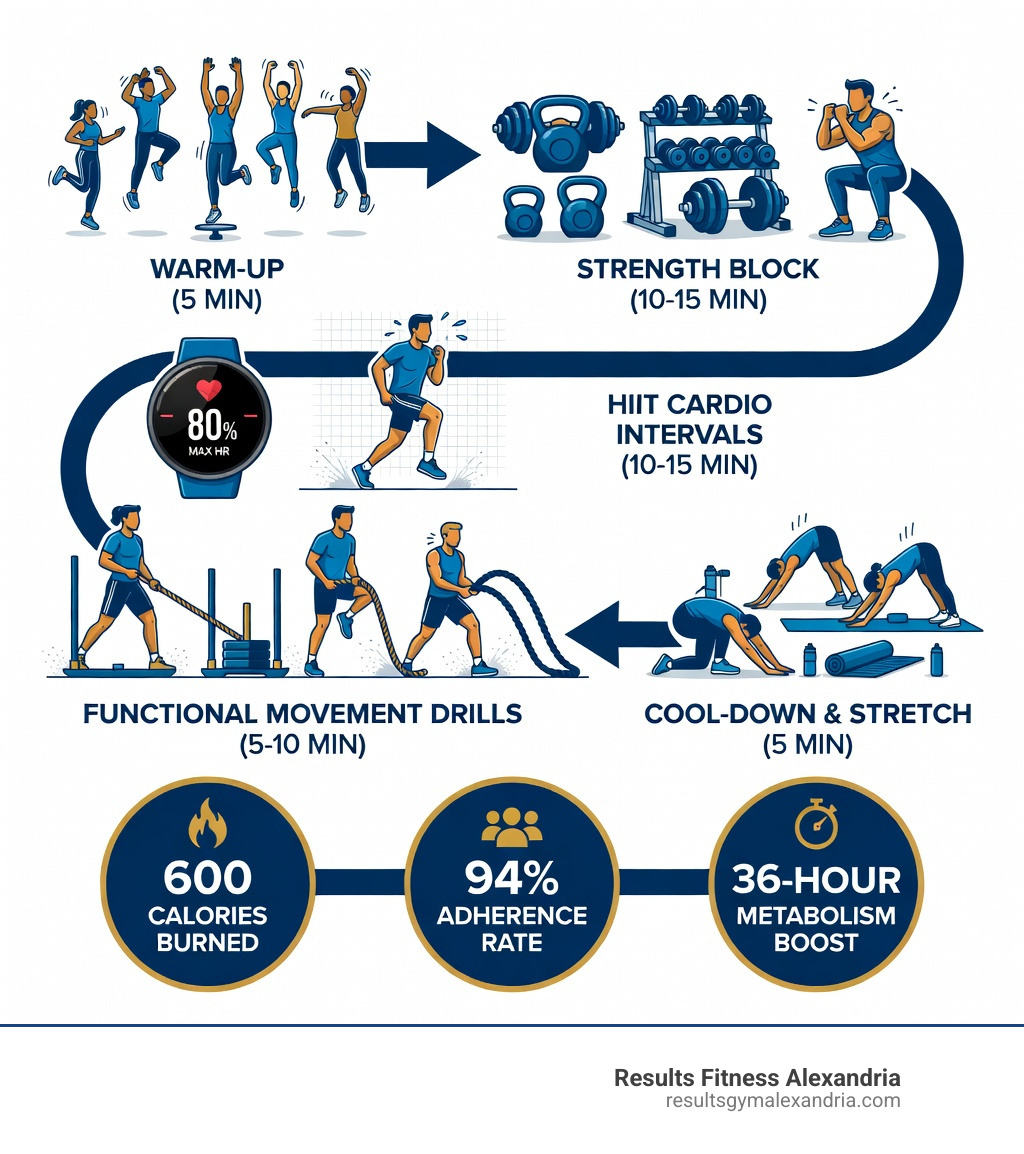
| Calorie burn | Up to 600 calories per session |
| Who it’s for | All fitness levels — modifications always available |
| Key benefits | Fat loss, strength, endurance, community accountability |
| How often | 2–4 sessions per week for best results |
Think of it as personal training — but in a group. You get structured, expert-led workouts without the one-on-one price tag. The energy of the group pushes you harder than you’d push yourself alone. And the format changes constantly, so it never gets boring.
If you’ve been putting off starting because you don’t know where to begin, feel intimidated by the gym, or just can’t seem to stay consistent — bootcamp is built for exactly that.
Studies back this up: people who work out in groups stick to their routines at a 94% adherence rate. That’s not a small difference. That’s the gap between results and giving up.
I’m Jennifer Rapchak, Fitness Director at Results Fitness Alexandria and a certified personal trainer with over 14 years of experience designing and leading bootcamp group fitness programs. In this guide, I’ll walk you through everything you need to survive — and thrive — in your first class.
Bootcamp group fitness word guide:
The Core Components of Bootcamp Group Fitness
When you step into a bootcamp group fitness class, you aren’t just signing up for a random assortment of exercises. These sessions are carefully curated to deliver a comprehensive, full-body experience. At its heart, bootcamp blends military-style discipline with modern sports science. We focus on three main pillars: strength, cardiovascular endurance, and functional agility.

Unlike a traditional gym session where you might spend twenty minutes on a treadmill and then wander over to a bicep curl machine, bootcamps utilize High-Intensity Interval Training (HIIT). This means we alternate between short bursts of intense activity and brief recovery periods. This method is scientifically proven to strengthen your cardiovascular system and build stamina much faster than steady-state cardio.
To get a deeper look at the philosophy behind this style of training, you can explore everything about bootcamp classes and how they transform your approach to movement.
Why Bootcamp Group Fitness Boosts Adherence
Why do so many people fail at solo gym routines? It usually comes down to accountability. In a bootcamp group fitness environment, the “group” part is just as important as the “fitness” part.
Research indicates that group fitness participants have a 94% adherence rate. When you know a coach and a team are expecting you, it is much harder to hit the snooze button. Furthermore, the “fun factor” and friendly competition inherent in these classes can help you push harder than you would alone, often resulting in burning up to 20% more calories compared to solo sessions. It turns a chore into a social highlight of your day. You can read more about the 10 benefits of group fitness classes to see why the community aspect is a game-changer.
Typical Exercises and Equipment
You won’t find many complex machines here. Instead, we use “functional” gear—tools that mimic real-world movements. Common equipment includes:
- Battle Ropes: For explosive power and core stability.
- Kettlebells and Dumbbells: To build lean muscle through squats, presses, and swings.
- Sled Pulls and Pushes: For total-body conditioning and leg strength.
- Medicine Balls: Used for slams and rotations to build rotational power.
- Bodyweight Staples: Expect burpees, push-ups, and squat jumps to keep your heart rate elevated.
The Science of the Afterburn Effect
One of the biggest draws of bootcamp group fitness is efficiency. You don’t need two hours to see results. In fact, our sessions are designed to keep you working at roughly 80% of your maximum heart rate. This is the “sweet spot” for optimizing fat burning and improving endurance.
This intensity triggers a physiological phenomenon known as Excess Post-exercise Oxygen Consumption (EPOC), commonly called the “Afterburn Effect.” Because your body works so hard during the HIIT portions of the bootcamp, your metabolism remains elevated for up to 36 hours after you leave the gym. While you’re sitting at your desk or sleeping, your body is still burning calories to repair muscle tissue and restore oxygen levels.
According to Mayo Clinic advice, incorporating 2 to 3 of these high-intensity sessions per week is the most effective way to see rapid changes in body composition and cardiovascular health.
Preparing for Your First Bootcamp Group Fitness Session
Walking into your first class can feel like the first day of school, but a little preparation goes a long way.
- Hydrate Early: Don’t wait until you’re thirsty in class. Sip water throughout the day leading up to your session.
- Fuel Right: Have a light, carb-based snack about 60 minutes before class (like a banana or a piece of toast).
- The Right Gear: Wear cross-training shoes that offer lateral support. Running shoes are okay, but you’ll appreciate the stability of a trainer during side-to-side movements.
- Arrive 15 Minutes Early: This is crucial. It gives you time to meet the instructor, mention any old injuries, and get a feel for the equipment.
For a more detailed breakdown of what to bring and how to mentally prepare, check out our ultimate guide to group fitness classes.
Frequency and Recovery for Optimal Results
While the energy of bootcamp group fitness is addictive, more isn’t always better. Your muscles don’t grow during the workout; they grow during the recovery period. We recommend attending 2–3 sessions per week to start. This allows for “rest days” in between, which are essential for preventing overtraining and injury. Consistency over months is always more effective than intensity for two weeks followed by burnout.
Inclusive Training: Modifications for Every Level
A common myth is that you need to be “in shape” just to start a bootcamp. That couldn’t be further from the truth. A great bootcamp is inclusive by design.
Every exercise we perform has a “regression” (an easier version) and a “progression” (a harder version). If the group is doing jump squats but your knees aren’t ready for impact, we’ll have you perform fast air squats or step-ups. If a full push-up is too much, we move to an incline or knee-supported version.
The goal isn’t to be the best in the room; it’s to be better than you were yesterday. Our instructors are trained to provide form correction in real-time to ensure you stay safe while pushing your limits.
Bootcamp vs. Personal Training vs. HIIT
It’s easy to get confused by all the fitness terminology. Here is how they generally stack up:
| Feature | Bootcamp | Personal Training | Standard HIIT |
|---|---|---|---|
| Group Size | 10–30 people | 1-on-1 | Varies |
| Personalization | Moderate (Modifications) | High (Custom Plan) | Low |
| Intensity | High | Variable | Very High |
| Cost | Budget-Friendly | Premium | Moderate |
| Atmosphere | Team/Community | Private/Focused | Independent |
Bootcamp offers a “best of both worlds” scenario. You get the professional guidance and safety of a trainer, the high-intensity results of HIIT, and the lower cost of a group setting. It’s an ideal environment for those who want small group training benefits with a bit more social energy.
Real-World Workout Structures and Themes
One of the reasons bootcamp group fitness stays exciting is that the “math” of the workout changes every time. You might walk in one day and see a “100 Club” challenge on the whiteboard, and the next day it’s a “54321” drill.
Here are a few structures you might encounter:
- AMRAP (As Many Rounds As Possible): You have a set list of exercises and a time limit (e.g., 10 minutes). You go through the list as many times as you can at your own pace.
- EMOM (Every Minute on the Minute): You perform a specific number of reps at the start of every minute, then rest for whatever time remains in that minute.
- The “54321” Drill: A descending ladder of intervals—5 minutes of work, then 4, then 3, and so on, often increasing in intensity as the time gets shorter.
- The Accumulator: You start with one exercise, then in the next round, you do the first exercise plus a second one, building a “stack” as you go.
We also love to keep things fresh with themed sessions—whether it’s a holiday-themed “Grinch” workout or a “Beyonce” lower-body blast. These themes keep the mood light while the work stays heavy.
The Role of Community and Coaching
The instructor’s job is part coach, part DJ, and part cheerleader. They are there to manage the clock, but more importantly, to build “mental grit.” When you feel like quitting at the 40-second mark of a plank, having a coach call out your name or a teammate give you a high-five is what keeps you in the game. This shared struggle creates a non-judgmental space where victories—no matter how small—are celebrated by everyone.
Frequently Asked Questions about Bootcamp
Do I need to be in shape before I start?
No! This is the most frequent question we hear. Bootcamp group fitness is the vehicle to get you in shape, not the destination you reach once you are fit. Because every movement is scalable, we meet you exactly where you are. Whether you are a former athlete or haven’t worked out in a decade, there is a place for you in the circle.
What should I eat before a high-intensity class?
Think of your body like a high-performance engine. You wouldn’t go on a long drive with an empty tank. Aim for easily digestible carbohydrates about an hour before class to provide a steady energy source. Post-workout, focus on protein to help repair the muscle fibers you just challenged. For a deeper dive, the Mayo Clinic fueling guide offers excellent science-based tips on timing your meals.
How long are the sessions and how soon will I see results?
Most sessions at Results Fitness Alexandria range from 30 to 45 minutes. Because of the high intensity, you don’t need to spend hours at the gym.
Regarding results:
- Week 1-2: You’ll likely feel more energetic and perhaps a bit sore (the good kind!).
- Week 4: You’ll notice your “work capacity” has increased—you aren’t getting as winded during the cardio blocks.
- Week 8-12: This is where visible changes in muscle tone and fat loss typically become apparent to others.
Conclusion
Starting a bootcamp group fitness journey is about more than just losing weight or building muscle; it’s about discovering what you’re capable of when you stop exercising in isolation. At Results Fitness Alexandria, we pride ourselves on creating an environment where personal transformation is supported by a community that actually knows your name.
Whether you’re looking to build mental resilience, find accountability, or simply break out of a fitness plateau, our doors are open. We invite you to experience the energy for yourself—we offer a free 1-day pass to all fitness levels so you can try our amenities and classes with zero pressure.
Ready to see what the hype is about? Start your journey with our group fitness programs today and let’s get to work!