Master the Flow in Your Next Vinyasa Yoga Class
What Are Vinyasa Yoga Classes (and Why You Should Try One)
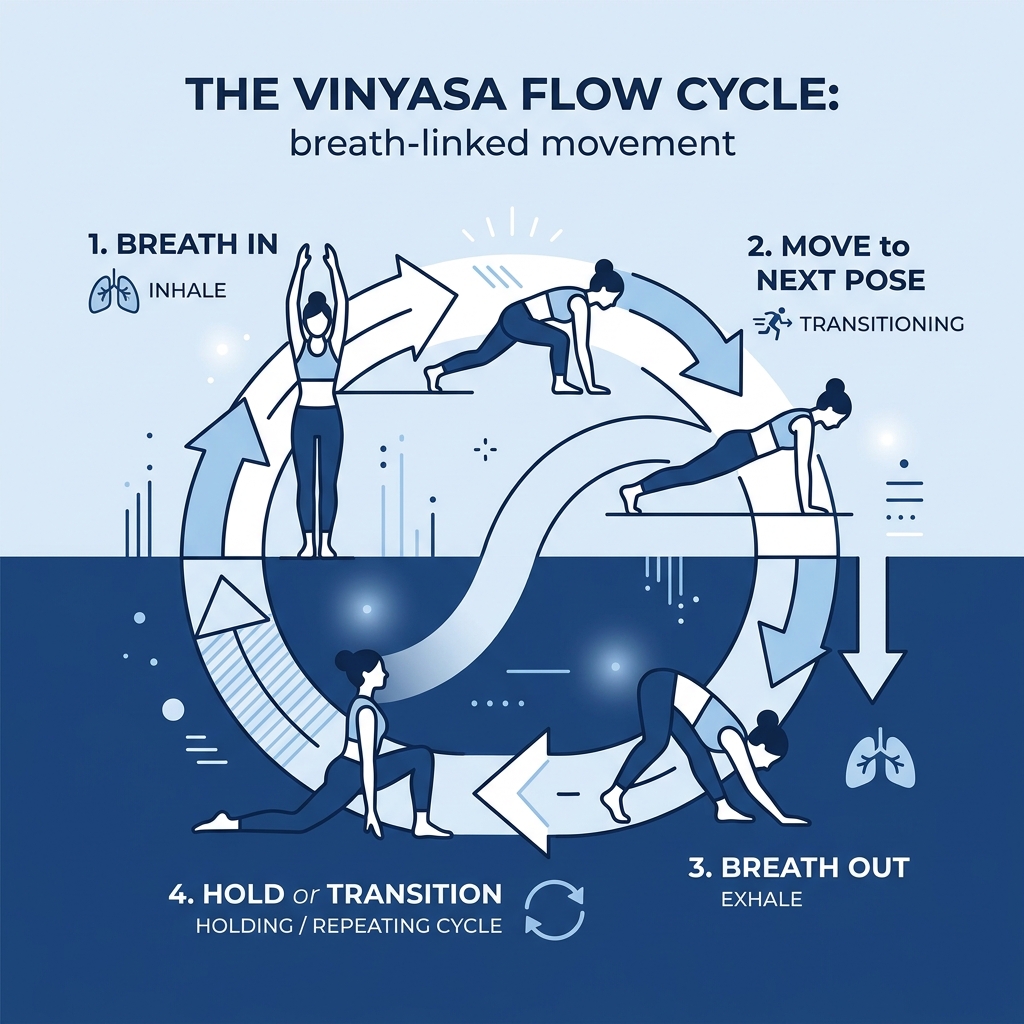
Vinyasa yoga classes are dynamic, breath-linked movement sessions where you flow from one pose to the next in a continuous sequence — no two classes are exactly the same.
Here’s what you need to know at a glance:
- What it is: A style of yoga where movement and breath are synchronized in a flowing sequence
- Class length: Typically 30–60 minutes
- Intensity: Moderate to high — expect to build heat and break a sweat
- Best for: Beginners to advanced practitioners, athletes, and anyone looking to improve strength, flexibility, and mental focus
- Where to find classes: In-person studios, online platforms, and gym group fitness programs
The word Vinyasa comes from Sanskrit — “vi” meaning “in a special way” and “nyasa” meaning “to place.” Together, they describe exactly what this practice is: intentional movement, placed with purpose.
Every pose flows into the next. Every movement is tied to a breath. The result is a practice that feels less like a workout and more like moving meditation — one that challenges your body while calming your mind.
Whether you’re just getting started with fitness or looking for a new way to push your training further, Vinyasa gives you a powerful tool that builds real-world strength, improves flexibility, and reduces stress — all in a single session.
I’m Jennifer Rapchak, Fitness Director at Results Fitness Alexandria and a certified personal trainer with over 14 years of experience designing and leading fitness programs. My background in strength training, HIIT, and group fitness gives me a clear-eyed view of how Vinyasa yoga classes fit into a well-rounded, results-driven fitness routine. In this guide, I’ll walk you through everything you need to know to get started with confidence.
Vinyasa yoga classes vocab explained:
What to Expect in Vinyasa Yoga Classes
If you are stepping into your first session, the first thing you’ll notice is the rhythm. Unlike some forms of yoga that focus on holding a single pose for several minutes, Vinyasa yoga classes are often referred to as “flow yoga” because of the smooth transitions between postures.
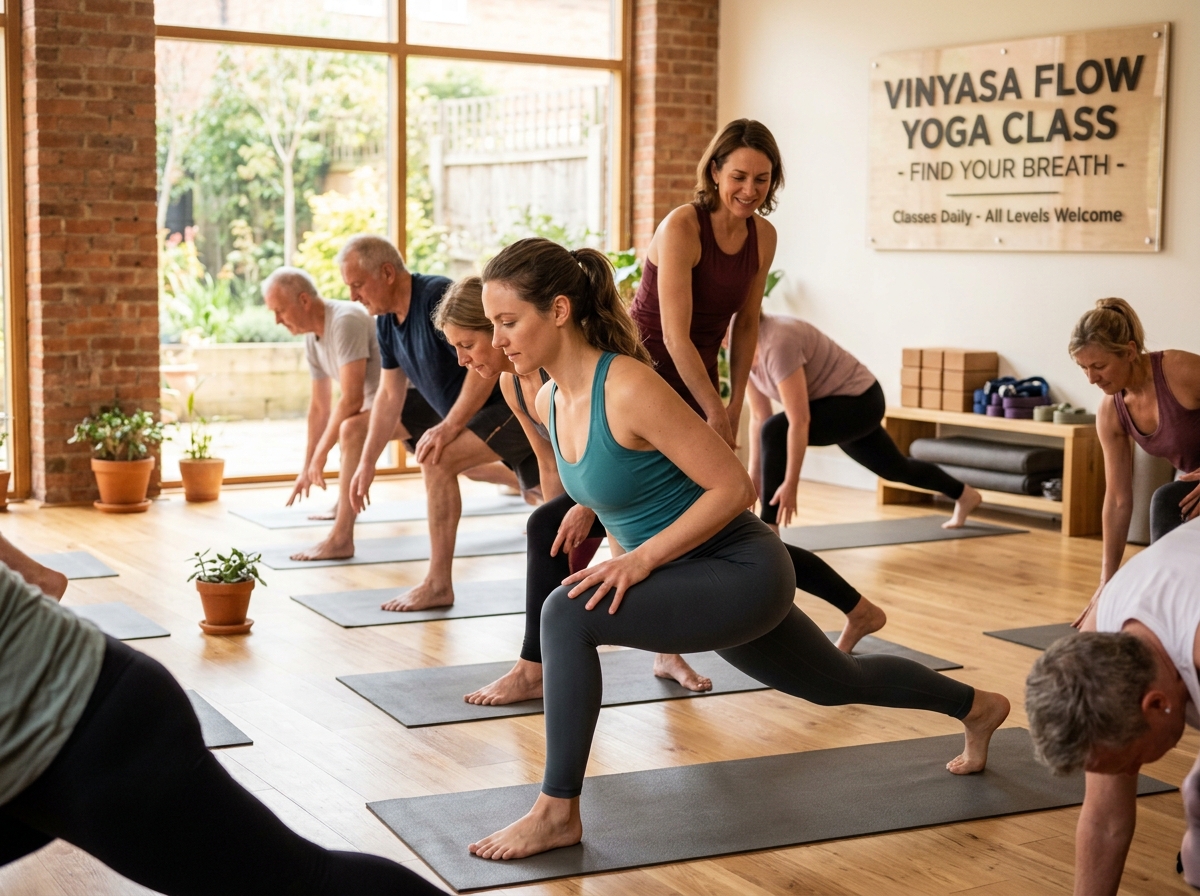
The pace and intensity can vary significantly depending on the instructor. Some classes are and athletic, while others take a “slow-flow” approach. Regardless of the speed, the goal is to build internal heat. We usually start with a gentle warm-up to prepare the joints, followed by progressive sequences that build toward a “peak pose”—a more challenging posture like a balance or a deep backbend.
After the peak, we transition into cooling postures, such as seated folds or gentle twists, to bring the heart rate back down. Every class ends with Savasana (Corpse Pose), a few minutes of total relaxation to let the benefits of the practice sink in. For those curious about how this compares to other traditions, you can find more info about different yoga types to see which style aligns with your current fitness goals.
The Role of Breathwork in Vinyasa Yoga Classes
In Vinyasa, the breath is the “DJ” of the practice—it sets the tempo and keeps everything moving smoothly. We utilize Pranayama (breath control), specifically a technique called Ujjayi breath. This involves breathing through the nose with a slight constriction in the back of the throat, creating a soft oceanic sound.
This mindful rhythm does more than just keep you moving; it creates a powerful mind-body connection. By syncing movement to breath, you stay present in the moment rather than letting your mind wander to your to-do list. Beyond the physical workout, scientific research on stress reduction and sleep suggests that this type of focused breathing can significantly lower cortisol levels and help you achieve a better night’s rest. If you find your breathing becoming labored or gasping, it’s a signal from your body to slow down or take a resting pose like Child’s Pose.
Common Poses and Sequences
While the beauty of Vinyasa is its variety, there are certain “building blocks” you will see in almost every class. The most famous is the Sun Salutation (Surya Namaskar). This sequence is the heartbeat of the flow and typically includes:
- Plank Pose: Building core and upper body stability.
- Chaturanga Dandasana: A low push-up that tones the triceps and shoulders.
- Upward-Facing Dog: A heart-opening backbend to stretch the chest and abdomen.
- Downward-Facing Dog: An inverted “V” shape that stretches the hamstrings and strengthens the back.
Beyond these, expect plenty of Warrior poses (Warrior I, II, and III) to build leg strength, balancing sequences to improve focus, and dedicated core work. These movements are designed to be a full-body experience, ensuring no muscle group is left behind.
Physical and Mental Benefits of a Regular Flow
Practicing Vinyasa yoga classes regularly offers a transformative experience for both the body and the brain. Physically, the constant movement makes it a unique form of “cardio yoga.” You aren’t just stretching; you are building functional strength and stability.
Because you are frequently supporting your own body weight in poses like Plank or Side Angle, you’ll notice a significant increase in upper body and core strength. Furthermore, the flowing nature of the class is excellent for cardiovascular health. Research has even highlighted yoga’s potential in lowering cholesterol, making it a heart-healthy addition to any gym routine.
Of course, flexibility is a major draw. By moving through wide ranges of motion while the muscles are warm, you can safely increase your reach and mobility. You can learn more about how yoga improves flexibility and how it helps prevent the stiffness often associated with sedentary jobs or heavy weightlifting.
Vinyasa Yoga Classes for Athletes and Beginners
One of the biggest myths is that you need to be flexible to start yoga. In reality, we practice yoga to become flexible. For beginners, Vinyasa provides a supportive environment to learn body awareness.
For athletes—whether you’re a runner, a weightlifter, or a hockey player—Vinyasa yoga classes serve as the ultimate cross-training tool. It focuses on:
- Injury Prevention: Strengthening the smaller stabilizer muscles around the joints.
- Mobility: Opening tight hips and shoulders that are often overworked in sports.
- Spinal Health: Using twists and extensions to keep the back resilient.
If you enjoy a workout that keeps your heart rate up while working on your range of motion, check out more info about aerobic yoga classes to see how they can complement your current training.
Comparing Vinyasa to Other Yoga Styles
With so many styles out there, it can be confusing to know which one to pick. Vinyasa is often described as the “offspring” of Ashtanga, but with more creative freedom.
| Feature | Vinyasa | Hatha | Ashtanga |
|---|---|---|---|
| Pace | Fast/Flowing | Slow/Steady | Moderate/Rigid |
| Sequence | Creative/Changes daily | Basic/Focus on holds | Fixed/Set series |
| Focus | Breath-linked movement | Alignment & Balance | Discipline & Stamina |
| Best For | Variety & Cardio | Beginners & Relaxation | Structure & Routine |
While Ashtanga follows a very specific, unchanging set of poses, Vinyasa allows the instructor to mix things up. Hatha is generally slower, making it great for learning the basics of alignment, while Power Yoga is an even more vigorous, fitness-based version of Vinyasa. For a deeper dive into these differences, read our ultimate guide to yoga classes.
Tips for Mastering Your Practice and Avoiding Mistakes
To get the most out of your Vinyasa yoga classes, alignment is key. It’s not about how deep you get into a pose, but how safely you get there.
- Don’t Rush: One of the most common mistakes beginners make is rushing through transitions to keep up. It is better to move slowly and maintain proper form than to “fling” your body into a pose.
- Listen to Your Body: If a pose feels sharp or painful, back off. Yoga should be challenging, but it should never hurt.
- Avoid Overexertion: Especially in heated classes, it’s easy to push too hard. Child’s Pose is always an option.
- Don’t Skip the Cool Down: The final resting poses are where your nervous system resets. Neglecting these can leave you feeling “wired” rather than relaxed.
- Rest Days are Mandatory: Just like heavy lifting, your muscles need time to recover. If you’re looking for other ways to stay active on “off” days, consider yoga group fitness as a lower-intensity option.
Frequently Asked Questions about Vinyasa Yoga
What is the history and origin of Vinyasa?
Vinyasa’s roots are deeply intertwined with Ashtanga Yoga, which dates back to ancient traditions. However, the modern “flow” style we see today was largely evolved in the mid-1900s by Sri Krishnamacharya. He is often called the “father of modern yoga” because he emphasized the importance of fluid transitions and tailoring the practice to the individual’s needs. This evolution turned yoga from a series of static postures into the cosmic dance of movement and breath we enjoy today.
What props are needed for a Vinyasa class?
While you can practice with just a mat, props are “tools for success,” not “crutches for the weak.”
- Yoga Mat: A non-slip mat is essential for safety.
- Blocks: These bring the floor to you, helping maintain alignment in poses like Triangle.
- Straps: Great for reaching your feet in seated folds if your hamstrings are tight.
- Towels: Essential for “hot” classes to prevent slipping.
- Blankets: Used for padding the knees or staying warm during Savasana.
How often should I practice to see results?
Consistency is the secret sauce. To see significant improvements in flexibility and strength, we recommend practicing 3 to 5 times per week. However, even once a week is better than nothing! As you build endurance, you’ll find that the mental clarity and stress-relief benefits become just as addictive as the physical ones.
Conclusion
At Results Fitness Alexandria, we believe that fitness should be a holistic journey. Our Vinyasa yoga classes are designed to challenge your body while providing a necessary reset for your mind. Whether you are an athlete looking to stay injury-free or a beginner ready to start your wellness journey, our community is here to support you.
We invite you to experience our amenities firsthand. We offer a free 1-day pass for all fitness levels, giving you the chance to meet our certified instructors and see why our members love the energy in our studio. From personal training to childcare, we provide everything you need to reach your goals.
Ready to find your flow? Start your journey with our group fitness classes and discover how a regular Vinyasa practice can transform your life. We can’t wait to see you on the mat!