Inclusive Fitness Classes for Every Body and Skill Level
Why Fitness for Everyone Matters More Than You Think
Fitness for everyone is the idea that exercise is not reserved for a certain body type, age, or ability level — it belongs to all of us, exactly as we are right now.
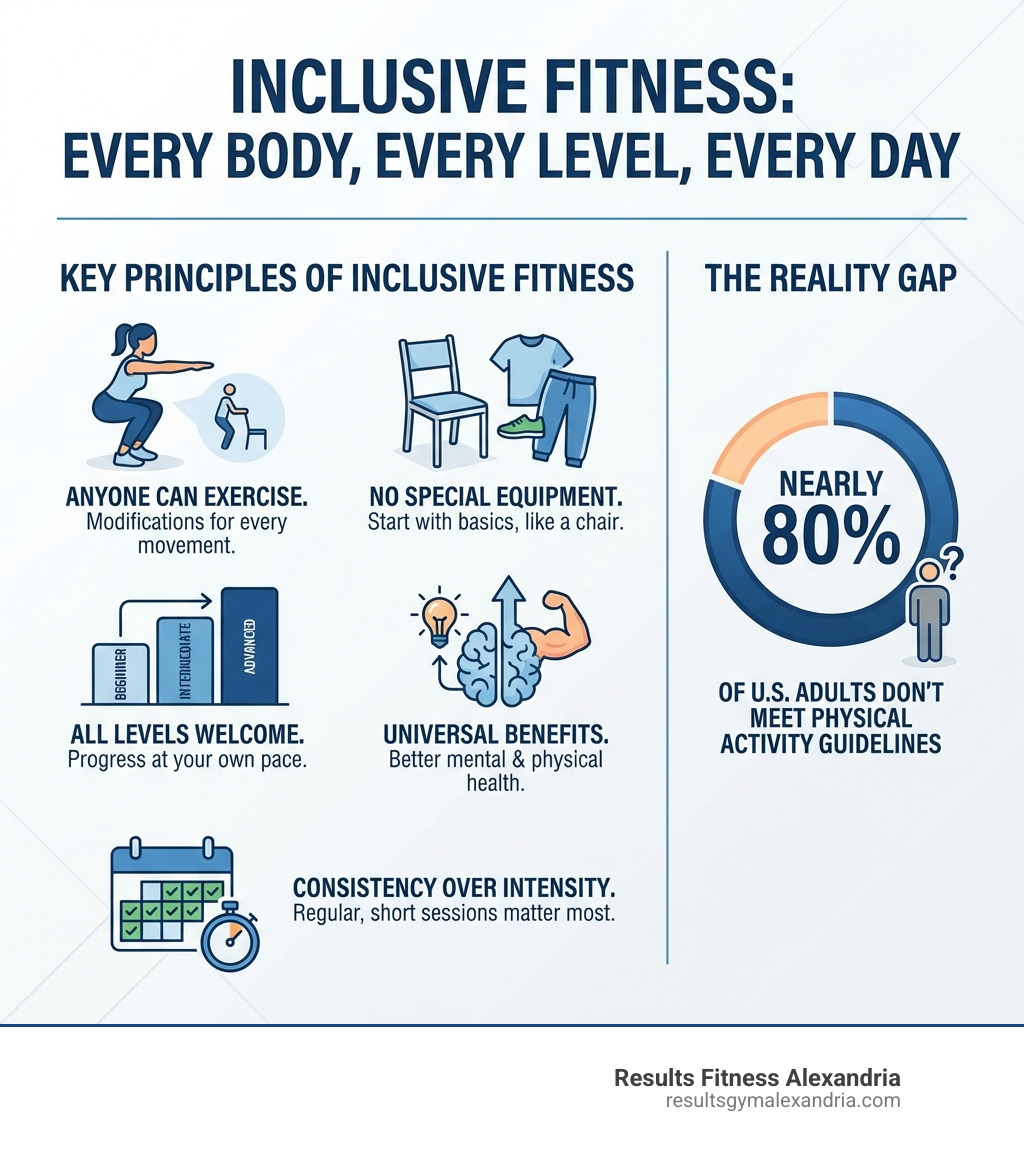
Here is a quick overview of what inclusive fitness means in practice:
- Anyone can exercise. Modifications exist for every movement, from push-ups to squats.
- No special equipment needed. A chair and comfortable clothes are enough to start.
- All fitness levels are welcome. Beginner, intermediate, or advanced — there is a place for you.
- Mental and physical benefits are universal. Better sleep, lower stress, and stronger muscles are available to every body.
- Consistency beats intensity. Short, regular sessions beat occasional hard workouts every time.
Yet the reality is that nearly 80% of U.S. adults do not meet the basic guidelines for aerobic and muscle-strengthening activity. That gap is not just about willpower. For many people, traditional fitness culture sends a clear message: you don’t belong here yet. Too focused on elite performance and unrealistic body ideals, it leaves out the majority of people who simply want to feel better and move more.
That is where inclusive fitness changes everything. It removes the barriers — the intimidation, the “not good enough” feeling, the confusion about where to start — and replaces them with practical tools, supportive environments, and workouts that meet you where you are.
I’m Jennifer Rapchak, Fitness Director at Results Fitness Alexandria, and with over 14 years of experience as an ACE-certified personal trainer, I’ve seen how the right approach to fitness for everyone can transform lives regardless of starting point. In this guide, I’ll walk you through everything you need to build a sustainable, accessible fitness routine that actually works for your body.
Relevant articles related to Fitness for everyone:
The Philosophy of Fitness for Everyone
The concept of Fitness for everyone isn’t just a catchy slogan; it’s a movement led by pioneers like Louise Green. As a fitness activist and author of the book Fitness for Everyone, Green has spent years dismantling the narrative that you must look a certain way to be an “athlete.” Through her work with “Big Fit Girl,” she champions the idea that every body type has a perfect exercise waiting for it, provided we use the right modifications.
At its core, this philosophy embraces body neutrality and inclusivity. Instead of exercising as a “punishment” for what you ate or to fit into a specific dress size, the focus shifts to how your body functions and feels. This approach is about sustainability—moving away from high-intensity “crash” programs and toward routines that you can actually enjoy for the next thirty years.
Research from the NIH on staying active at any size supports this, noting that physical activity is safe and beneficial for almost everyone, regardless of weight. By using diverse models in fitness media—including people of different ages, ethnicities, and abilities—we break down the psychological barriers that keep people sedentary. When you see someone who looks like you succeeding in a workout, it’s a powerful invitation to join in.
Whether you are interested in group fitness classes or solo routines, the goal is the same: to make movement a “core” part of your life rather than an outside chore.
Breaking Down the “Fitness for Everyone” Approach
So, what does this look like in a practical sense? The “Fitness for Everyone” methodology typically centers on a versatile toolkit of exercises that can be adjusted for any skill level. Louise Green’s guide, for example, highlights 50 foundational exercises and 10 specific routines designed to build confidence.
The magic happens in the modifications. We don’t believe in “easy versions” of exercises; we believe in appropriate versions.
- Push-ups: Can be done against a wall, on an incline (like a sturdy table), or on the floor with knees down.
- Burpees: Instead of jumping, you can step back one foot at a time or use a chair to reduce the distance you have to travel to the floor.
- Squats: Can be performed by sitting down into a chair and standing back up to ensure proper form and safety.
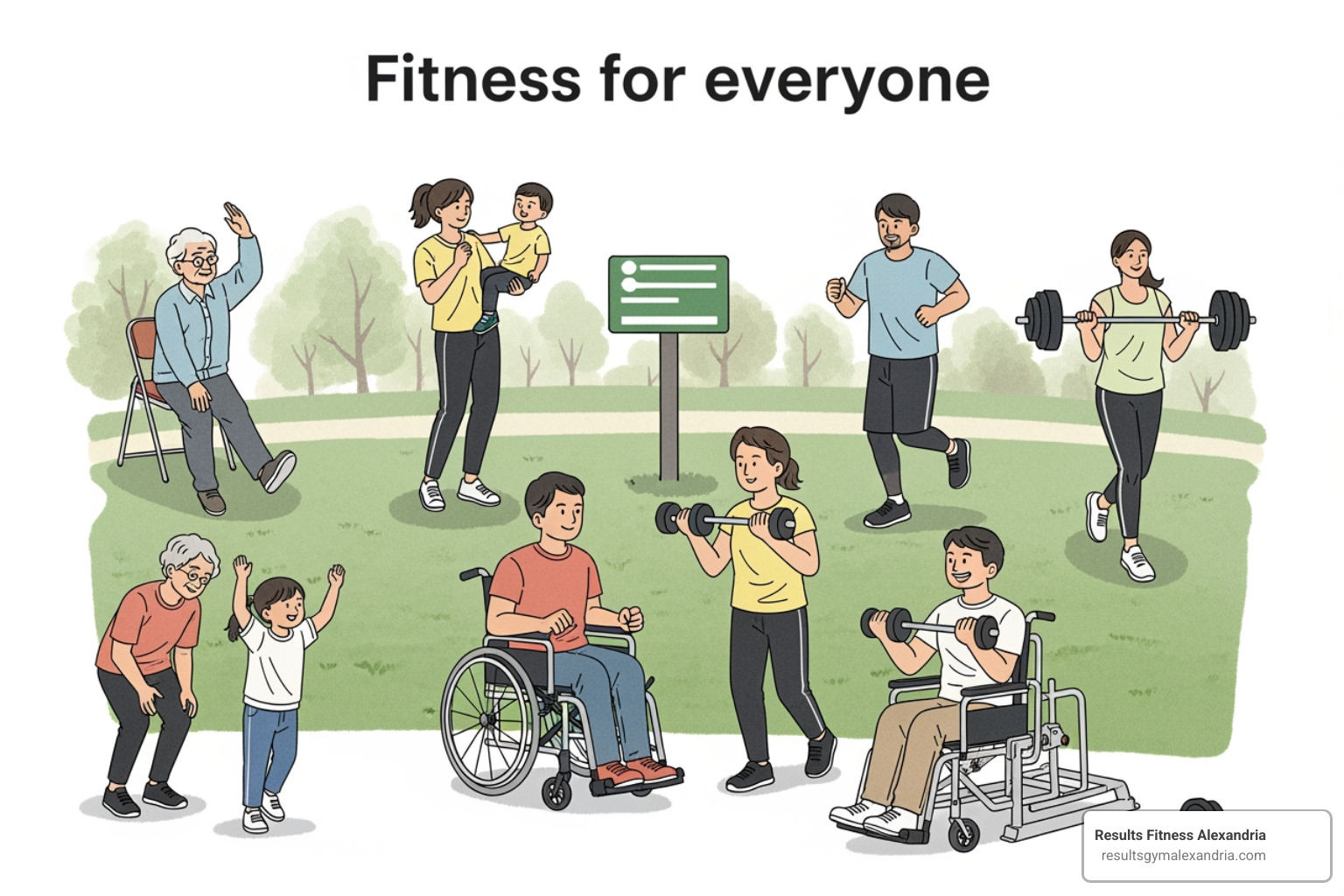
By providing step-by-step instructions and expert advice, this approach ensures that whether you are a complete novice or returning from an injury, you have a roadmap to success.
Science-Backed Benefits of Inclusive Strength Training
We often hear about “cardio,” but strength training is a vital pillar of Fitness for everyone. As we age, lean muscle mass naturally diminishes—a process often called “use it or lose it.” Strength training helps preserve that muscle, boosts bone density (reducing the risk of osteoporosis), and helps manage chronic conditions like arthritis, diabetes, and heart disease.
According to the Physical Activity Guidelines for Americans, adults should aim for at least 150 to 300 minutes of moderate-intensity aerobic activity per week. However, the guidelines also emphasize that muscle-strengthening activities should be done at least two days a week.
If you feel unsure about how to start lifting weights or using resistance, the benefits of personal training can be a game-changer. A trainer helps you navigate these guidelines safely, ensuring you hit all major muscle groups without overtraining.
| Activity Type | Weekly Recommendation | Key Health Benefits |
|---|---|---|
| Aerobic Activity | 150–300 Minutes | Heart health, weight management, improved sleep |
| Strength Training | 2+ Days | Bone density, muscle preservation, metabolic rate |
| Flexibility/Balance | As needed (daily is best) | Fall prevention, mobility, reduced joint pain |
Even if you can’t hit the full 150 minutes right away, the CDC notes that any activity is better than none. In fact, moving from sedentary to “some” activity provides the single greatest health boost you can get.
How to Modify Workouts for Your Unique Body
One of the biggest misconceptions in fitness is that you have to adapt your body to the exercise. In reality, the exercise should adapt to you. Inclusive fitness means providing variations for pregnancy, limited mobility, and different age groups.
Seated variations are particularly effective for those with balance issues or chronic pain. You can perform bicep curls, overhead presses, and even “chair dancing” for cardio while seated. For those looking for a low-impact way to build strength and flexibility, yoga classes for all levels offer a perfect environment where blocks, straps, and chairs are used to make every pose accessible.
Safety and consistency are the two most important factors. When starting a new routine, remember:
- Breathing techniques: Never hold your breath during a lift. Exhale on the effort.
- Minimal equipment: You don’t need a fancy home gym. Soup cans can serve as light weights, and a sturdy kitchen chair is a versatile piece of gym equipment.
- Listen to your body: There is a difference between the “burn” of a working muscle and the sharp pain of an injury. If it hurts, stop and modify.
Practical Tips for Fitness for Everyone in Daily Life
You don’t need a 60-minute block of time to be “active.” The CDC’s Active People, Healthy Nation initiative suggests that small bursts of activity throughout the day add up.
- Habit Stacking: Do ten calf raises while you wait for the coffee to brew.
- Daily Chores: Gardening, briskly vacuuming, or taking the stairs all count toward your aerobic goals.
- Short Bursts: Five or ten minutes of walking three times a day is just as effective as one 30-minute walk.
- Goal Setting: Focus on “non-scale victories,” like being able to carry all the groceries in one trip or having more energy to play with your kids.
Building a Supportive Fitness Community
Fitness is rarely just about the physical; it’s deeply social. Human beings are wired for connection, and the “loneliness epidemic” is currently cited as being as detrimental to health as smoking 15 cigarettes a day. This is why the 10 benefits of group fitness often list “social support” at the very top.
When you join a community with shared values, your resilience increases. You aren’t just working out; you’re showing up for your friends. This “Blue Zones” approach—finding a “tribe” that encourages healthy habits—is a proven marker for longevity. In a supportive environment, the fear of judgment disappears, replaced by collective encouragement.
Finding Your Place in Fitness for Everyone
If a large class feels intimidating, small group training options provide a middle ground. You get the personalized attention of a trainer with the camaraderie of a few peers.
Overcoming self-consciousness is often the hardest part of the journey. Everyone in the room was a beginner once. By focusing on your personal growth rather than comparing yourself to others, you build a sense of empowerment that carries over into every other area of your life.
Frequently Asked Questions about Inclusive Fitness
Can I exercise if I have limited mobility or a chronic condition?
Absolutely. Research into physical activity for adults with chronic health conditions shows that movement is not only safe but often serves as a key treatment for issues like osteoarthritis and hypertension. The key is to consult your doctor first and then work with a professional to find the right modifications. Safe movement might include water aerobics, wheelchair rolling, or seated strength exercises.
What minimal equipment is needed to start an inclusive routine?
You can start today with zero investment. Comfortable clothes and a sturdy chair are the basics. As you progress, you might add:
- Resistance bands: Great for building strength without the bulk of dumbbells.
- Household items: Use water bottles or cans of beans as weights.
- Yoga Mat: Provides a non-slip surface for stretching or Pilates classes for core strength.
How do I stay consistent with a new fitness plan?
The secret to consistency is making it easy and rewarding.
- Start small: Five minutes a day is better than zero.
- Find a support system: Whether it’s a workout buddy or a coach.
- Use non-food rewards: Treat yourself to a new book or a relaxing bath when you hit a milestone.
- Be patient: Setbacks are part of the process. If you miss a day, just start again the next morning. Learning how to choose the right fitness class for your personality will also help you look forward to your workouts rather than dreading them.
Conclusion
At Results Fitness Alexandria, we believe that Fitness for everyone isn’t just a philosophy—it’s our daily practice. We’ve built an environment where every body is celebrated, and every skill level is supported. From our diverse range of classes to our expert personal training and convenient childcare, we aim to remove every possible barrier between you and your health.
We want you to experience this inclusive atmosphere for yourself. That’s why we offer a free 1-day pass to try our amenities and see how we can help you reach your goals in a way that feels sustainable and empowering. Whether you’re looking for the zen of a yoga mat or the energy of a strength circuit, your place is here.
Join our inclusive group fitness classes today and take the first step toward a healthier, more active you—exactly as you are.