From Ashtanga to Restorative: The Ultimate Guide to Yoga Classes
Why Ashtanga Yoga Classes Matter for Your Fitness Journey
Ashtanga yoga classes offer a structured, breath-focused practice that builds strength, flexibility, and mental discipline through a set sequence of postures. Here’s what you need to know:
What to Expect:
- Mysore Style – Self-paced practice with individual teacher guidance (5:30 AM – 9:30 AM typical)
- Led Classes – Group practice with synchronized breath and movement, teacher calls out postures
- Primary Series – Foundation sequence of 41 floor postures plus sun salutations
- Cost Range – $5-$60 per class or $125+ for introductory workshops
Who It’s For:
- Beginners welcome (especially in Mysore style or foundational programs)
- Experienced practitioners seeking structure and discipline
- Athletes wanting to improve flexibility and breath control
- Anyone committed to regular practice (99% practice, 1% theory)
The foundation of Ashtanga yoga is trishtana – the integration of breath, posture, and gazing point. Unlike other yoga styles, you learn postures one at a time in a specific sequence, progressing at your own pace while building strength and internal heat.
This ancient practice traces its lineage back over 80 years to the Ashtanga Yoga Research Institute in Mysore, India, where K. Pattabhi Jois taught until his death at age 93. Today, teachers worldwide maintain this traditional method, offering both independent Mysore-style practice and synchronized Led classes.
As Jennifer Rapchak, Fitness Director at Results Fitness Alexandria with over 14 years of experience in group fitness programming, I’ve seen how Ashtanga yoga classes complement strength training and HIIT workouts by developing body awareness and breath control. My background in Les Mills programs and personal training gives me insight into how this structured practice fits into a comprehensive fitness routine.
Whether you’re looking for a cardiovascular workout that induces cleansing sweat or a meditative practice that challenges your mental limits, understanding the tradition and structure of Ashtanga helps you choose the right class format for your goals.
Ashtanga yoga classes terms to know:
Understanding the Tradition of Ashtanga Yoga Classes
At Results Fitness Alexandria, we believe understanding a practice’s roots deepens your engagement. Ashtanga yoga classes are steeped in a precise lineage passed down through generations. The name Ashtanga means “8 limbs” in Sanskrit, reflecting its connection to traditional yoga principles.
The lineage traces back to the ancient sage Vamana Rishi and the Yoga Korunta. This wisdom was revitalized by T. Krishnamacharya and systematized by K. Pattabhi Jois in Mysore, India. Jois taught this method for over 65 years. Today, his grandson, R. Sharath Jois, continues the tradition at the Sharath Yoga Centre. You can learn more about this lineage at sharathyogacentre.com.
The Ashtanga Yoga Research Institute, established 80 years ago, remains the central hub for this practice. Authorized teachers undergo rigorous training to uphold the traditional method. This historical context highlights the intentionality behind every posture. It is a living tradition designed for physical and mental change. As Pattabhi Jois said, “Yoga is 99% practice and 1% theory.”
Ashtanga emphasizes a linear progression of asanas, where each posture builds upon the previous one. This methodical approach improves flexibility and body conditioning. For more insights, explore How yoga can help improve your flexibility.
The Core Principles of Ashtanga Yoga Classes
At the heart of Ashtanga yoga classes is Trishtana, a three-pronged approach integrating breath, posture, and gazing point.
- Breath (Ujjayi Pranayama): We use Ujjayi (victorious breath), a rhythmic technique that generates internal heat and focuses the mind. The audible breath acts as an anchor, keeping you present.
- Asana (Posture): Ashtanga features a fixed sequence. Most practitioners focus on the Primary Series, Yoga Chikitsa (Yoga Therapy), designed to detoxify and align the body.
- Drishti (Gazing Point): Each posture has a designated gazing point (e.g., the nose or navel) to develop concentration and inward focus.
Another vital principle is Vinyasa, the synchronized movement of breath and action. This flow generates internal heat, or Agni, which induces a cleansing cardiovascular sweat to burn away impurities. As observed in our mind-body fitness programs, this connection is incredibly effective for holistic well-being.
Who Should Attend Ashtanga Yoga Classes?
Ashtanga yoga classes are adaptable for everyone from beginners to athletes.
For beginners, the Mysore-style teaching method is ideal. You learn postures one by one at your own pace with individualized guidance. This personalized approach ensures a strong foundation. If you’re curious about other styles, see What are the different types of yoga?.
Experienced practitioners value Ashtanga for its depth. The fixed sequence allows for continuous refinement of the breath and posture, offering a structured path for growth.
Athletes benefit from the strength, flexibility, and stamina built through the practice. The focus on Pranayama improves lung capacity and mental focus, while the cardiovascular sweat aids in recovery and detoxification. Ashtanga is for anyone seeking discipline and a transformative fitness routine.
Mysore vs. Led: Navigating Your Practice
When exploring Ashtanga yoga classes, you’ll encounter two primary formats: Mysore style and Led classes. Understanding these is key to choosing the right environment at Results Fitness Alexandria.
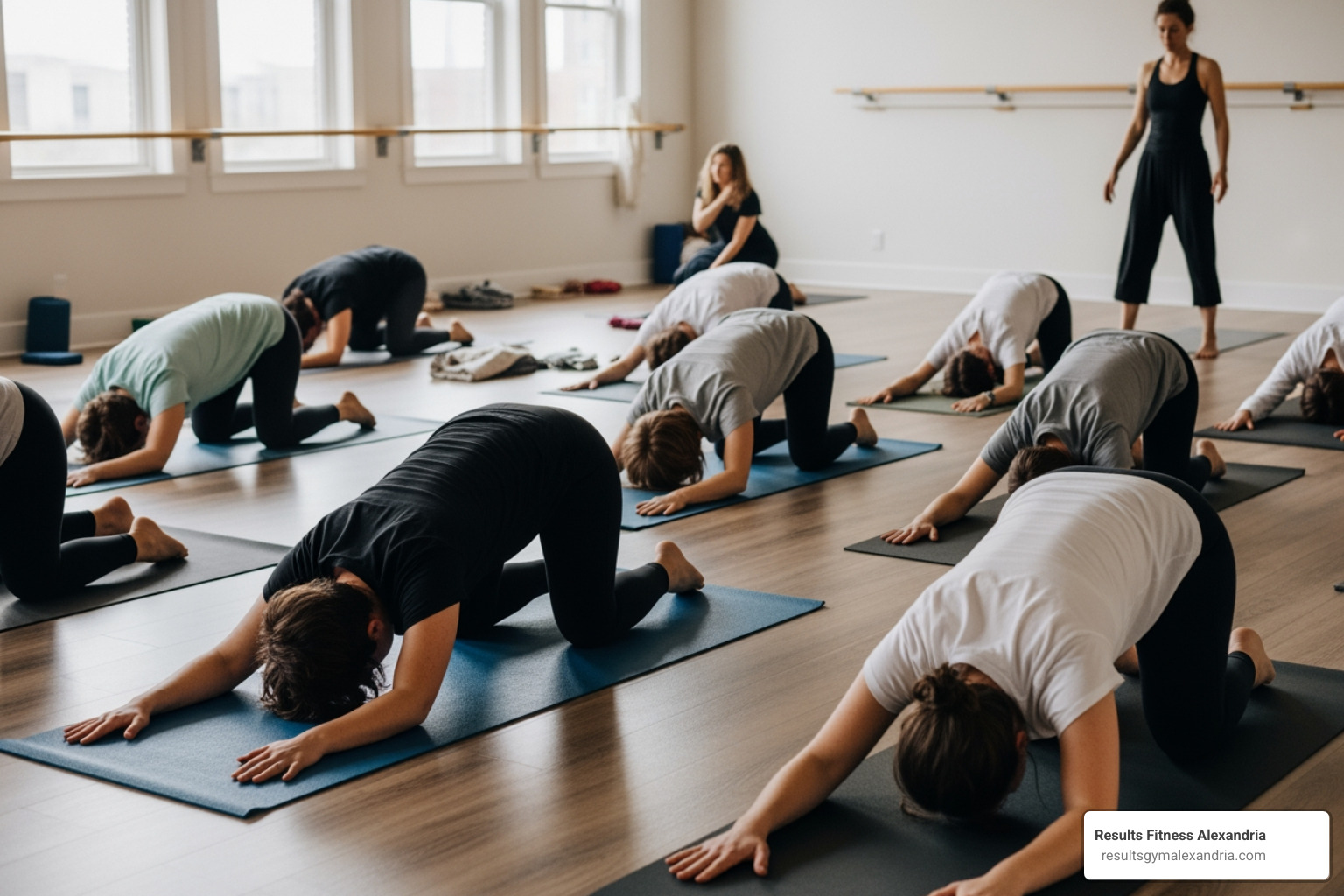
The Mysore method is the traditional approach. In a Mysore class, there is no teacher leading the group in unison. Instead, students practice the memorized sequence independently at their own pace. The teacher provides one-on-one support and hands-on adjustments custom to each student.
This format is perfect for beginners as it allows for a gradual introduction. You master one posture before moving to the next. Practice length varies from 40 minutes for beginners to nearly two hours for advanced students. This flexibility allows you to drop in during the Mysore window and practice according to your schedule.
Led classes involve a teacher calling out postures and the vinyasa count in Sanskrit. All students move and breathe in sync. These classes are dynamic and demand familiarity with the sequence. They are recommended for experienced practitioners to refine their rhythm and maintain focus.
| Feature | Mysore Style | Led Class |
|---|---|---|
| Pace | Self-paced | Group-paced |
| Instruction | One-on-one guidance | Group verbal cues |
| Sequence | Memorized by student | Called out by teacher |
| Suitability | All levels, ideal for beginners | Experienced practitioners |
| Start Time | Flexible window | Fixed start time |
| Duration | Varies (40 – 100+ min) | Fixed duration |
Both formats offer profound benefits. Choose the style that resonates with your learning preference and current level.
The 8 Limbs and Studio Etiquette
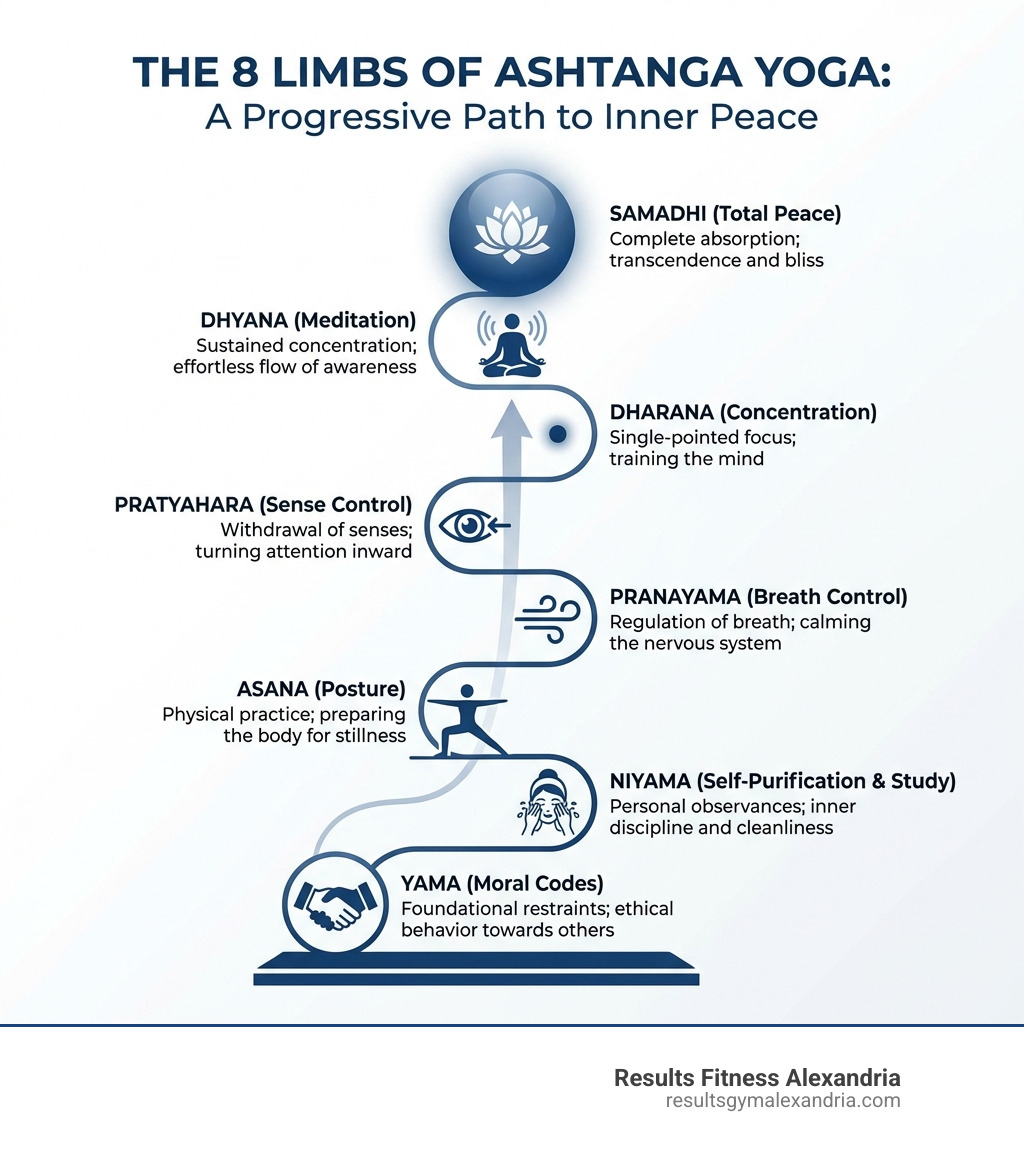
Ashtanga yoga classes are rooted in the Eight Limbs of Yoga from Patanjali’s Yoga Sutras. Understanding these enriches your practice beyond the physical postures.
- Yama: Ethical guidelines like non-violence and truthfulness.
- Niyama: Self-discipline and study.
- Asana: Physical postures for stability.
- Pranayama: Breath control to regulate energy.
- Pratyahara: Withdrawal of the senses.
- Dharana: Concentration.
- Dhyana: Meditation.
- Samadhi: Total peace.
While we focus on Asana and Pranayama, the other limbs guide a mindful lifestyle. For those interested in cardiovascular benefits, explore our aerobic yoga classes.
Key Etiquette for Ashtanga Yoga Classes
- Moon Days: Classes are typically not held on full or new moon days. These are traditional rest days to honor natural energetic cycles.
- Empty Stomach: Practice on an empty stomach (wait 2-3 hours after eating) to avoid discomfort during vigorous movement.
- No Scented Products: Avoid strong perfumes or lotions to maintain a focused environment for all.
- Hydration: Drink water after practice. Avoid drinking during the session to maintain internal heat (Agni).
- Quiet and Focus: The practice room is a silent space. Enter and exit quietly.
- Electronics: Turn off cell phones and smartwatches to support deep focus.
- Arrival: Arrive 5-10 minutes early for Led classes to settle in for the opening chant.
- Gear: Use a Mysore rug or micro-fiber towel over your mat to manage sweat and prevent slipping.
Following these guidelines ensures a harmonious environment for everyone’s transformative journey.
From Vinyasa to Restorative: Finding Your Flow
Ashtanga yoga classes offer a structured, dynamic practice, but the broader world of yoga provides a spectrum of styles. At Results Fitness Alexandria, we help you find the perfect flow for your goals.
Ashtanga’s Vinyasa flow builds cardiovascular health and stamina. The intense engagement is effective for fitness enthusiasts seeking a rigorous workout with mental discipline. However, balance is essential. Practices like Yin yoga and Restorative yoga promote recovery.
- Yin Yoga: Involves holding floor poses for 3-5 minutes to stress connective tissues like ligaments and fascia. It improves joint mobility and complements the muscle-heavy Ashtanga practice.
- Restorative Yoga: Focuses on deep relaxation using props like bolsters and blankets. Poses are held without effort to calm the nervous system and relieve stress.
Integrating these styles creates a well-rounded routine. You might start the week with the heat of Ashtanga yoga classes and end it with the repose of Restorative yoga.
Benefits of a Diverse Practice:
- Physical Cleansing: Internal heat aids in detoxification.
- Injury Healing: Mindful practice builds strength to prevent and heal injuries.
- Mental Clarity: Breath-focused movement challenges the mind and creates positive change.
- Holistic Health: Yoga aids in managing back pain, anxiety, and inflammation.
For an accessible approach to rigorous practice, teachers like Kino MacGregor offer great insights on her kinoyoga Instagram. Explore our general offerings at Yoga to see how these fit into your fitness routine.
Frequently Asked Questions about Ashtanga Yoga
What is the difference between Mysore and Led classes?
In Mysore Style Classes, you practice the sequence at your own pace while the teacher provides individualized adjustments. It is a personalized journey in a group setting. In Led Classes, the teacher guides the group in unison with a Sanskrit count. Mysore is ideal for learning the foundation, while Led classes refine rhythm and collective energy.
Why are classes cancelled on full and new moon days?
This tradition aligns the practice with natural cycles. The moon’s gravitational pull affects the body’s water content. Full moons are associated with expansive, ungrounded energy, while new moons bring contracting, lethargic energy. Resting on these days prevents injury and encourages practitioners to listen to their bodies.
Is Ashtanga yoga suitable for complete beginners?
Yes! Through the Mysore method, beginners receive individualized instruction. You learn the sequence one posture at a time, building strength and flexibility gradually. The focus on breath control immediately helps calm the nervous system. At Results Fitness Alexandria, we welcome all levels to start this transformative journey.
Conclusion
We hope this extensive guide has illuminated the rich tradition, core principles, and diverse formats of Ashtanga yoga classes. From its ancient lineage tracing back to Vamana Rishi and K. Pattabhi Jois, to the dynamic breath-synchronized movements of Vinyasa, Ashtanga offers a powerful pathway to physical strength, mental clarity, and holistic well-being. Whether you’re drawn to the individualized instruction of Mysore style or the communal energy of a Led class, this practice provides a structured framework for profound personal change.
At Results Fitness Alexandria, we are committed to offering a wide range of fitness options that cater to all levels and goals. We understand that finding the right class can be a game-changer for your fitness journey, complementing everything from high-intensity workouts to personal training sessions. Our aim is to help you build not just a stronger body, but a more resilient mind, fostering the kind of discipline and focus that translates into all areas of your life.
We invite you to experience the benefits of our diverse offerings firsthand. Find how Ashtanga yoga classes or any of our other group fitness options can improve your flexibility, build strength, and promote a deeper mind-body connection. To help you get started, we offer a free 1-day pass, allowing you to try our amenities and see how Results Fitness Alexandria can become your partner in health and wellness. Come see why our approach to fitness, including comprehensive group fitness classes ultimate guide, sets us apart. We can’t wait to welcome you!