Find Your Fit: A Guide to Bootcamp Fitness Classes (and What to Look For Near You)
Why Bootcamp Fitness Classes Are Gaining Popularity
Bootcamp fitness classes are high-energy group training sessions that combine military-inspired exercises, high-intensity interval training (HIIT), and functional movements to build strength, burn calories, and improve overall fitness. Here’s what you need to know:
What to Expect:
- Format: 30-60 minute group sessions with dynamic warm-ups, circuit training, and cool-downs
- Exercises: Pushups, situps, running, plyometrics, interval training, and bodyweight movements
- Intensity: Reach 80% of your maximum heart rate and burn nearly 600 calories per hour
- Results: Boost metabolism for up to 36 hours after your workout (the “afterburn effect”)
- Community: Supportive group environment with certified trainers who modify exercises for all fitness levels
Who They’re For: Bootcamp classes welcome beginners through advanced athletes. Instructors provide modifications and regressions so everyone can participate safely, regardless of current fitness level.
If you’ve ever felt overwhelmed by the treadmill or wondered if there’s a more efficient way to get fit, you’re not alone. One Reddit user described their first bootcamp experience: “I nearly threw up… but everyone was super encouraging and I kept going back.” That mix of challenge and support defines what makes bootcamp classes so effective.
The concept traces back to military training from the Spanish-American War, when U.S. Navy recruits wore boots during basic training—giving rise to the term “boot camp.” Modern fitness bootcamps emerged independently in Australia, the U.S., the U.K., and Canada during the 1990s and early 2000s. Today, they blend HIIT, functional training, and weight loss strategies into one powerful workout format.
I’m Jennifer Rapchak, Fitness Director at Results Fitness Alexandria, with over 14 years of experience as a certified personal trainer and Les Mills instructor specializing in HIIT and group exercise. Throughout my career, I’ve designed and led bootcamp fitness classes that help people of all fitness levels build strength, confidence, and lasting results through structured programming and supportive coaching.
Basic bootcamp fitness classes vocab:
What Are Bootcamp Fitness Classes?
At its core, a bootcamp fitness class is a type of group fitness program designed to build strength and fitness through a variety of intense group intervals. While the term “bootcamp” might sound intimidating—conjuring images of drill sergeants and mud pits—the modern reality is a highly structured, science-backed workout that focuses on functional fitness.
These classes are unique because they don’t just focus on one aspect of health. Instead, they provide a comprehensive workout that targets cardiovascular endurance, muscular strength, and flexibility all in one session. According to scientific research on bootcamp intensity, participants can reach an average of 80% of their maximum heart rate, making it one of the most efficient ways to train.
What sets bootcamps apart from a solo gym session is the atmosphere. We focus on camaraderie and team effort. You aren’t just a person on a treadmill; you’re part of a unit moving toward a common goal. This social dynamic is a powerful motivator that keeps people coming back long after their initial New Year’s resolution has faded.
The History and Origins of the Format
The history of physical fitness shows that military-style training has been the gold standard for centuries. The term itself originated during the Spanish-American War, referring to the “boots” worn by U.S. Navy and Marine recruits.
In the mid-20th century, fitness began to transition from the barracks to the living room. Dr. Bill Orban developed the Royal Canadian Air Force (RCAF) exercise plans in 1961, which sold 23 million copies and introduced the public to structured, time-efficient workouts. Later, Kenneth Cooper’s “Aerobics” book further launched the fitness culture we know today.
By the late 1990s and early 2000s, fitness bootcamps as a commercial “class” format exploded. They transitioned from strictly outdoor park sessions to sophisticated indoor programs. This evolution allowed for better equipment, climate control, and specialized flooring, making the workouts safer and more accessible to the general public.
Bootcamp vs. CrossFit and HIIT
When looking for a guide to different fitness classes, it’s easy to get confused between bootcamp, CrossFit, and standard HIIT. While they share some DNA, there are key differences:
- Technical Complexity: CrossFit often involves highly technical Olympic lifting and gymnastic movements (like overhead squats or muscle-ups). Bootcamps generally stick to functional, low-risk movements that are easier for beginners to master quickly.
- Intensity Structure: While all three use high-intensity intervals, bootcamps often emphasize “Active Rest.” Instead of stopping completely between sets, you might perform a lower-intensity movement to keep your heart rate in the fat-burning zone.
- Atmosphere: Bootcamps lean heavily into team camaraderie and group motivation without the same level of individual competition often found in CrossFit boxes.
Typical Structure of Bootcamp Fitness Classes

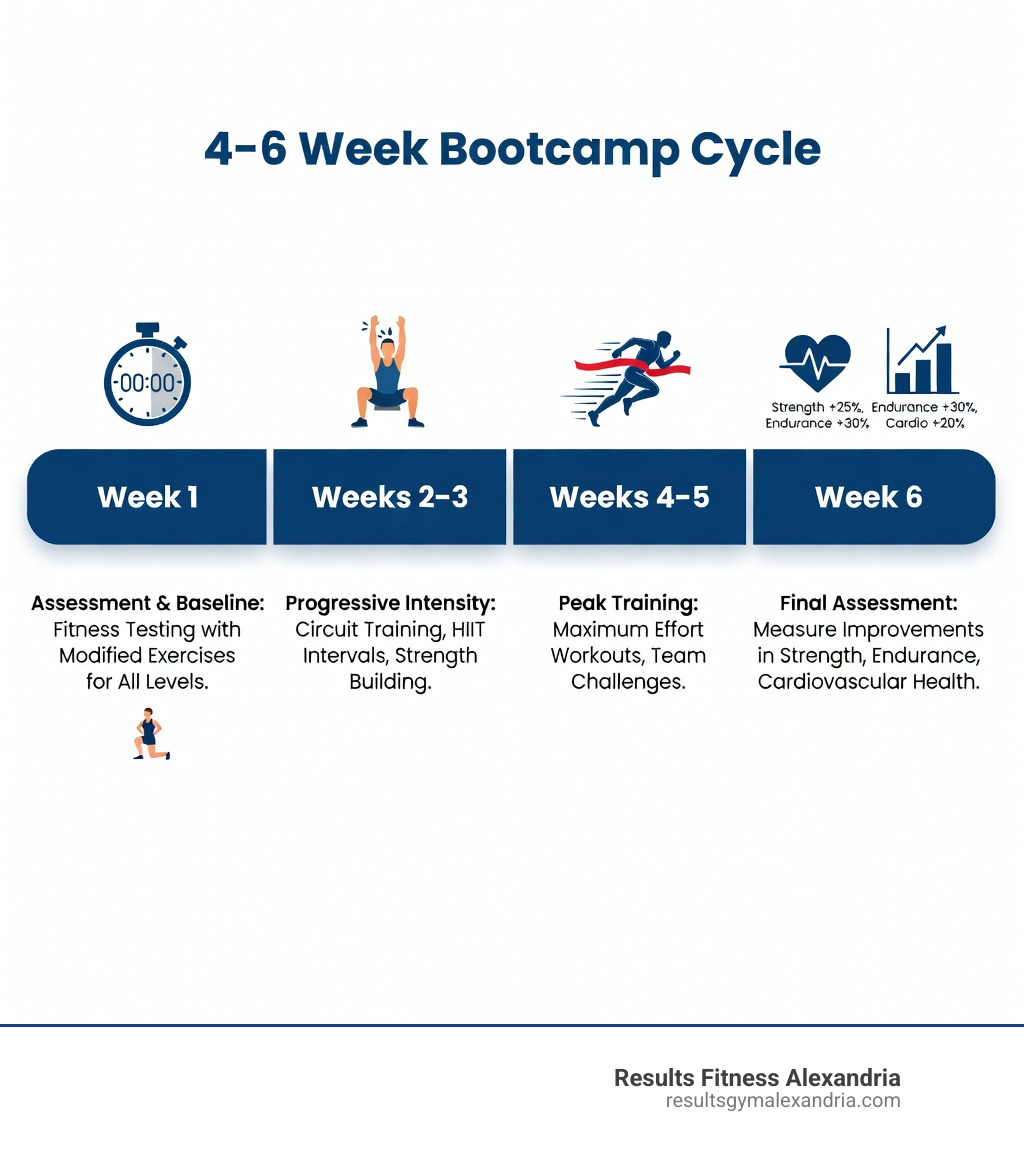
A typical bootcamp fitness class follows a very specific rhythm to ensure you get the most out of every minute. Most sessions last between 30 and 60 minutes, and every second is programmed for maximum impact.
- The Warm-Up (5-10 Minutes): We start with dynamic stretching and light cardio (like jogging or jumping jacks) to increase blood flow to the muscles and prepare the joints for movement.
- The Main Set (20-40 Minutes): This is the “meat” of the workout. It usually involves circuit training where you move through different stations or timed intervals. You might do 45 seconds of work followed by 15 seconds of rest or a lower-intensity “active rest” exercise.
- The Finisher (2-5 Minutes): A high-intensity burst at the end to empty the tank—think burpees, mountain climbers, or a team sprint.
- Cool-Down and Stretch (5 Minutes): This is crucial for recovery. We use static stretching and sometimes yoga-inspired movements to bring the heart rate down and improve flexibility.
Scientific insights on bootcamp benefits suggest that this structured variety is exactly what prevents fitness plateaus. By constantly changing the exercises and the timing, your body never gets “too comfortable,” which leads to continuous improvement.
Common Exercises You Will Encounter
In a bootcamp, you’ll learn to unleash your inner warrior using exercises that mimic real-world movements. Some staples include:
- Upper Body: Pushups, dips, and overhead presses.
- Lower Body: Squats, lunges, and plyometric jumps.
- Core: Situps, planks, and flutter kicks.
- Cardio: Sprints, high knees, and interval training.
- Functional: Sled pushes, battle ropes, and medicine ball slams.
These exercises are chosen because they engage multiple muscle groups at once, which burns more calories than isolated movements like bicep curls.
Essential Equipment for Bootcamp Fitness Classes
While many bootcamps utilize bodyweight exercises, we often incorporate specialized tools to add resistance and variety.
- Kettlebells and Dumbbells: For strength circuits.
- Medicine Balls: Great for explosive power and core work.
- Resistance Bands: Perfect for adding tension to standard movements.
- Battle Ropes and TRX: Excellent for high-intensity metabolic conditioning.
- Specialized Flooring: High-quality indoor bootcamps often use “floating floors” or shock-absorbing mats. These act as buffers to protect your joints during high-impact plyometric moves.
Why These Classes Are Effective for Weight Loss and Health
If your goal is weight loss, bootcamp fitness classes are arguably the most efficient tool in your arsenal. The combination of strength training and high-intensity cardio creates a metabolic environment that is hard to replicate with other formats.
| Workout Type | Avg. Calories/Hour | Primary Focus |
|---|---|---|
| Bootcamp Class | 500 – 600 | HIIT, Strength, Cardio |
| Traditional Weight Lifting | 200 – 300 | Hypertrophy/Strength |
| Steady-State Cardio (Walking) | 200 – 250 | Endurance |
| Yoga | 150 – 250 | Flexibility/Balance |
The Afterburn Effect and Metabolism
One of the biggest 10 benefits of group fitness like bootcamp is the “Afterburn Effect,” scientifically known as Excess Post-exercise Oxygen Consumption (EPOC).
Because bootcamps push you to 80% of your max heart rate, your body has to work overtime to return to its resting state. This spikes your metabolism and keeps it elevated for up to 36 hours after the workout is over. This means you are still burning extra calories while you’re sitting at your desk or sleeping!
Building Strength and Mental Toughness
Beyond the physical changes, bootcamps are famous for building mental discipline. As noted in our ultimate guide to group fitness, the “team” aspect of these classes creates a level of accountability you won’t find on your own. When you see your teammates pushing through the last ten seconds of a plank, you’re much less likely to quit. This discipline often carries over into other areas of life, from career goals to nutritional choices.
Safety, Inclusivity, and Community Support
A common misconception is that you need to be “in shape” to start a bootcamp. This couldn’t be further from the truth. A high-quality bootcamp is designed to be inclusive.
Certified instructors are trained to provide “modifications” or “regressions.” For example, if the class is doing box jumps but you have a history of knee issues, your instructor will provide a low-impact alternative like step-ups or air squats. This ensures you get the same cardiovascular benefit without the risk of injury.
Learning how to benefit from group classes involves listening to your body and working with your trainer to scale the intensity to your current ability.
Supporting Beginners and Different Fitness Levels
We believe that everyone has a “Day One.” In our fun fitness classes for everyone, we emphasize form over speed. For beginners, this might mean performing fewer repetitions but with perfect technique.
As your strength and endurance improve, the “scaling” works the other way—instructors will challenge advanced participants with heavier weights or more complex movement patterns to ensure they continue to see results.
Indoor vs. Outdoor Settings
Bootcamps can take place in parks or specialized gyms. While outdoor sessions offer fresh air, indoor bootcamps provide a “climate-proof” environment. You never have to worry about rain, humidity, or the Virginia winter cancelling your workout. Indoor settings also allow for specialized equipment and shock-absorbing floors that aren’t available in a public park.
You can view our class schedule to see how we balance these high-energy sessions throughout the week.
Frequently Asked Questions about Bootcamps
Are bootcamp classes suitable for beginners?
Absolutely! While the intensity is high, every exercise can be modified. Most bootcamps have participants ranging from 18 to 65+ years old. The key is to communicate with your instructor about any previous injuries or concerns before the class starts.
How many calories do you burn in a typical session?
On average, a 60-minute bootcamp session burns nearly 600 calories. However, due to the HIIT nature of the workout, your metabolism stays elevated for up to 36 hours afterward, leading to even more total calorie burn.
What should I wear to my first bootcamp class?
Wear moisture-wicking athletic clothing and supportive cross-training shoes. Bring a water bottle and a towel—you’re going to sweat! If the class is indoors, you won’t need much else, as the facility typically provides the equipment.
Conclusion
At Results Fitness Alexandria, we know that starting a new fitness journey can be daunting. That’s why we focus on creating a community that motivates rather than intimidates. Our bootcamp fitness classes are led by certified experts who are dedicated to helping you reach your goals safely and efficiently.
Whether you want to lose weight, build functional strength, or simply find a group of people who will hold you accountable, bootcamp is the answer. We invite you to experience the difference for yourself.
Ready to see what you’re capable of? We offer a free 1-day pass so you can try our amenities and classes with no strings attached. Start your group fitness journey today and find the strength you never knew you had!