
Cardio training for endurance: Master 3 Simple Steps
What is Cardiovascular Endurance and Why It Matters
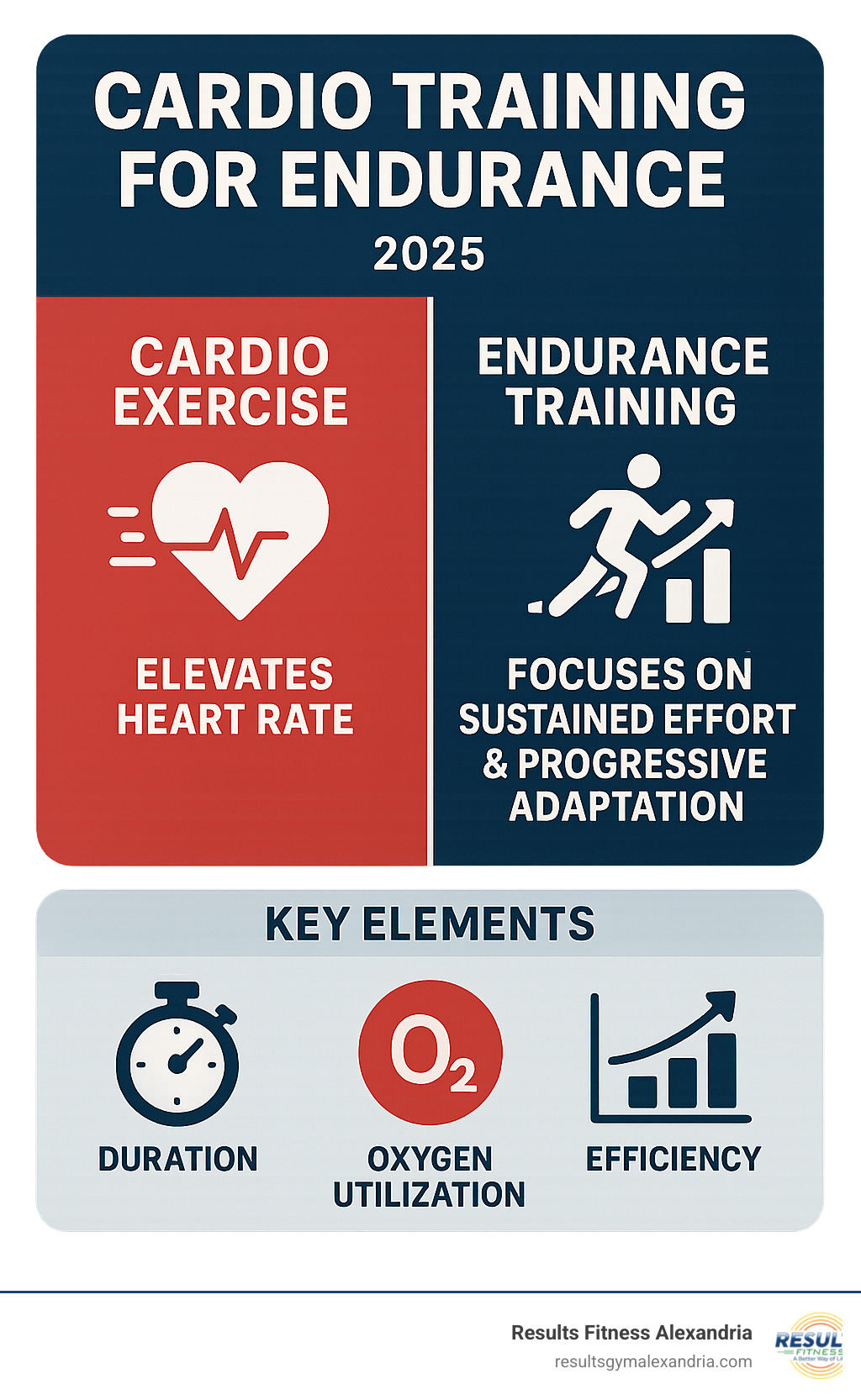
Cardio training for endurance is your body’s ability to supply oxygen to working muscles during sustained physical activity. Unlike general cardio that simply gets your heart rate up, endurance training specifically improves how efficiently your heart, lungs, and circulatory system work together over extended periods.
Quick Answer: Key Components of Cardio Training for Endurance
- Duration: 150-300 minutes of moderate activity per week
- Intensity: 65-75% of maximum heart rate (Zone 2 training)
- Types: Running, cycling, swimming, rowing, brisk walking
- Progression: Start with 10-15 minutes, increase by 10% weekly
- Benefits: Improved heart health, increased stamina, better oxygen utilization
Cardiovascular endurance differs from regular cardio in one crucial way: specificity. While any activity that raises your heart rate counts as cardio, endurance training focuses on your body’s ability to perform sustained effort. Active young people typically have a maximum oxygen consumption of 35-50 milliliters per kilogram per minute, while endurance athletes can reach 70-85 milliliters.
The benefits extend far beyond physical fitness. Research shows that cardiovascular exercise releases endorphins, reduces stress and anxiety, and can lower the risk of major depression. Walking for just one hour or running for 15 minutes daily has measurable mental health benefits.
As Jennifer Rapchak, Fitness Director at Results Fitness Alexandria with over 14 years of certified training experience, I’ve helped countless members build their cardiovascular endurance through structured cardio training for endurance programs. My expertise in HIIT, strength training, and group fitness allows me to design effective endurance-building workouts for all fitness levels.
The Powerful Benefits of Building Endurance
When you commit to cardio training for endurance, you improve heart function, energy, and mood while making everyday tasks feel easier.
Regular cardio helps in lowering blood pressure and fat in the blood (triglycerides). As your heart and lungs become more efficient, they deliver oxygen with less strain, so you can do more with less fatigue.
You’ll notice better stamina in day-to-day life—climbing stairs, carrying groceries, and playing with your kids feels easier because your body uses oxygen more effectively.
For weight management, consistent endurance training is a powerful partner to nutrition. Studies show people who combine diet and exercise are 17.5 times more likely to lose weight than those who make no changes; exercise alone makes participants 5.2 times more likely to see results. Learn more in our guide on cardio vs strength training for weight loss.
Meeting about 150 minutes of moderate weekly activity is linked to reduced risk of type 2 diabetes, heart disease, stroke, and certain cancers. The mood boost is real, too—cardio helps release endorphins, lowers stress, and supports better sleep (finish harder sessions a few hours before bedtime).
Many of our members also report better focus and productivity once they establish a consistent endurance routine.
Effective Cardio Training for Endurance: Strategies and Workouts
Building real cardiovascular endurance isn’t about random workouts. At Results Fitness Alexandria, we use the FITT principle: Frequency, Intensity, Time, Type to structure training that progresses safely and effectively.
The Physical Activity Guidelines recommend 150 to 300 minutes of moderate physical activity a week, or 75 to 150 minutes of vigorous activity.
Intensity matters. On the Rate of Perceived Exertion (RPE) scale from 0-10:
- Moderate: RPE 3-4, conversational pace, roughly 65-75% max heart rate
- Vigorous: RPE 5-7, short phrases only, roughly 76-96% max heart rate

Top choices for endurance
- Running or jogging: easy to vary speed, distance, and incline
- Cycling: high cardio return with lower joint impact
- Swimming: full-body, joint-friendly, builds lung capacity
- Rowing: full-body strength-endurance and high calorie burn
- Brisk walking: accessible and effective—progress pace, distance, or hills
Steady-state vs HIIT
- Steady-state: hold a moderate effort (RPE 3-4) for 30+ minutes to build your aerobic base and fat-burning efficiency.
- HIIT: alternate short vigorous bouts (RPE 5-7) with recovery to boost VO2 max and your ability to sustain higher intensities.
Beginner-Friendly Cardio Training for Endurance
Start with 10-15 minute sessions, 3-5 days per week. Progress by adding a few minutes weekly. Brisk walking, light jogging, swimming, or steady cycling are ideal—keep a conversational pace. Consistency beats sporadic long sessions. For water-based training ideas, see swimming for fitness.
Advanced Cardio Training for Endurance: HIIT and Interval Methods
- HIIT: e.g., 30 seconds hard, 90 seconds easy, repeated several times for a 20-30 minute session. Research shows substantial VO2 and endurance gains with time-efficient workouts.
- SIT: 10-30 seconds of near-max effort with 2-5 minutes recovery, 3-7 rounds, 3x/week, can improve endurance in 2-8 weeks.
- Tabata: 20 seconds all-out, 10 seconds rest, 8 rounds (4 minutes of work) to challenge both aerobic and anaerobic systems.
Explore formats in Why You Should Give HIIT Exercises a Try. The best approach blends steady-state and intervals to build a strong base and top-end fitness.
Tracking Progress and Advancing Safely
Knowing how to track and progress keeps you improving without setbacks.

Measuring improvement
- VO2 Max: your capacity to use oxygen. You’ll feel gains in daily life even without lab testing.
- RPE: the same workout feels easier over time (a 7 becomes a 5-6).
- Talk test: easy chat = light; conversation = moderate; few words = vigorous. As fitness rises, you can talk more at faster paces.
- Heart-rate zones: Zone 2 (60-70% max HR) builds your aerobic base. A simple formula: 185 minus your age gives you a good Zone 2 target.
Safe progression: the 10% rule
Increase time, distance, or intensity by about 10-20% per week. If you ran 10 miles this week, target 11-12 next week. Honor signs of excessive fatigue, soreness, or pain.
Warm-up and cool-down
Spend 5-10 minutes preparing your body with light movement and dynamic mobility. Cool down 5-10 minutes to bring HR down gradually and add gentle static stretching while muscles are warm.
Special Considerations and When to See a Doctor
Consult a healthcare professional before starting if you have medical conditions, are returning from injury, or haven’t been active recently. Watch for overtraining signs: chronic fatigue, performance decline, poor sleep, frequent illness, persistent heaviness. For those recovering from stroke or cardiac events, exercise can help but requires medical supervision. Follow this guidance for exercise after a stroke or cardiac event.
Fueling Your Endurance: Nutrition, Recovery, and Mindset
Building cardio training for endurance also depends on smart fueling, recovery, and a sustainable mindset.

Nutrition
- Emphasize whole foods and complex carbs (oats, brown rice, quinoa, fruits, vegetables) for steady energy.
- Include lean protein (chicken, fish, eggs, legumes, dairy) to repair and rebuild. Aim to eat protein + carbs within two hours post-workout.
- Add healthy fats (avocado, nuts, seeds, olive oil) for longer sessions and overall health; limit refined sugars.
- Hydrate consistently; consider electrolytes for longer, hot, or intense sessions.
Recovery
- Sleep 7-9 hours to consolidate adaptations and restore energy.
- Plan rest days; use light movement for active recovery.
Mindset
- Choose activities you enjoy to stay consistent.
- Set realistic, incremental goals and celebrate small wins.
For a complete plan, see how to create a balanced fitness routine combining cardio, strength and flexibility.
Frequently Asked Questions about Cardio for Endurance
When you’re starting cardio training for endurance, these answers will help you build momentum.
How long does it take to improve cardiovascular endurance?
Most people notice improvements within 4-8 weeks of consistent training (aim for at least 150 minutes of moderate activity weekly). Beginners often see faster initial gains. Interval methods can accelerate progress; studies report 4% to 13.5% improvements in 2-8 weeks with Sprint Interval Training, with HIIT sometimes producing even larger gains.
Can I build endurance just by walking?
Yes. Start with brisk walks where conversation takes effort, then progress pace, distance, or incline weekly. As it gets easier, try power walking or short jog intervals. Walking is sustainable, low-impact, and highly effective.
How does strength training affect cardio endurance?
It helps. Stronger muscles work more efficiently, reducing fatigue during runs, rides, and swims. Strength training also lowers injury risk and boosts power for hills and finishes. For programming tips, see maximizing results: integrating strength training into your cardio routine.
Start Building Your Endurance Today
Endurance training strengthens your heart, boosts stamina and mood, and lowers health risks. You don’t need perfection—just consistent steps forward. Choose activities you enjoy, start with manageable sessions, and progress gradually.
At Results Fitness Alexandria, you’ll find supportive coaching, a welcoming environment, and quality cardio equipment to meet you at any level—from your first walk-jog to advanced intervals.
Ready to get moving? Explore our top-tier cardio equipment and start your journey with a free pass today.