Cardio training for better endurance women: 5 Super Tips
Why Cardiovascular Endurance is a Woman’s Superpower
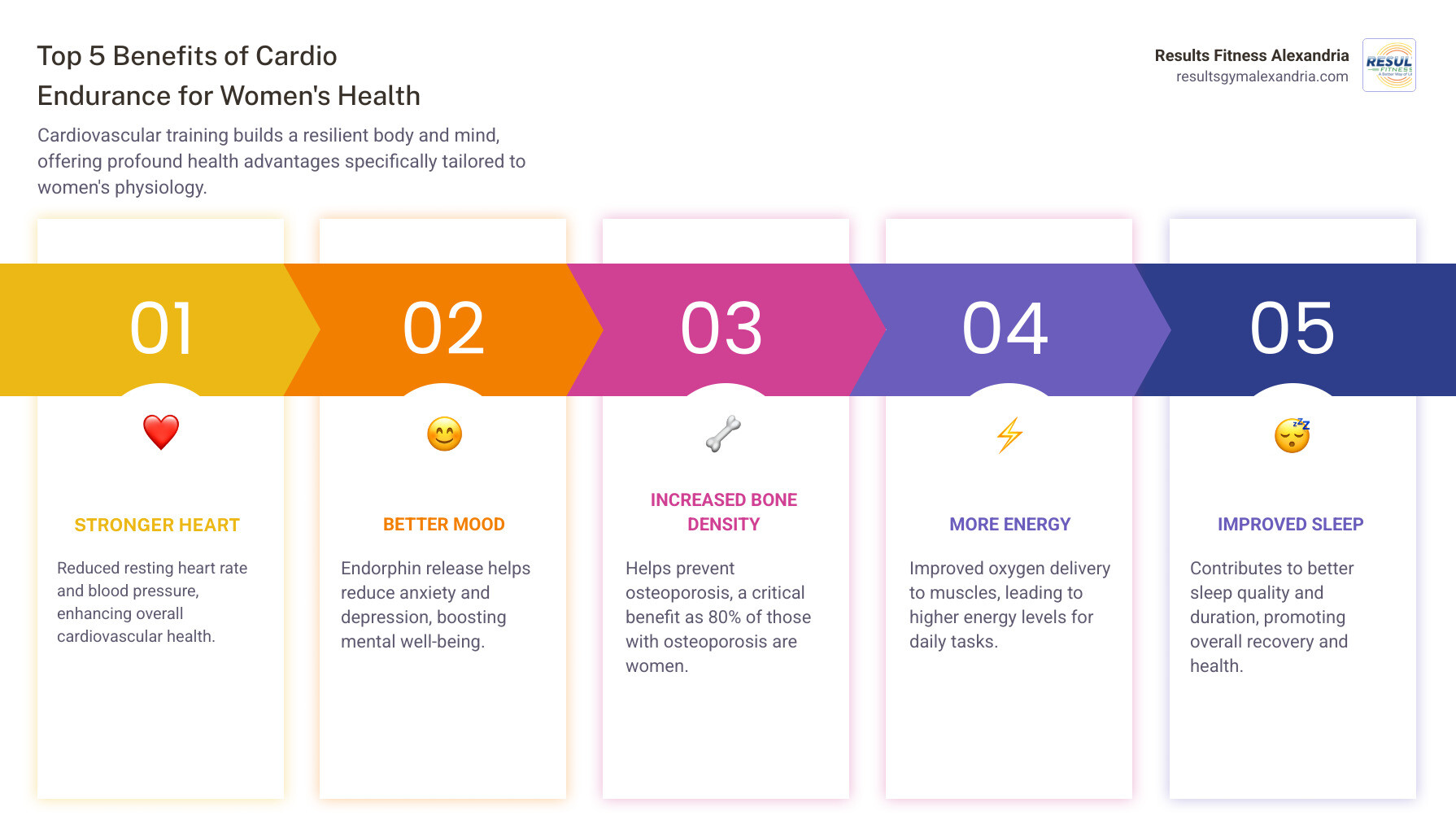
Cardio training for better endurance women can achieve transforms more than just your fitness level – it becomes your foundation for a stronger, healthier, and more confident life. Studies show that women who focus on cardiovascular endurance training experience significant improvements in bone density (crucial since 80% of Americans with osteoporosis are women), better sleep quality, and reduced anxiety and depression.
Quick Answer: Optimal Cardio Training for Women’s Endurance
- HIIT Training: 2-3 times per week, 38-79% endurance improvement in 2 weeks
- Zone 2 Cardio: 60-70% max heart rate, 45+ minutes for fat burning
- Progressive Approach: Start with 10-15 minutes, 3 days per week
- Cycle-Aware Training: Higher intensity during follicular phase, lower during luteal phase
- Recovery Focus: Include rest days and prioritize sleep for optimal results
Cardiovascular endurance is your heart and lungs’ ability to supply oxygen efficiently during sustained physical activity. When you improve this capacity, everyday tasks become easier, your energy levels soar, and your body becomes more resilient against chronic diseases like heart disease, diabetes, and certain cancers.
Women have unique advantages when it comes to endurance training. Your bodies are naturally efficient at fat metabolism during moderate-intensity exercise, and regular cardio helps balance hormones throughout your menstrual cycle. The mental health benefits are particularly powerful – endurance exercise combats the anxiety, depression, and social withdrawal that women experience at higher rates than men.
As Jennifer Rapchak, Fitness Director at Results Fitness Alexandria with over 14 years of certified training experience, I’ve helped countless women find their endurance potential through personalized cardio programs. My expertise in HIIT, core conditioning, and results-driven training has shown me that cardio training for better endurance women need isn’t one-size-fits-all – it requires understanding your unique physiology and lifestyle demands.
Designing Your Personalized Endurance Plan
Creating your perfect endurance plan doesn’t have to feel overwhelming. Think of it like learning to cook – you start with basic recipes and gradually add more complex techniques as your skills grow.
The progressive overload principle is your best friend here. It’s simply about gradually asking a little more from your body each week. Maybe you add two minutes to your walk, increase your pace slightly, or tackle one more hill. Your body adapts beautifully to these small, consistent challenges.
We use the FITT principle to keep things organized and effective. Frequency means how often you exercise each week. Intensity covers how hard you’re working during each session. Time refers to how long each workout lasts. Type is what kind of cardio you choose – whether that’s dancing, swimming, or power walking through your neighborhood.
Starting small is absolutely crucial, especially if you’re new to regular exercise. Begin with just 10 to 15 minutes of movement three times per week. I promise you’ll be amazed at how quickly your body responds to this gentle approach. Consistency beats intensity every single time in those early weeks.
A balanced fitness routine that combines cardio with strength and flexibility work gives you the best foundation for long-term success. Your heart, muscles, and joints all work together, so training them as a team makes perfect sense.
Now, let’s talk about measuring your progress – because seeing improvement is incredibly motivating. VO2 Max sounds technical, but it’s simply how efficiently your body uses oxygen during exercise. Think of it as your engine’s horsepower. Most active women have a VO2 max between 35-50 ml/kg/min, while endurance athletes often reach 70-85 ml/kg/min.
The Rate of Perceived Exertion (RPE) scale from 0 to 10 is your internal fitness coach. At moderate intensity (RPE 3-4), you can chat comfortably but couldn’t belt out your favorite song. During vigorous exercise (RPE 5-7), you can only manage a few words between breaths.
Your Resting Heart Rate (RHR) tells an amazing story about your fitness journey. As your cardiovascular system gets stronger, your heart becomes more efficient and your RHR typically decreases. Heart Rate Variability (HRV) measures the tiny variations between heartbeats – higher variability usually indicates better fitness and stress resilience.
How to adapt cardio training for better endurance women can sustain
Here’s where cardio training for better endurance women gets really interesting – your hormones are actually powerful training partners when you understand how to work with them.
During your follicular phase (from menstruation to ovulation), rising estrogen levels often make you feel energetic and ready for challenge. This is your body’s way of saying “bring on the HIIT workout!” Many women find they can push harder and recover faster during this time.
The luteal phase (from ovulation to menstruation) brings higher progesterone levels, which can increase your core body temperature and change how you feel during exercise. This isn’t your body being difficult – it’s being smart. Lower-intensity steady-state cardio often feels better during this phase, and that’s perfectly normal.
Learning to listen to your body means paying attention to these natural rhythms rather than fighting them. Research shows that HRV can fluctuate with your menstrual cycle, giving you valuable insight into when to push and when to pull back.
If you’re pregnant, continuing to exercise is generally wonderful for both you and your baby, but always check with your healthcare provider first. The focus shifts from building new endurance records to maintaining your fitness safely.
During menopause, cardio training for better endurance women becomes even more powerful. As estrogen levels change, combining regular cardio (especially HIIT) with consistent strength training helps maintain bone density and supports your metabolism through this transition.
Tracking Your Progress and Staying on Course
Progress tracking doesn’t have to be complicated or time-consuming. A simple journal or fitness app where you record your workouts, how you felt, and small victories creates a powerful record of your journey.
Check your resting heart rate each morning before getting out of bed. It takes just 30 seconds and gives you incredible insight into your cardiovascular fitness. Watching that number gradually decrease over months is incredibly rewarding.
Monthly fitness tests like a 12-minute walk/run or timing yourself on a familiar route provide concrete proof of your progress. These benchmarks become celebration moments when you see improvement.
Remember to celebrate every small win along the way. Whether you walked an extra block, felt more energetic climbing stairs, or simply showed up on a day you didn’t feel like it – these moments matter. They’re building blocks of the stronger, more resilient you.
For more science-backed strategies to support your fitness journey, focus on consistency over perfection. Your endurance plan should feel sustainable and enjoyable, not like punishment.
The Best Cardio Training for Better Endurance Women Can Do
When it comes to cardio training for better endurance women, we have several powerful tools in our arsenal. Each type of training offers unique benefits, and often, the most effective strategy involves incorporating a mix of them into your routine.
| Training Type | Best For | Duration | Intensity We are thrilled to bring you this comprehensive guide on cardio training for better endurance women! Far too often, we see endurance training simplified, overlooking the incredible adaptability and specific needs of the female body. Here at Results Fitness Alexandria, we believe in empowering every woman to open up her full potential, and that starts with understanding how to optimize your cardio workouts for superior endurance.
Designing Your Personalized Endurance Plan
The key to building lasting endurance, especially for women, lies in a smart, progressive approach. It’s not just about doing more, it’s about doing it better and smarter. We accept the progressive overload principle, which simply means gradually increasing the demands on your body over time. This could be running a little further, increasing your speed, or adding more intense intervals. Our bodies are wonderfully adaptable, and consistency with this principle is how we see real, sustainable gains.
To guide this progression, we use the FITT principle:
- Frequency: How often you train. For general health, the American Heart Association recommends that all adults complete two and a half hours of endurance training per week, which can be broken down into 30 minutes, five days a week.
- Intensity: How hard you train. We measure this with tools like the Rate of Perceived Exertion (RPE) scale and heart rate monitoring.
- Time: How long your sessions are. This will vary based on your fitness level and goals.
- Type: The kind of exercise you do. Variety keeps things interesting and works different muscle groups.
Starting small is incredibly important, especially if you’re new to the game or returning after a break. If you’re new to working out, it’s best to start with just 10 to 15 minutes of physical activity for your first week, gradually increasing the intensity by increasing your duration. This gentle introduction allows your body to adapt, reducing the risk of injury and burnout. We believe in creating a holistic fitness routine, combining cardiovascular exercise with strength and flexibility training. For more insights into crafting a well-rounded regimen, check out our guide on More info about creating a balanced fitness routine.
To truly understand your progress and refine your training, we rely on several key metrics:
- VO2 Max Explained: This is your maximum oxygen consumption, representing the highest amount of oxygen your body can use during intense exercise. It’s measured in milliliters of oxygen per kilogram of body weight per minute (ml/kg/min) and is a strong indicator of cardiovascular fitness. For active young people, a typical VO2 max might be 35 to 50 ml/kg/min, while endurance athletes can use 70 to 85 ml/kg/min. As we improve our endurance, we expect to see an increase in this vital metric.
- Rate of Perceived Exertion (RPE) Scale: This is a simple yet powerful subjective scale from 0 (rest) to 10 (maximum effort). It helps us gauge how hard you’re working without needing complex equipment.
- Moderate-intensity exercise: You’re at an RPE of about 3-4. You can hold a conversation, but singing would be a challenge. Your heart rate is typically around 65-75% of your maximum.
- Vigorous-intensity exercise: Your RPE is 5-7. You can speak only a few words comfortably, and your breathing is heavy. This corresponds to roughly 76-96% of your maximum heart rate.
- Resting Heart Rate (RHR): Taken first thing in the morning, your RHR is a fantastic indicator of cardiovascular fitness. As your heart becomes more efficient at pumping blood, your RHR will generally decrease, signaling improved endurance.
- Heart Rate Variability (HRV): This measures the slight variations in time between your heartbeats. A higher HRV often indicates a more resilient and adaptable cardiovascular system, reflecting greater fitness and stress recovery. It’s worth noting that HRV can fluctuate due to various factors, including the menstrual cycle.
How to adapt cardio training for better endurance women can sustain
One of the most powerful insights for cardio training for better endurance women is acknowledging and adapting to our unique physiological rhythms, particularly hormonal fluctuations. We aren’t just smaller versions of men; our bodies operate on different hormonal cycles that can profoundly impact our energy, strength, and recovery.
- Menstrual Cycle Training: We’ve found that syncing your training with your menstrual cycle can open up new levels of performance and prevent unnecessary fatigue or overtraining.
- Follicular Phase (from menstruation to ovulation): During this phase, estrogen levels are on the rise, often leading to increased energy, pain tolerance, and better carbohydrate utilization. This is typically an ideal time to push intensity, accept higher-intensity interval training (HIIT), and focus on strength-building sessions. Many women report feeling stronger and more capable of challenging workouts.
- Luteal Phase (from ovulation to menstruation): Progesterone dominates this phase, which can slightly increase core body temperature, fluid retention, and reliance on fat as fuel. Energy levels might feel lower, and recovery needs can be higher. This is an excellent time to prioritize lower-intensity steady-state (LISS) cardio, active recovery, and maintain rather than push for new personal bests. Listening to your body is paramount here; if a high-intensity session feels like a struggle, it’s okay to dial it back. The research on HRV and the menstrual cycle further supports this nuanced approach to training.
- Pregnancy Adaptations: Exercise during pregnancy is generally beneficial, but safety is our top priority. We recommend consulting with your healthcare provider before starting or continuing any exercise program. Our approach focuses on maintaining fitness with modified, lower-impact exercises, ensuring proper hydration, and avoiding overheating. The goal is to support a healthy pregnancy, not to achieve new endurance milestones.
- Menopause Adaptations: As women transition through menopause, declining estrogen levels can impact bone density, metabolism, and body composition. This makes cardio training for better endurance women can maintain even more critical. We emphasize a dual approach:
- Focus on HIIT: High-intensity interval training can be particularly effective for improving cardiovascular health and managing weight during this phase, as it provides a strong metabolic stimulus.
- Strength Training Importance: Resistance training is non-negotiable for combating bone density loss (remember, 80% of osteoporosis cases are in women!) and maintaining lean muscle mass, which supports a healthy metabolism. We often integrate strength and cardio for optimal results. For more on this, explore how we approach More info on strength training.
Tracking Your Progress and Staying on Course
Consistency is the ultimate fuel for endurance, and tracking our progress is how we stay motivated and ensure we’re on the right path.
- Using a Journal or Fitness Apps: These are invaluable tools for logging your workouts, distances, times, and even how you felt (your RPE). This data helps us identify patterns, celebrate improvements, and make informed adjustments.
- Weekly RHR Check: Taking your resting heart rate each morning before you get out of bed is a simple yet powerful way to monitor your cardiovascular fitness. A consistent downward trend (within your normal range) is a great sign of improved endurance.
- Monthly Fitness Tests: We encourage clients to perform a repeatable fitness test, such as a 12-minute Cooper test (how far you can run in 12 minutes) or a 5K time trial, once a month. This provides a tangible benchmark of your progress and can be incredibly motivating.
- Celebrating Small Wins: Endurance is a marathon, not a sprint, and recognizing every step forward is crucial. Whether it’s extending your run by five minutes, shaving a few seconds off your mile time, or simply feeling more energized throughout your day, acknowledge and celebrate these achievements. They fuel your motivation for the long haul. For more tips on maximizing your fitness journey, we share The Best Health and Fitness Tips Backed by Science.
The Best Cardio Training for Better Endurance Women Can Do
When it comes to cardio training for better endurance women, we have several powerful tools in our arsenal. Each type of training offers unique benefits, and often, the most effective strategy involves incorporating a mix of them into your routine.
| Training Type | Best For | Duration | Intensity