Beginner Exercise Plan: Practical Guide
Starting a Beginner Exercise Plan: What You Need to Know First
A solid beginner exercise plan gives you a clear, step-by-step path to building real fitness habits — without the guesswork or overwhelm.
Here’s a quick-start framework to get you moving:
- Work out 3 days per week — alternate strength and cardio sessions
- Aim for 150 minutes of moderate activity weekly — that’s about 20-30 minutes per day
- Keep sessions short — 20 to 30 minutes is plenty when you’re starting out
- Warm up first — 5 minutes of light movement before every workout
- Rest between sessions — allow 48 hours before training the same muscle group again
- Progress gradually — add reps, time, or weight only after your form feels solid
You don’t need to be fit to start. You just need to start.
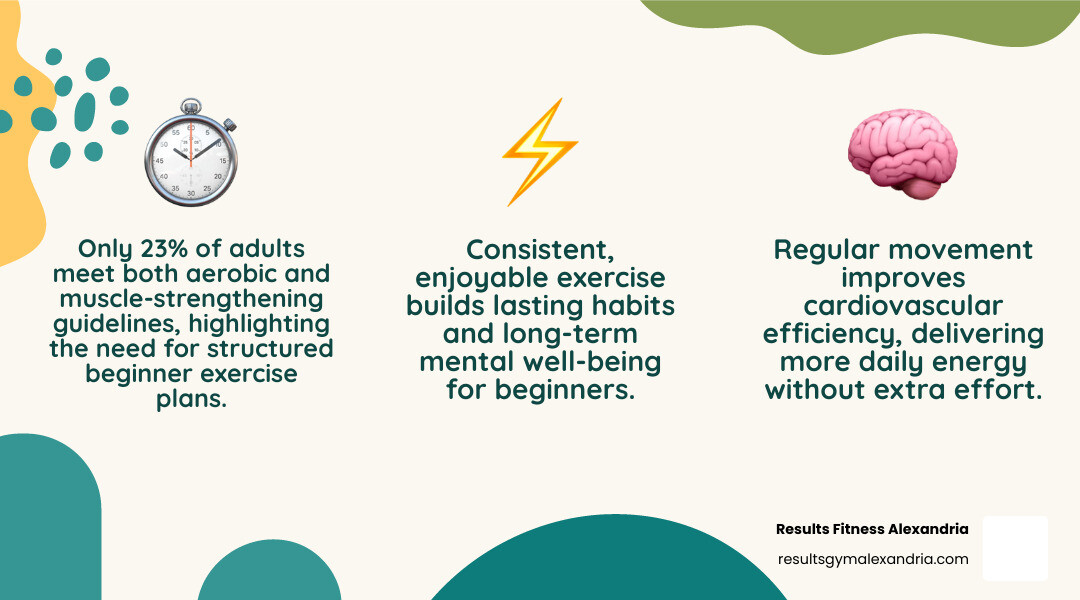
Only 23% of adults currently meet the recommended guidelines for both aerobic and muscle-strengthening activity. That gap isn’t about willpower — it’s usually about not having a clear plan to follow.
The good news? Research shows that when exercise is enjoyable and done consistently, people stick with it long-term. The first step is simply showing up.
I’m Jennifer Rapchak, Fitness Director at Results Fitness Gym in Alexandria, Virginia, and with over 14 years of experience as an ACE-certified personal trainer, I’ve helped hundreds of people launch their first beginner exercise plan and turn it into a lasting habit. In this guide, I’ll walk you through exactly how to structure your workouts, stay safe, and build momentum from day one.
Why Start a Beginner Exercise Plan?
Starting a fitness journey in May 2026 is one of the most transformative gifts you can give yourself. When we talk about a beginner exercise plan, we aren’t just talking about fitting into a different size of clothing; we are talking about building a core foundation for the rest of your life.
One of the most immediate benefits we see at Results Fitness Alexandria is the surge in energy levels. It seems counterintuitive — spending energy to get energy — but regular movement improves your cardiovascular efficiency, meaning your heart and lungs don’t have to work as hard during daily tasks.
Beyond energy, a structured plan focuses on:
- Revitalized Posture: Most of us spend our days hunched over screens. A balanced routine strengthens the “posterior chain” (the muscles on the back of your body), helping you stand taller and reducing chronic back pain.
- Enhanced Flexibility and Mobility: We don’t just want you to be strong; we want you to move through a full range of motion. This makes everything from playing with your kids to reaching for a high shelf easier and safer.
- Bone Density: Research shows that weight-bearing and resistance exercises are essential for maintaining bone mass as we age, which is a critical factor for long-term health.
- Mental Health: Exercise is a powerful tool for regulating hormones and improving sleep quality. It’s a natural mood booster that helps manage the stresses of modern life in Alexandria.
Establishing a routine also removes “decision fatigue.” When you have a plan, you don’t have to wonder what to do when you walk through our doors. You can find more details on Building Your Exercise Plan to see how medical experts view these foundational steps. We also recommend checking out our guide on Creating an Effective Workout Routine for Beginners to see how we tailor these principles to our local community.
Core Components of a Balanced Routine
A successful beginner exercise plan isn’t just about doing one thing repeatedly. We believe in a “well-rounded” approach that touches on four main pillars: aerobic exercise, resistance training, flexibility, and balance.
Aerobic Exercise (Cardio)
This is anything that gets your heart rate up. Whether it’s using an elliptical — which can burn between 300 to 600 calories per hour — or a brisk walk, cardio improves your heart and lung health. For beginners, we often recommend “Zone 2” training. This means keeping your heart rate at a level where you can still hold a conversation but are definitely working. A simple way to estimate your Zone 2 target is 185 minus your age.
Resistance Training (Strength)
Strength training is where the magic happens for your metabolism and bone health. We focus on “compound movements” — exercises that use more than one joint and muscle group at a time, like squats or rows. For women specifically, building muscle is the key to a toned look and a healthy metabolism. You can learn more about our approach to Working Out for Beginners Female here.

Flexibility and Balance
As we become more active, our muscles can tighten. Incorporating stretching and balance work (like yoga or simple stability drills) ensures that your body remains resilient. In 2023, nearly 12 million people in the U.S. engaged in Pilates for these very reasons — it’s a fantastic way to build a solid core foundation.
The FITT Principle
To keep your plan organized, we use the FITT principle:
- Frequency: How often you work out (aim for 3-5 days).
- Intensity: How hard you work (start at a 5 or 6 out of 10).
- Time: How long each session lasts (20-40 minutes).
- Type: The specific activity (cardio, weights, etc.).
Your First Week: A Structured Beginner Exercise Plan
The first week is all about familiarization and habit formation. You aren’t trying to break world records; you’re trying to learn where the equipment is and how your body feels when it moves. We suggest a 3-day split to allow for plenty of recovery.
| Day | Activity Type | Focus | Duration |
|---|---|---|---|
| Monday | Cardio | Heart rate & endurance | 20-25 mins |
| Tuesday | Rest | Active recovery (walking) | 15-20 mins |
| Wednesday | Strength | Lower body & Core | 30 mins |
| Thursday | Rest | Stretching/Yoga | 15 mins |
| Friday | Strength | Upper body & Total body | 30 mins |
| Saturday | Cardio | Fun activity (cycling/hiking) | 30 mins |
| Sunday | Rest | Full recovery | – |
For a deeper dive into a month-long progression, you can explore this Beginner Workout Plan: 4-Week Strength Training, Cardio Program. If you’re feeling nervous about your first visit to a facility, our guide on How to Do Beginner Gym Workout in 5 Simple Steps will walk you through the logistics.
Day 1: Cardio Foundations in Your Beginner Exercise Plan
On your first day, keep it simple. Choose a cardio machine like the treadmill or elliptical.
- Warm-up: 5 minutes of brisk walking.
- Work: 20 minutes at a moderate pace. On a scale of 1 to 10 (where 1 is sitting on the couch and 10 is sprinting for your life), aim for a 5 or 6.
- Cool-down: 5 minutes of slow walking followed by light stretching.
This session is designed to get your blood flowing and build your “aerobic base” without leaving you too sore to move the next day.
Days 2-3: Strength Training for Your Beginner Exercise Plan
When you transition to strength, we focus on foundational movements. For women, we often emphasize the Best Beginner Weight Lifting Women routines that build confidence with weights.
Sample Routine:
- Bodyweight Squats: 3 sets of 10-12 reps. Focus on sitting your hips back as if sitting in a chair.
- Glute Bridges: 3 sets of 15 reps. Lie on your back and lift your hips toward the ceiling.
- Planks: 3 rounds of 20-30 seconds. Keep your body in a straight line from head to heels.
- Lat Pulldowns: 3 sets of 10-12 reps. Focus on pulling your shoulder blades down and back.
- Dumbbell Chest Press: 3 sets of 10 reps.
Always leave “two reps in the tank.” This means you should finish your set feeling like you could have done two more with good form. This prevents burnout and excessive soreness.
Safety, Equipment, and Exercise Modifications
Safety is our number one priority at Results Fitness Alexandria. Many beginners feel intimidated by gym equipment, but most machines are designed to be very user-friendly.
Machine Safety
- Treadmills: Always use the safety clip. Start the belt while standing on the side rails, then step on.
- Adjustments: Most machines have a pin to adjust the weight and a lever to adjust the seat. Ensure the “pivot point” of the machine aligns with your joints (like your knees or shoulders).
Modifications: Meeting You Where You Are
Don’t feel pressured to perform advanced moves immediately. We love modifications because they allow you to build strength safely.
- Push-ups: If a standard push-up is too difficult, try knee push-ups or even wall push-ups.
- Squats: If your balance feels off, try an assisted squat by holding onto a sturdy rack or using a bench to sit down on.
- Range of Motion: It is better to do a half-squat with perfect form than a deep squat that hurts your knees.
For more specific tips for female lifters, see Beginner Weight Training for Women.

Nutrition, Recovery, and Long-Term Motivation
You cannot out-train a poor diet or a lack of sleep. To get the most out of your beginner exercise plan, you need to fuel your “engine.”
Nutrition Basics
- Protein: Aim for 0.7 to 1.0 grams of protein per pound of body weight. This provides the building blocks for muscle repair.
- Carbohydrates: These are your primary energy source. Focus on complex carbs like oats, brown rice, and sweet potatoes.
- Hydration: Men should aim for about 15.5 cups of water daily, and women about 11.5 cups. If you’re sweating, you need more!
Recovery and Sleep
Muscles don’t grow while you’re working out; they grow while you’re resting. We recommend 7-9 hours of quality sleep. On your off days, try “active recovery” — a light 20-minute walk or some gentle yoga can actually help reduce soreness by increasing blood flow to your muscles.
Staying Motivated
The hardest part of any beginner exercise plan is the second and third week when the initial “new year, new me” excitement wears off.
- Track Progress: Use a visible wall calendar. Marking an ‘X’ for every completed workout provides a visual dopamine hit.
- The “Don’t Miss Twice” Rule: Life happens. If you miss a workout, don’t sweat it. Just make sure you don’t miss the next one.
- Find a Buddy: Exercising with a friend increases accountability and makes the process more fun.
- Celebrate Small Wins: Did you do one more push-up than last week? That’s a victory!
Frequently Asked Questions about Beginner Workouts
How many days a week should a beginner work out?
For most people starting a beginner exercise plan, three days a week is the “sweet spot.” This allows you to stimulate your muscles and heart enough to see progress while giving your body 48 hours to recover between sessions. As you get stronger, you can move to four or five days, but consistency on three days is better than doing five days for one week and then quitting.
What should I eat before and after a workout?
- Pre-workout: Eat a small snack with simple carbohydrates about 30-60 minutes before you train (like a banana or a piece of toast). This gives you immediate energy.
- Post-workout: Focus on protein and some carbs within two hours of finishing. A protein shake or a meal with chicken and rice helps kickstart the recovery process.
How do I know if I am using the right weight?
We use an “effort rating” (or RPE). If you are aiming for 12 reps, the 11th and 12th reps should feel challenging, and your form should still be perfect. If you could easily do 20 reps, the weight is too light. If you can only do 5 reps before your form breaks, it’s too heavy.
Conclusion
Starting a beginner exercise plan is a journey of a thousand miles that begins with a single step — or in this case, a single squat. At Results Fitness Alexandria, we pride ourselves on being more than just a gym; we are a community dedicated to helping you reach your goals in a supportive, ego-free environment.
Whether you’re looking for personal training to perfect your form, or you want to join our vibrant Alexandria fitness community in a group class, we are here to support every milestone. Those “small wins” add up to massive transformations over time.
Ready to see what we’re all about? We invite you to come in and experience our facility firsthand. Start your journey with a specialized women’s beginner gym workout and take advantage of our free 1-day pass to try our amenities. We can’t wait to see you on the turf!