No Oxygen Required: The Ultimate Guide to Anaerobic Exercises
Why Anaerobic Workout Examples Belong in Every Fitness Routine
Anaerobic workout examples include some of the most effective exercises you can do for strength, speed, and overall fitness. Here’s a quick look at the most common ones:
- Sprint training — short, all-out runs (50–200 meters) with walking recovery
- HIIT (High-Intensity Interval Training) — alternating bursts of max effort with brief rest periods
- Heavy weightlifting — compound lifts like squats, deadlifts, and bench press
- Plyometrics — explosive moves like box jumps, squat jumps, and burpees
- Calisthenics circuits — bodyweight exercises like pull-ups, push-ups, and mountain climbers performed at high intensity
These exercises work by pushing your body beyond what oxygen alone can fuel — tapping into stored energy in your muscles for short, powerful bursts of effort.
Most people are familiar with aerobic cardio — jogging, cycling, swimming. But anaerobic training is the piece many fitness routines are missing. Research from Georgia State University found that anaerobic capacity explained 31% of the variation in 5K running times among endurance athletes. That’s a significant performance factor that steady-state cardio simply won’t develop on its own.
Whether you’ve ever run out of steam near the finish line or felt like you just couldn’t keep up during a high-intensity sport, anaerobic training is likely the missing link.
I’m Jennifer Rapchak, Fitness Director at Results Fitness Alexandria and an ACE-certified personal trainer with over 14 years of experience designing programs that include anaerobic workout examples for all fitness levels. I’ll walk you through everything you need to know to train smarter, not just harder.
Anaerobic workout examples word guide:
Understanding Anaerobic Exercise vs. Aerobic Exercise

To truly appreciate how these training methods transform your body, we have to look under the hood at how your body produces energy. The fundamental difference between aerobic and anaerobic exercise comes down to oxygen.
“Aerobic” literally means “with oxygen.” During aerobic exercises—like steady-state jogging, swimming, or cycling—your cardiovascular system delivers enough oxygen to your working muscles to sustain energy production over a long period. Your body primarily burns fats and carbohydrates in a slow, highly efficient, oxygen-dependent process.
“Anaerobic,” on the other hand, means “without oxygen.” When you perform short, explosive movements, your energy demand skyrockets instantly. Your heart and lungs simply cannot inhale, process, and transport oxygen to your muscles fast enough to meet this immediate demand.
Instead of waiting for oxygen, your body relies on internal, localized chemical processes to generate energy right away. This is called anaerobic metabolism. To get a better sense of how these two styles compare, Learn more about the health benefits of anaerobic exercise.
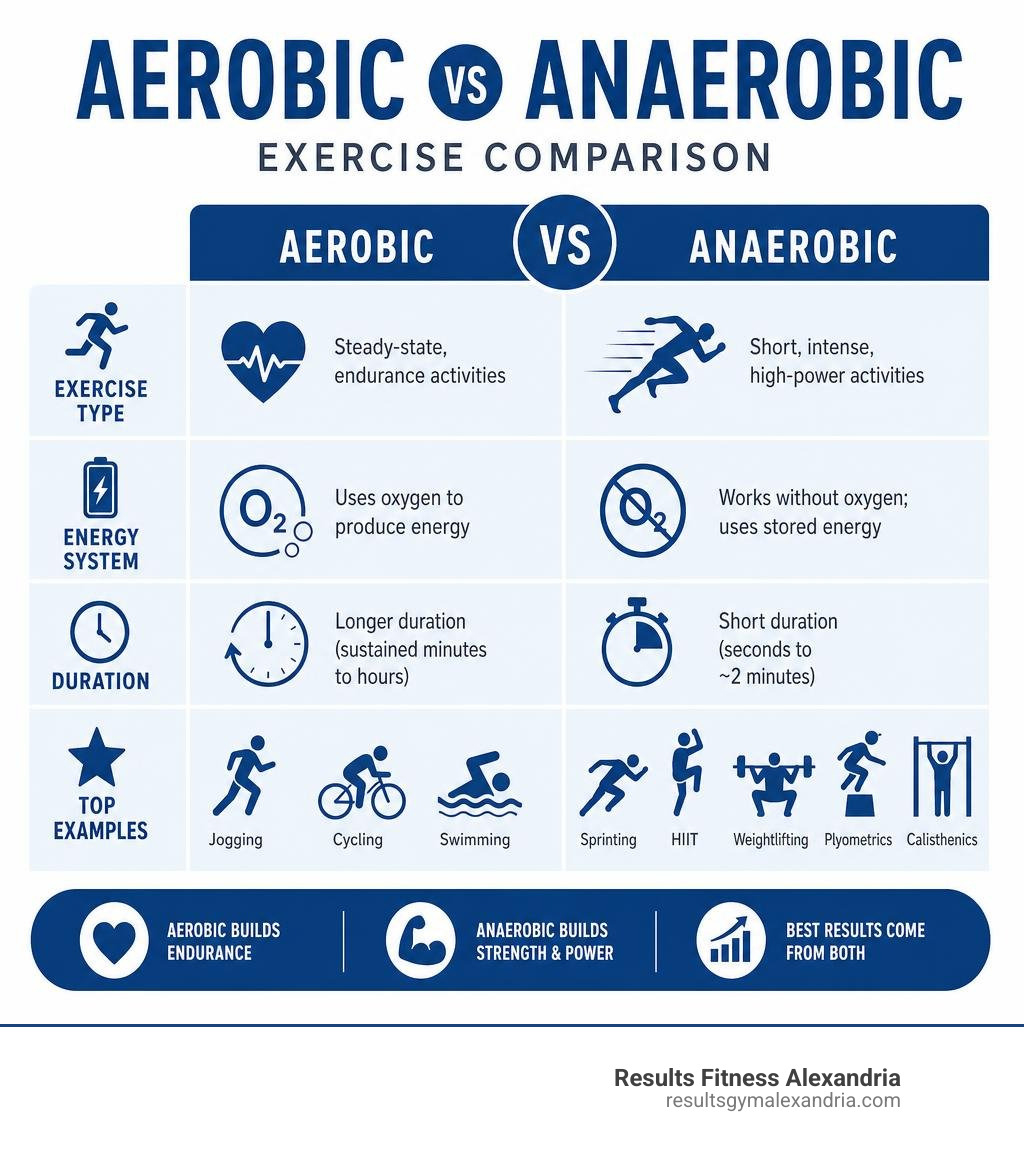
Here is a quick breakdown of how these two systems compare in action:
| Characteristic | Aerobic Exercise | Anaerobic Exercise |
|---|---|---|
| Oxygen Use | High (uses oxygen to produce energy) | None/Low (independent of oxygen) |
| Primary Fuel Source | Glycogen, glucose, and fatty acids | Muscle glycogen and phosphocreatine |
| Intensity Level | Low to moderate (60% to 80% max HR) | High to maximum (85% to 100% max HR) |
| Duration | Sustained (20 minutes to several hours) | Short bursts (seconds up to 2-3 minutes) |
| Primary Fiber Recruited | Slow-twitch (Type I) muscle fibers | Fast-twitch (Type II) muscle fibers |
| Primary Adaptations | Cardiorespiratory endurance, capillary density | Muscular power, hypertrophy, speed, strength |
The Science of Anaerobic Energy Systems: ATP-CP and Lactic Acid
When you engage in anaerobic training, your body relies on two distinct pathway systems to generate adenosine triphosphate (ATP)—the cellular currency of energy:
- The ATP-CP (Phosphagen) System: This is your body’s ultimate emergency power button. It handles ultra-short, explosive activities lasting under 10 seconds (such as a 100-meter sprint or a 1-rep max deadlift). It relies on stored ATP and creatine phosphate (CP) directly inside the muscle tissue. Because these stores are extremely limited, this system depletes rapidly and requires several minutes of rest to fully recharge.
- The Lactic Anaerobic (Glycolytic) System: For intense efforts lasting between 10 seconds and two minutes (like a 400-meter run or a high-rep set of kettlebell swings), your body transitions to glycolysis. This is the rapid breakdown of glucose and stored muscle glycogen without oxygen.
A natural byproduct of rapid glycolysis is the production of hydrogen ions and lactate. It is a common myth that lactic acid is a toxic waste product that causes muscle soreness days later. In reality, lactate is a valuable fuel source that your body recycles.
The physical “burning” sensation and muscle fatigue you feel during a tough interval are actually caused by the accumulation of hydrogen ions, which temporarily lowers the pH inside your muscle tissue and slows down metabolic enzymes. Other factors like energy availability, oxygen delivery, and psychological limits also contribute to this fatigue.
Key Differences: Aerobic vs. Anaerobic Metabolism
The speed of energy production is the defining factor here. Aerobic metabolism is incredibly efficient, producing a massive amount of ATP per molecule of glucose, but it is slow. It works beautifully for steady-state efforts where slow-twitch muscle fibers dominate.
Anaerobic metabolism is highly inefficient—producing far less ATP per unit of glucose—but it produces that energy instantly. This rapid energy production is what allows your fast-twitch muscle fibers to fire with massive force, giving you the power to jump higher, lift heavier, and sprint faster.
The Powerful Benefits of Anaerobic Training
Many people avoid high-intensity training because, frankly, it is hard work. However, pushing past your comfort zone yields incredible health and performance adaptations that steady-state cardio simply cannot replicate. To dig deeper into how these adaptations improve your overall physical health, you can Explore the fitness benefits of anaerobic exercises.
First, anaerobic training is a powerful tool for weight management and body composition. It significantly increases your basal metabolic rate (BMR) and triggers Excess Post-Exercise Oxygen Consumption (EPOC)—often called the “afterburn effect.”
Because high-intensity workouts disrupt your body’s homeostasis so intensely, you continue to burn calories at an elevated rate for hours after your workout ends as your body works to repair muscle tissue and restore oxygen levels. Research shows that combining anaerobic and aerobic training leads to a greater reduction in non-esterified fatty acids and body mass index (BMI) in obese individuals compared to aerobic training alone.
Additionally, anaerobic training stimulates the release of key myokines—muscle-derived signaling proteins—which support overall muscle health, reduce chronic inflammation, and protect metabolic function. This makes high-intensity training particularly valuable for seniors looking to preserve lean muscle tissue and functional independence as they age.
Boosting VO2 Max and Lactate Threshold
Many athletes believe that the only way to build cardiovascular endurance is through long, slow distance runs. However, high-intensity anaerobic training is actually one of the fastest ways to improve cardiorespiratory fitness.
When you push your body to its limit, your heart undergoes structural adaptations. It increases its left ventricular size and elasticity, which allows it to hold and pump more blood per beat. This increase in stroke volume and cardiac output directly boosts your VO2 max—the maximum amount of oxygen your body can utilize during intense exercise.
Furthermore, anaerobic training teaches your body to buffer and clear metabolic byproducts more efficiently. By consistently training near your limit, you raise your lactate threshold, meaning you can sustain a higher intensity of exercise for a longer duration before fatigue sets in. To learn how to program these progressions, Read our guide on anaerobic endurance training.
Building Muscle Mass and Enhancing Agility
If your goal is a strong, lean, and athletic physique, anaerobic training is essential. Heavy resistance training and explosive movements trigger muscle hypertrophy (growth) by recruiting and fatiguing fast-twitch muscle fibers. These movements also place a healthy stress on your skeletal system, stimulating osteoblast activity to increase bone mineral density and protect against osteoporosis.
Beyond strength, anaerobic training improves spatial awareness, coordination, and reaction times. A 2021 study involving 45 college women demonstrated that those who incorporated anaerobic training achieved significantly greater improvements in speed and agility compared to those who performed aerobic training alone. To understand how to structure your training for these physical adaptations, Discover the science of building muscle.
5 High-Yield Anaerobic Workout Examples to Try

Ready to add some high-yield anaerobic training to your routine? Here are five highly effective workout styles that utilize anaerobic energy systems to build strength, power, and metabolic conditioning.
1. Sprint Training: Classic Anaerobic Workout Examples for Speed
Sprinting is the purest form of anaerobic exercise. It forces your body to recruit maximum fast-twitch muscle fibers and operate entirely within the ATP-CP and lactic acid energy pathways.
- Flat Track Sprints: Warm up thoroughly, then perform 6 to 8 repetitions of 50-meter to 100-meter sprints at 95% to 100% effort. Rest for 2 to 3 minutes between reps to allow your ATP stores to fully recover.
- Hill Sprints: Find a steep hill. Sprint uphill at maximum effort for 10 to 15 seconds, then walk slowly back down to the starting point. Repeat for 8 to 10 rounds. The incline reduces joint impact while building incredible lower-body power.
To see how fitness professionals structure these short, high-yield running programs, Check out ACE’s 14-minute sprint and hill circuits.
2. High-Intensity Interval Training (HIIT): Metabolic Anaerobic Workout Examples
HIIT involves short, intense bursts of cardiovascular activity followed by brief periods of active recovery or rest. It is designed to keep your heart rate elevated while repeatedly crossing your anaerobic threshold.
- The Tabata Protocol: Perform 20 seconds of maximum-effort work (such as battle ropes, thrusters, or high knees) followed by 10 seconds of rest. Repeat this cycle 8 times for a brutal, highly efficient 4-minute round.
- The 40/15 Metabolic Circuit: Perform three exercises back-to-back, working for 40 seconds at a high Rate of Perceived Exertion (RPE 8-9) and resting for 15 seconds between moves. Complete 3 to 4 rounds.
If you are ready to push your limits, Try this brutal anaerobic threshold HIIT workout. If you prefer to combine strength and cardio in a timed format, Maximize your minutes with our cardio strength interval plan.
3. Heavy Weightlifting and Resistance Training
Weightlifting is fundamentally anaerobic because each individual set typically lasts under 30 seconds and requires explosive force production.
- Compound Strength Training: Focus on multi-joint movements like barbell back squats, deadlifts, overhead presses, and bench presses. To keep the stimulus anaerobic, lift heavier loads (75% to 85% of your 1-rep max) for 3 to 5 sets of 4 to 8 repetitions. Rest for 2 to 3 minutes between sets.
To learn the principles behind organizing these movements for optimal muscle growth, Learn how to build muscle with strength training. If you want a fun, timed challenge that blends bodybuilding with metabolic conditioning, Try Arnold’s 30-30 dumbbell challenge.
4. Plyometrics and Explosive Calisthenics
Plyometrics, or “jump training,” teaches your muscles to produce maximum force in minimum time by utilizing the stretch-shortening cycle of your tendons and muscles.
- Explosive Bodyweight Circuit: Perform box jumps, jump squats, burpees, and medicine ball slams in short, explosive intervals. For example, perform 15 seconds of maximum-effort box jumps, rest for 45 seconds, and repeat for 5 rounds.
For a fast, equipment-free routine you can do anywhere, Try this 10-minute bodyweight HIIT workout.
5. Kettlebell Metcon (Metabolic Conditioning)
Kettlebells are uniquely suited for anaerobic conditioning because their offset center of mass forces your core, glutes, and shoulders to stabilize dynamically throughout explosive movements.
- The 20-Minute Kettlebell EMOM: “Every Minute on the Minute” (EMOM) is an exceptional anaerobic training structure. At the start of every minute, perform a set of explosive movements, then rest for the remainder of that minute.
- Minute 1: 15 Kettlebell Swings
- Minute 2: 10 Goblet Squats
- Minute 3: 8 Kettlebell Clean and Presses (each arm)
- Minute 4: 10 Renegade Rows
- Minute 5: Rest
- Repeat this 5-minute circuit for 4 total rounds.
How to Structure and Schedule Your Anaerobic Workouts Safely
Because anaerobic training requires maximum effort, it places a heavy demand on your central nervous system, joints, and muscle tissue. To prevent injury and ensure long-term progress, you must approach your training structure with a smart plan.
Never skip your warm-up. A proper warm-up increases your core body temperature, dilates blood vessels, and prepares your nervous system for explosive force production. Spend 5 to 10 minutes on dynamic movements like arm circles, bodyweight squats, lunges, and light jogging. Gradually increase the intensity of your warm-up until it matches the demands of your main workout.
Similarly, always finish with a cool-down. Spend 3 to 5 minutes performing light movement and static stretching to help your heart rate return to baseline and prevent blood pooling in your extremities.
Weekly Frequency and Overtraining Prevention
When it comes to high-intensity anaerobic training, more is not better. Your body does not grow stronger during the workout itself; it grows stronger during the rest periods between workouts.
- Beginners: Start with 1 to 2 sessions per week, ensuring you have at least 48 hours of recovery between high-intensity workouts.
- Advanced Athletes: Limit true high-intensity anaerobic sessions to 3, or at most 4, times per week.
If you try to perform high-intensity sprints, heavy lifting, or HIIT workouts every single day, you will quickly experience symptoms of overtraining, such as chronic fatigue, persistent joint soreness, poor sleep quality, and decreased performance. To learn how to safely build your initial routine, Read our beginners guide to anaerobic workouts.
The Role of Rest, Recovery, and Nutrition
To maximize the benefits of your anaerobic training, you must support your body with proper recovery habits:
- Nutrition: Anaerobic workouts deplete your stored muscle glycogen. To replenish these stores and kickstart muscle protein synthesis, consume a balanced meal containing high-quality carbohydrates and 20 to 40 grams of protein within a few hours of completing your workout.
- Hydration: Dehydration significantly reduces muscular power and increases your risk of cramping and heat-related issues. Drink water consistently throughout the day, and consider adding electrolytes if you are sweating heavily.
- Sleep: Deep sleep is when your body releases the majority of its natural growth hormone to repair damaged muscle tissue. Aim for 7 to 9 hours of quality sleep per night.
Frequently Asked Questions about Anaerobic Training
What is the difference between aerobic and anaerobic exercise?
Aerobic exercise is steady, moderate-intensity activity that relies on a continuous supply of oxygen to burn fats and carbohydrates for energy (e.g., jogging or cycling). Anaerobic exercise consists of short, high-intensity bursts of effort where oxygen demand exceeds supply, forcing the body to burn stored muscle glycogen and phosphocreatine without oxygen (e.g., sprinting or heavy lifting).
Can beginners safely perform anaerobic workouts?
Yes, absolutely! However, beginners should start by scaling the movements. For example, instead of performing maximum-effort box jumps, you can start with rapid step-ups or bodyweight squats. Focus on mastering proper movement patterns and building a solid aerobic fitness base before increasing your speed and resistance.
How often should I do anaerobic training?
For most individuals, 2 to 3 anaerobic sessions per week is the sweet spot. This frequency provides enough stimulus to trigger physical adaptations—like increased strength, speed, and cardiovascular fitness—while leaving plenty of time for recovery and steady-state aerobic work.
Conclusion
Incorporating anaerobic workout examples like sprinting, heavy lifting, and high-intensity intervals into your fitness routine is one of the most effective ways to build a strong, powerful, and resilient body. These workouts challenge your heart, lungs, and muscles in ways that steady-state cardio simply cannot match.
At Results Fitness Alexandria, located in Alexandria, Virginia, we believe in providing balanced, expert-guided fitness programs for all levels. Whether you are looking for high-energy fitness classes, highly customized personal training, mindful yoga, or convenient childcare options, we are here to support your journey.
We invite you to experience our community firsthand. Grab a free 1-day pass to try our amenities, meet our coaches, and discover how we can help you reach your goals.
Take your fitness to the next level with our comprehensive anaerobic endurance training guide.