The Best Beginner Yoga Routine for Strength and Flexibility
The Science-Backed Benefits of Beginner Yoga for Flexibility and Strength
Starting a journey with beginner yoga for flexibility and strength is one of the best ways to transform your physical and mental well-being. If you’re looking to improve how your body moves, feels, and performs, yoga offers a gentle yet powerful solution. It helps you build a more resilient body and a calmer mind, no matter your current fitness level.
Here’s how beginner yoga immediately addresses your fitness goals:
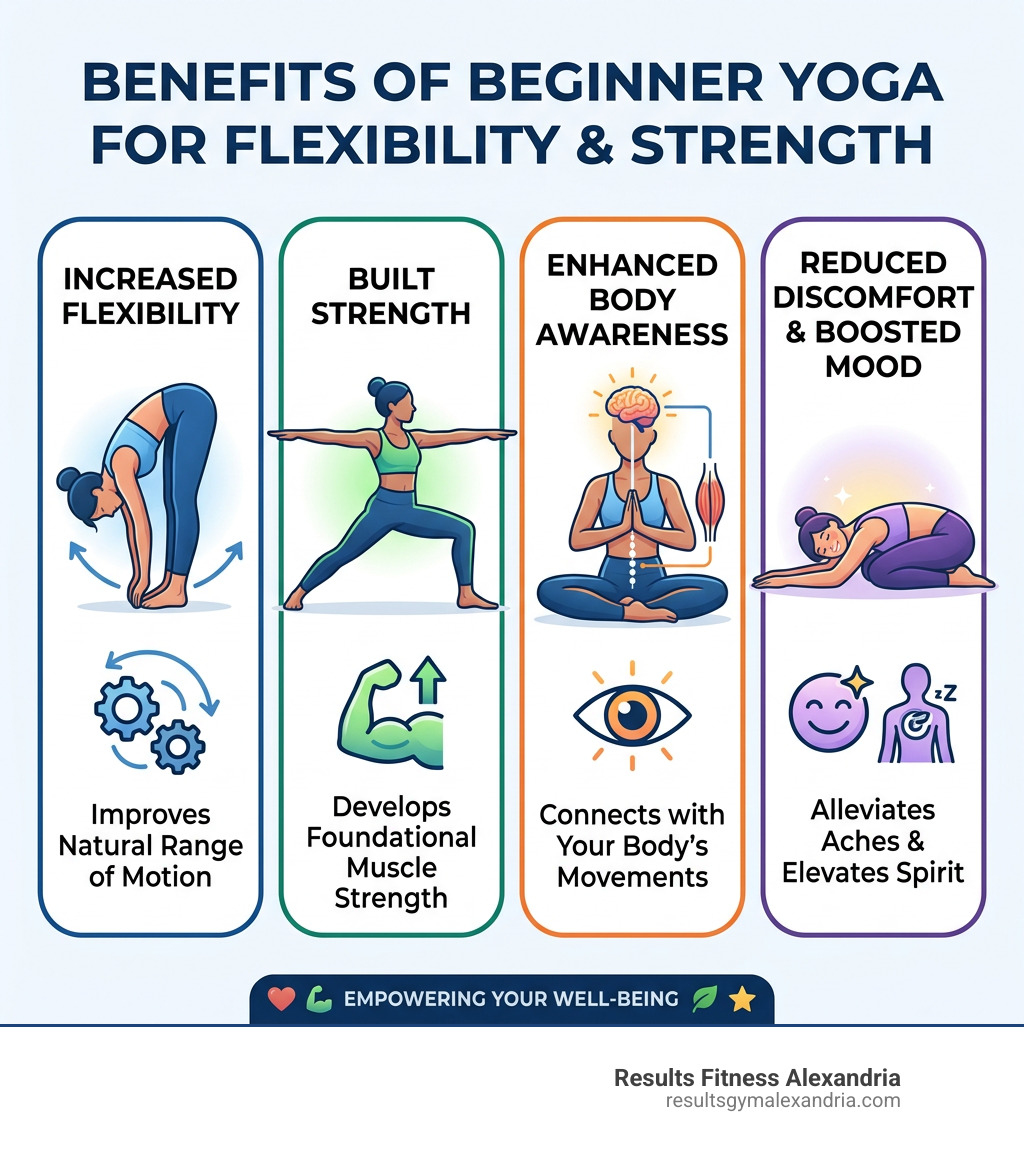
- Increases Flexibility: Yoga improves your body’s natural range of motion, helping to reduce stiffness in joints and muscles.
- Builds Strength: You use your own body weight to develop foundational muscle strength, especially in your core, legs, and arms.
- Enhances Body Awareness: Yoga teaches you to connect with your body, recognizing and addressing areas of tension or weakness.
- Reduces Discomfort: Regular practice can alleviate everyday aches, especially from sitting or repetitive movements.
- Boosts Mood: Even short yoga sessions can significantly reduce physical discomfort and improve your overall mood.
As Jennifer Rapchak, Fitness Director at Results Fitness Gym and a certified personal trainer, I’ve seen how beginner yoga for flexibility and strength empowers individuals to move better and feel stronger. My experience developing fitness programs ensures you’ll find effective, accessible ways to build your practice.
Beginner yoga for flexibility and strength terms at a glance:

Yoga is often pigeonholed as just “stretching,” but the science tells a much more robust story. When we practice beginner yoga for flexibility and strength, we are engaging in a sophisticated form of bodyweight resistance training that simultaneously addresses the health of our connective tissues.
One of the primary physical gains is an increased range of motion. Unlike traditional stretching, yoga poses often require you to support your weight at the end of your muscle’s length, which builds “active flexibility.” This is crucial for how yoga can help improve your flexibility because it ensures your joints are stable even when they are fully extended.
Research supports these claims. A study on 10-minute yoga benefits for mood and discomfort published in 2023 found that even a brief daily practice significantly reduced physical discomfort and improved the mood of people working from home. This suggests that the barrier to entry is low; you don’t need a 90-minute session to see a difference.
Furthermore, yoga is a powerful tool for posture correction. By strengthening the “posterior chain”—the muscles along your back, glutes, and hamstrings—and opening the chest, yoga counteracts the “slump” caused by our digital lives. This builds joint health and muscle endurance, which are key benefits of strength training for all ages.
Beyond the physical, yoga cultivates mental resilience and body awareness. By holding challenging poses and focusing on the breath, you train your nervous system to remain calm under pressure. This “mind-body” connection allows you to move through the world with more grace and less risk of injury.
10 Essential Poses for Your Yoga Practice
To help you get started, we have curated a list of ten essential poses. These are foundational movements that appear in various types of yoga and provide a balanced mix of core stability and functional movement. Whether you are practicing at home or joining us for yoga in Alexandria, these poses form the bedrock of a solid routine.
1. Downward-Facing Dog (Adho Mukha Svanasana)
Often considered the “all-in-one” pose, Downward Dog provides a deep hamstring stretch while building significant shoulder strength. By pushing the floor away and lifting your hips toward the sky, you create spinal length and improve calf flexibility.
- Beginner Tip: Keep your knees bent as much as needed to keep your spine long and straight. Your heels do not need to touch the floor!
2. Plank Pose (Phalakasana)
Plank is the ultimate test of core engagement. It builds arm strength and upper body stability by requiring you to hold your body in a straight line from head to heels. Proper wrist alignment is key here; ensure your shoulders are stacked directly over your wrists and spread your fingers wide to distribute your weight.
3. Warrior II (Virabhadrasana II)
This standing pose is a powerhouse for leg endurance and quadriceps strength. It encourages hip opening and requires intense focus. As you reach your arms out in opposite directions, you also engage the shoulders and upper back.
- Alignment Check: Make sure your front knee is stacked over your ankle and isn’t “caving” inward.
4. Triangle Pose (Utthita Trikonasana)
Triangle Pose offers a unique side body stretch and improves groin flexibility. It is also a fantastic way to work on your balance.
- Modification: If you can’t reach the floor without rounding your back, place a yoga block under your bottom hand. This keeps your chest open and your spine aligned.
5. Bridge Pose (Setu Bandha Sarvangasana)
Bridge Pose is essential for glute activation and lower back health. By lifting your hips while lying on your back, you create a gentle hip flexor stretch and encourage chest opening. It’s the perfect antidote to a day spent sitting at a desk.
6. Tree Pose (Vrksasana)
Balance is a “use it or lose it” skill. Tree Pose develops ankle stability and concentration. It also provides a gentle opening for the hips.
- Safety Note: Never place your foot directly on your knee joint. Place it either on your calf or your inner thigh.
7. Cobra Pose (Bhujangasana)
Cobra is a foundational back extension that helps with respiratory health by opening the lungs. It provides an excellent abdominal stretch and improves shoulder mobility. Focus on lifting your chest using your back muscles rather than just pushing up with your arms.
8. Child’s Pose (Balasana)
Every beginner yoga for flexibility and strength routine needs a moment of restorative rest. Child’s Pose provides a deep lower back release and hip relaxation. It is our go-to for stress reduction whenever the practice (or life) feels too intense.
9. Cat-Cow (Chakravakasana)
This dynamic duo is the best way to improve spinal mobility. By flowing between arching and rounding your back, you encourage pelvic tilt and breath synchronization. It’s particularly effective for relieving morning stiffness.
10. Low Lunge (Anjaneyasana)
The Low Lunge provides a deep psoas stretch, which is vital for anyone with tight hips. It also builds knee stability and challenges your balance.
- Modification: If you have sensitive knees, place a folded blanket or a cushion under your back knee for extra support.
How to Structure Your Routine and Stay Safe
Creating a routine is about more than just doing the poses; it’s about how you approach them. For beginners, understanding the difference between static and dynamic movement is vital.
| Feature | Static Stretching | Dynamic Stretching |
|---|---|---|
| Action | Holding a pose in stillness | Moving through a range of motion |
| Duration | 30 to 60 seconds | Controlled repetitions |
| Best For | Increasing long-term flexibility | Warming up and mobility |
| Benefit | Signals muscles to loosen | Increases blood flow |
According to the American College of Sports Medicine stretching guidelines, healthy adults should perform flexibility exercises at least 2-3 days per week. For yoga, holding a static stretch for at least 30 seconds is the “sweet spot” for signaling your nervous system to let the muscle relax.
Structuring Your Beginner Yoga for Flexibility and Strength Routine
When creating an effective workout routine for beginners, consistency is your best friend. We recommend starting with 20-minute sessions three times a week.
- Morning vs. Evening: A morning practice helps clear morning stiffness and sets a positive tone for the day. An evening practice can help “unwind” the body and improve sleep quality.
- Progressive Overload: In yoga, this doesn’t necessarily mean adding weight. It means holding poses longer, trying deeper variations, or moving through transitions with more control.
- Class Variety: Don’t feel limited to one style. You can explore everything from Ashtanga to Restorative to see what fits your body’s needs on any given day.
Essential Props and Modifications
Props are not “cheating”—they are tools for better alignment. Using yoga blocks can bring the floor to you, while straps can help you reach your feet in forward folds without straining your back. Cushions or blankets are excellent for protecting joints.
One of our favorite “secret” modifications is micro-bending knees. Especially in poses like Downward Dog or Forward Fold, keeping a tiny bend in the knees protects the lower back and ensures the stretch stays in the belly of the muscle rather than pulling on the joints. This is a principle we also emphasize in weight training for beginners.
The Role of Pranayama (Breathing)
In yoga, the breath is the bridge between the body and the mind. Nasal breathing (inhaling and exhaling through the nose) helps regulate the nervous system, keeping you in a “rest and digest” state rather than “fight or flight.”
- Energy Flow: Proper breathing helps you move through transitions. Generally, we inhale to expand or lift and exhale to fold or twist.
- Focus: Focusing on the sound of your breath acts as a “moving meditation,” which builds mental focus and resilience.
Frequently Asked Questions
How long does it take to see results from beginner yoga for flexibility and strength?
With consistency, most beginners start to feel a difference in their mobility within just 2-3 weeks. You might notice you can reach a bit further in your daily life or that your back feels less “cranky” after work. Scientific research on yoga for mobility shows that regular practice increases the lubrication in your joints and the elasticity of your muscles. Significant changes in muscle tone and foundational strength usually become visible after 8-12 weeks of practicing 3 times per week.
Do I need to be flexible to start yoga?
Absolutely not! Saying you’re too stiff for yoga is like saying you’re too dirty to take a bath. Yoga is the tool you use to become flexible. Every pose has modifications designed to meet you at your current starting point. The goal isn’t to touch your toes; it’s to feel the stretch along the way and improve your personal range of motion.
Can yoga replace traditional weight lifting?
Yoga is excellent for building functional strength and bodyweight resistance, but it works differently than heavy lifting. While yoga improves endurance and stability, it may not provide the same maximal power gains as bench presses or squats. However, it is the perfect cross-training partner. Many of our members use yoga to supplement their strength training because it helps with recovery and keeps the muscles from becoming “tight” and restricted.
Conclusion
At Results Fitness Alexandria, we believe that fitness should be accessible, sustainable, and—dare we say—fun. Incorporating beginner yoga for flexibility and strength into your life isn’t just about the physical poses; it’s about joining a community support system that cheers for your progress.
Whether you’re interested in one-on-one personal training to perfect your form or want to dive into our vibrant group fitness classes, we are here to help you reach your goals.
Ready to see what your body can really do? We offer a free 1-day pass for you to come in, meet our team, and try out our amenities. From our dedicated yoga space to our childcare services, we’ve built an environment where you can focus entirely on your wellness. Come visit us in Alexandria and let’s start your journey together!