Beginner’s Guide to Anaerobic Exercise Workouts
Why an Anaerobic Exercise Workout Belongs in Your Fitness Routine
An anaerobic exercise workout uses short, intense bursts of effort to build strength, burn fat, and boost performance — without relying on oxygen for fuel. Here’s a quick look at what that means for you:
Common anaerobic exercise workouts:
- Sprints (10–30 seconds at max effort)
- Heavy weightlifting (squats, deadlifts, bench press)
- HIIT (high-intensity interval training)
- Plyometrics (box jumps, burpees, jump squats)
- Calisthenics circuits (pull-ups, mountain climbers)
Key benefits at a glance:
| Benefit | What It Means for You |
|---|---|
| Builds muscle | More lean mass, higher resting metabolism |
| Burns fat efficiently | Includes an afterburn effect after your workout |
| Improves VO2 max | Better cardiovascular fitness in less time |
| Increases power and speed | Real performance gains in sport and daily life |
| Strengthens bones | Weight-bearing effort increases bone density |
You’ve probably felt it before — that burning sensation in your legs at the end of a hard sprint, or the moment your muscles give out on a heavy set. That’s your body crossing into anaerobic territory. It’s uncomfortable, but that discomfort is exactly where real fitness gains happen.
Most people focus on steady-state cardio like jogging or cycling. Those are great. But if you’re not including some form of high-intensity anaerobic training, you’re likely leaving significant results on the table — especially when it comes to body composition, strength, and athletic performance.
I’m Jennifer Rapchak, Fitness Director at Results Fitness Alexandria, and with over 14 years of experience as an ACE-certified personal trainer, I’ve helped countless clients incorporate anaerobic exercise workouts into their routines to achieve real, lasting results. In this guide, I’ll walk you through everything you need to get started safely and effectively.
Understanding the Science: How Anaerobic Training Works
To master the anaerobic exercise workout, we first need to look under the hood. The word “anaerobic” literally means “without oxygen.” While aerobic exercise (like a long, steady jog) relies on a continuous supply of oxygen to fuel your muscles, anaerobic exercise happens when the demand for energy exceeds the oxygen currently available in your bloodstream.
When you go “all out,” your body can’t wait for oxygen to travel from your lungs to your muscles. Instead, it taps into immediate energy stores. This process primarily engages your fast-twitch muscle fibers, which are responsible for explosive movements and power but fatigue quickly. According to this Complete Guide to Benefits, Workouts & Results, your body switches to these pathways during high-intensity efforts to keep you moving when the going gets tough.
The ATP-CP and Lactic Acid Systems
We use two primary energy systems during an anaerobic exercise workout:
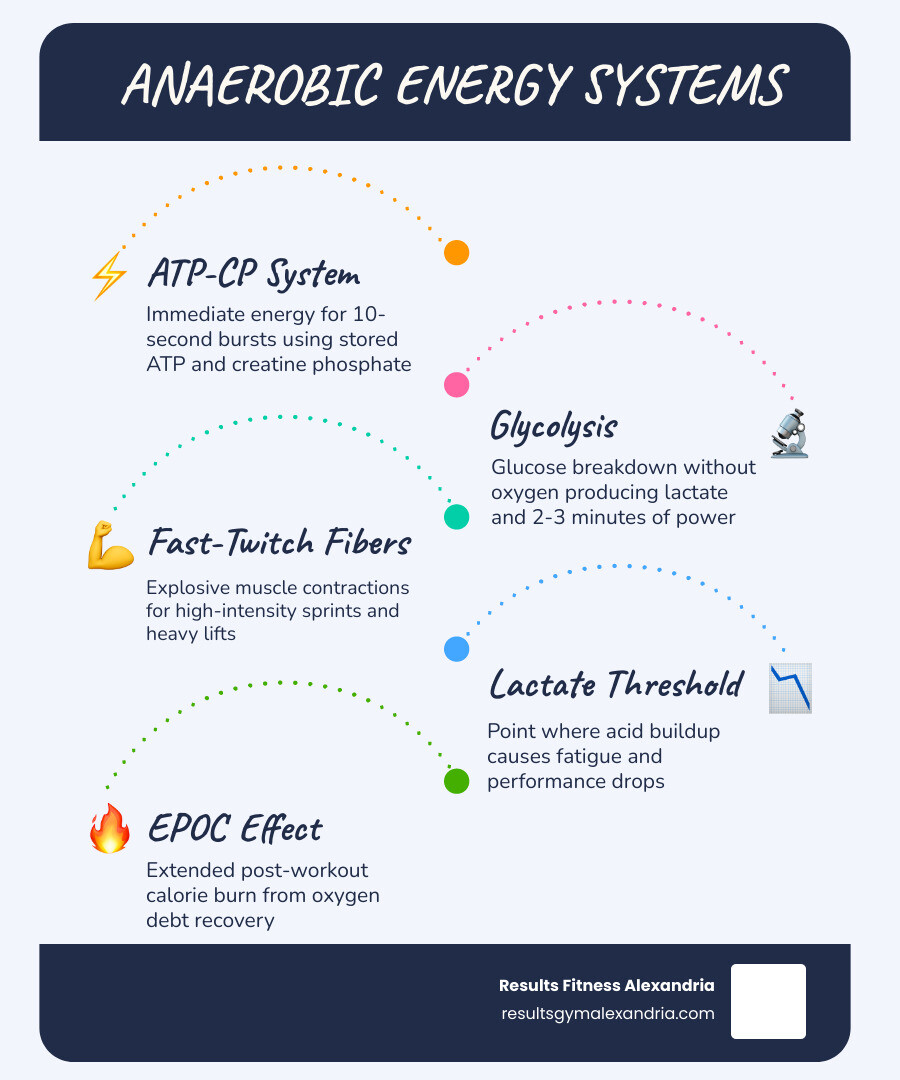
- The ATP-CP (Phosphagen) System: This is your “turbo button.” It provides immediate energy for maximum-effort bursts lasting fewer than 10 to 15 seconds. Think of a 100-meter sprint or a 1-rep max heavy lift. It uses stored Adenosine Triphosphate (ATP) and Creatine Phosphate (CP) for instant fuel.
- The Lactic Acid (Glycolytic) System: Once the ATP-CP system runs dry, this system takes over. It breaks down glucose (sugar) from your muscles without using oxygen. This system can fuel you for about 30 seconds up to 2 minutes. The byproduct of this process is lactic acid—that “burn” you feel in your muscles.
Understanding these systems is vital for Anaerobic Endurance Training, as it helps you structure your rest periods so these “batteries” can recharge before your next set.
Reaching the Anaerobic Threshold
The anaerobic threshold is the point during exercise where lactate begins to accumulate in the bloodstream faster than it can be removed. When you cross this line, you’ll notice a “performance plateau” or a sudden feeling of heavy, sluggish limbs.
Training just at or slightly above this threshold creates significant training adaptations. Your body becomes more efficient at clearing lactic acid and buffering the acidity in your muscles. Over time, this means you can go harder and faster for longer before hitting that “wall.”
Key Benefits of an Anaerobic Exercise Workout

If you’ve ever wondered why sprinters look so muscular compared to marathon runners, it’s the power of anaerobic training. By pushing your limits, you trigger physiological changes that steady-state cardio simply can’t match.
- Increased Muscle Mass: Anaerobic training is the gold standard for building lean muscle.
- Improved Bone Density: High-intensity, weight-bearing movements put healthy stress on bones, signaling them to become denser and stronger.
- Metabolism Boost: Because muscle tissue is more metabolically active than fat, increasing your muscle mass raises your basal metabolic rate.
- Improved Insulin Sensitivity: Research shows high-intensity work upregulates GLUT4 transporters, helping your body manage blood sugar more effectively.
One of the most exciting benefits is EPOC (Excess Post-exercise Oxygen Consumption), often called the “afterburn effect.” After an intense anaerobic exercise workout, your body has to work overtime to restore oxygen levels, clear lactate, and repair muscle tissue. This process burns extra calories for hours—sometimes even days—after you’ve left the gym.
Improving VO2 Max with an Anaerobic Exercise Workout
You might think you need to run for miles to improve your “cardio,” but anaerobic training is actually one of the fastest ways to boost your VO2 max (the maximum amount of oxygen your body can use during exercise).
Studies show that HIIT can improve VO2 max as effectively—or even more so—than traditional endurance training, but in a fraction of the time. This is one of the biggest reasons Why You Should Give HIIT Exercises a Try. By strengthening the heart’s stroke volume and improving oxygen utilization, you’ll find that your “easy” runs feel even easier.
Enhancing Power and Speed
For those of us in Alexandria who enjoy competitive sports or local 5Ks, anaerobic capacity is a secret weapon. Research from Georgia State University found that individual differences in anaerobic capacity explained a staggering 31 percent of the differences in 5K running times.
Furthermore, a study on athletes who performed eight 20- to 30-second wind sprints three times a week saw their power increase by an average of 15 percent over the season. Whether you’re trying to beat your personal best or just keep up with the kids, this Brutal Anaerobic Threshold HIIT approach can get you there.
Effective Examples of Anaerobic Training
The beauty of an anaerobic exercise workout is its variety. You don’t need a track or a massive weight room to get it done. At Results Fitness Alexandria, we incorporate these methods across our various programs.
- HIIT: Alternating short bursts of 90% max effort with recovery.
- Plyometrics: Explosive movements like box jumps or tuck jumps.
- Weightlifting: Lifting heavy loads for low to moderate repetitions.
- Calisthenics: High-intensity bodyweight moves like pull-ups and burpees.

If you thrive on community energy, you might want to learn Everything About Bootcamp Classes, where we blend these styles into one heart-pumping session.
Sample Anaerobic Exercise Workout for Beginners
If you’re new to this, don’t worry—you don’t have to start with 400-meter sprints. A simple Tabata-style circuit is a great entry point. Tabata involves 20 seconds of all-out work followed by 10 seconds of rest, repeated for 4 minutes.
Try this 15-minute beginner circuit:
- Burpees: 20 seconds work / 10 seconds rest (Repeat 4 times)
- Rest: 1 minute
- Mountain Climbers: 20 seconds work / 10 seconds rest (Repeat 4 times)
- Rest: 1 minute
- Squat Jumps: 20 seconds work / 10 seconds rest (Repeat 4 times)
For more ideas on how to push your limits, check out this guide to Give This 15-Minute Anaerobic Workout Your All.
Incorporating Resistance and Circuit Training
You can also turn a traditional strength session into an anaerobic exercise workout by manipulating your rest and intensity. Using a single dumbbell for a 25-Minute Dumbbell HIIT Workout is a perfect example of how to build strength and anaerobic capacity simultaneously.
Movements like squat thrusts, kettlebell swings, and heavy deadlifts are fantastic choices. If you prefer a structured environment, you can Learn about Circuit Training Classes, which take the guesswork out of your programming by moving you through various stations with minimal rest.
How to Safely Structure Your Routine
Because anaerobic exercise is so taxing, “more” is not always “better.” These workouts put significant stress on your Central Nervous System (CNS) and your joints.
To stay safe, always follow these rules:
- Warm-up: Spend at least 8–10 minutes doing dynamic stretches and light cardio to prime your muscles.
- Form First: Never sacrifice technique for intensity. If your form breaks down, the set is over.
- Recovery: Allow at least 48 to 72 hours of recovery between intense anaerobic sessions.
- Cool-down: Use static stretching and deep breathing to help your heart rate return to normal.
Following a structured 10-day HIIT Workout Plan can help you balance intensity with necessary rest days.
Progression and Frequency for New Athletes
For most beginners in Alexandria, we recommend starting with just two anaerobic sessions per week. This allows your body to adapt to the new stimulus without risking overtraining or injury. As your fitness improves, you can gradually increase the intensity or add a third session.
If you’re looking for a fun, high-intensity way to build this capacity, The Ultimate Guide to Boxing Group Fitness offers an incredible anaerobic challenge through heavy bag work and interval drills.
Frequently Asked Questions about Anaerobic Training
What is the main difference between aerobic and anaerobic exercise?
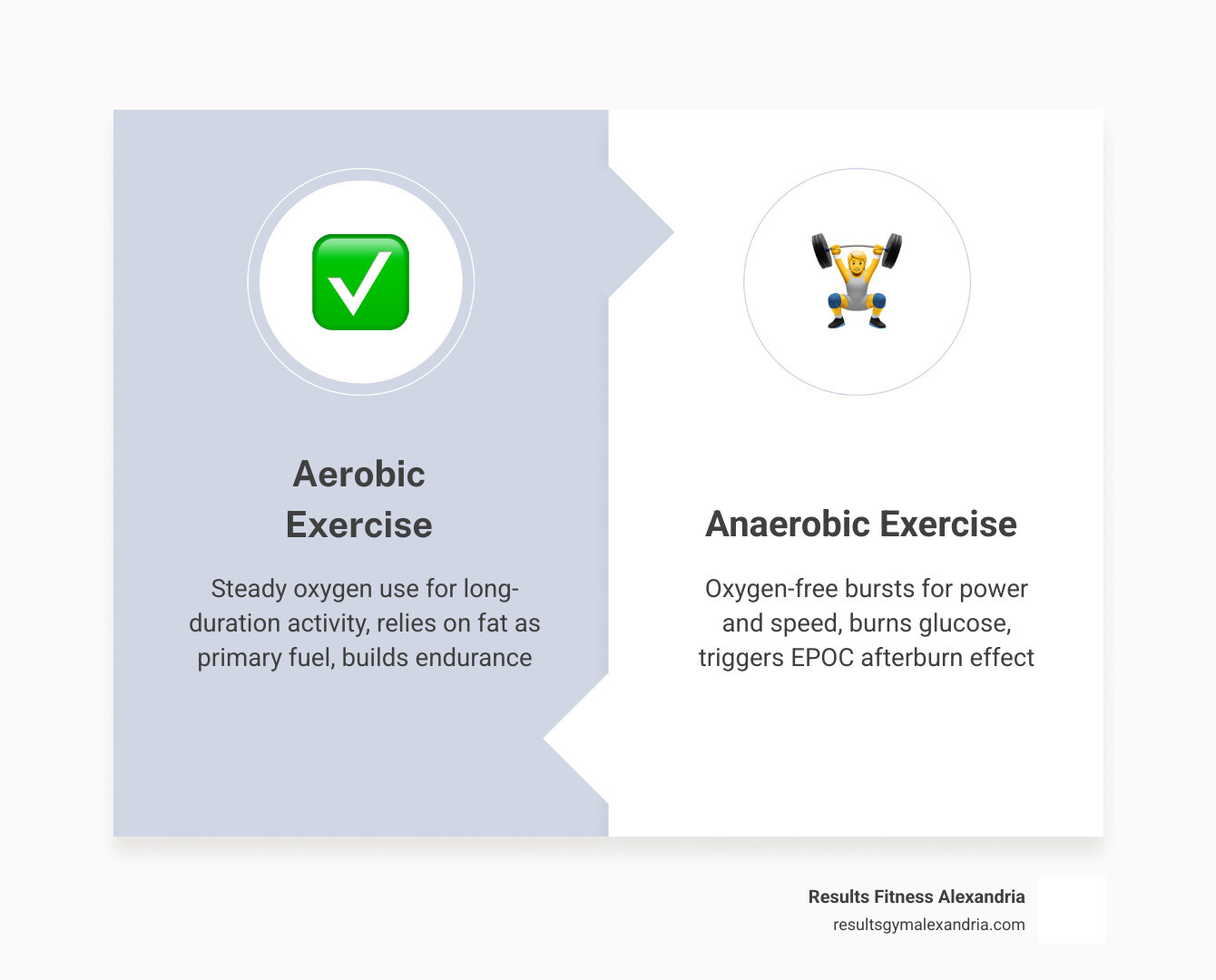
The main difference is oxygen utilization. Aerobic (“with oxygen”) is for long-duration, lower-intensity activities where your body can keep up with oxygen demand. Anaerobic (“without oxygen”) is for short, high-intensity bursts where your body must rely on stored glucose and phosphagens because oxygen can’t be delivered fast enough.
Can anaerobic exercise help with weight loss?
Absolutely. While you might burn more fat during a long walk, an anaerobic exercise workout burns more total calories in less time and triggers the “afterburn effect.” It also helps with stomach fat reduction and builds lean muscle, which keeps your metabolism humming even while you sleep.
How often should a beginner perform anaerobic workouts?
We suggest 2–3 days per week, ensuring you have at least one full day of rest or light activity (like walking or yoga) between sessions. This prevents injury and ensures your nervous system has time to recover.
Conclusion
An anaerobic exercise workout is one of the most efficient tools in your fitness arsenal. Whether you want to lose weight, build explosive power, or simply improve your overall health, pushing into that high-intensity zone is the key to unlocking your full potential.
At Results Fitness Alexandria, we’re committed to helping you navigate this journey safely. Our expert trainers can help you tailor a plan that fits your current level and future goals. Ready to see what your body is truly capable of? Come visit us and grab a free 1-day pass to try our amenities and classes for yourself.
Start your Anaerobic Endurance Training today and experience the difference that high-intensity training can make in your life!