
How to Find a Childcare Gym Without Breaking the Bank
Why Finding a Childcare Gym Is Harder Than It Should Be
A childcare gym can be the difference between working out consistently and skipping the gym for months because you have no one to watch your kids. If you’re looking for a quick answer, here’s what you need to know:
What is a childcare gym?
- A gym that offers supervised childcare onsite so parents can work out
- Children stay in a dedicated, staffed play area while parents train
- Most programs accept children from as young as 6 weeks up to 12 years old
- Time limits typically range from 90 minutes to 2 hours per visit
- Some gyms include childcare in membership; others charge a per-visit or per-class fee
What to look for:
- Age acceptance for your child’s specific age
- Childcare hours that match when you can actually train
- Trained, supervised staff in a clean, secure space
- Clear illness and pick-up policies
- Costs that fit your budget (included vs. add-on)
Staying active as a parent is genuinely hard. You want to work out. You need to work out. But finding time when you also have young children is a constant puzzle. Childcare at the gym solves that problem by putting your kids in a safe, engaging space just steps away from where you’re training.
The challenge? Not all gym childcare is equal. Hours vary. Costs vary. Age rules vary. And some gyms charge extra fees that quietly make it less affordable than it first looks.
This guide breaks it all down so you can find a childcare gym that actually works for your schedule and your budget.
I’m Jennifer Rapchak, Fitness Director at Results Fitness Gym in Alexandria, Virginia, and with over 14 years of experience as an ACE-certified personal trainer, I’ve seen how access to a reliable childcare gym can transform a parent’s ability to stay consistent with their fitness goals. Whether you’re just starting out or getting back on track, finding the right setup makes all the difference.
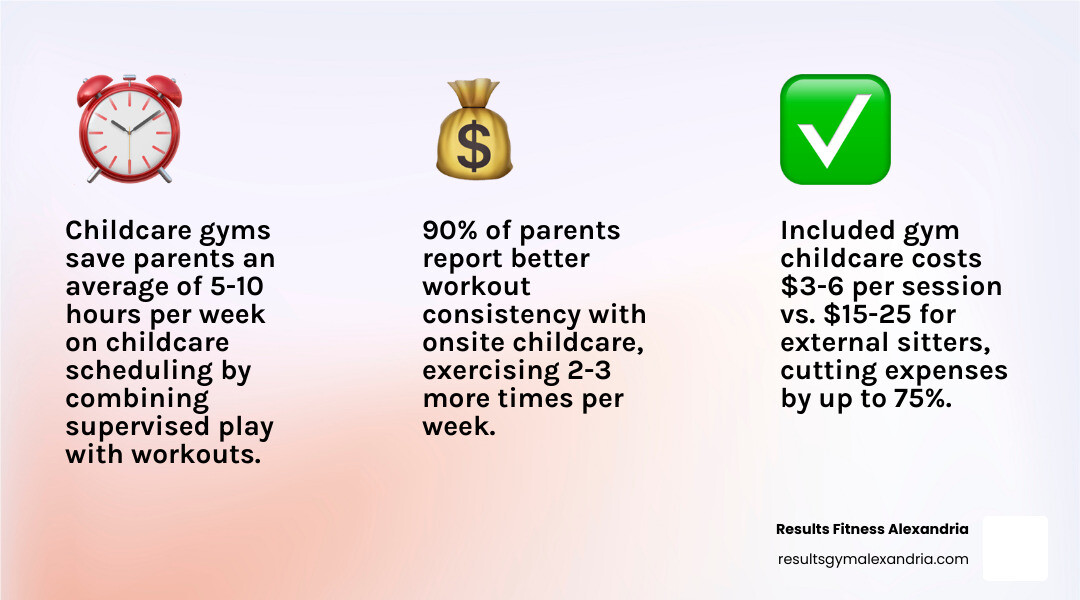
What Is a Childcare Gym and Why Do Parents Use One?
A childcare gym is a fitness facility that offers short-term, onsite child watch while parents work out. In plain English: you get your workout, your child gets supervised play, and nobody has to pretend that scheduling a sitter is “easy.”
For busy families, this setup removes one of the biggest barriers to exercise. Instead of trying to coordinate childcare every time you want to train, you can build workouts into your normal week.
How a childcare gym helps parents stay consistent with fitness
The biggest benefit is consistency. When childcare is right there in the building, it becomes much easier to:
- Show up for workouts you would otherwise miss
- Finish a strength or cardio session without interruption
- Keep personal training appointments
- Reduce the stress of arranging separate child care
- Protect a little time for your physical and mental health
This matters more than most people realize. Fitness results usually come from repeating simple habits over time, not from one heroic workout after three weeks of chaos.
If you want a deeper look at the practical side, read How Gym Childcare Can Help You Train/.
Who gym childcare is usually designed for
Most childcare gym programs serve a wide range of ages, but exact cutoffs vary. Based on current industry examples, many programs start somewhere between 6 weeks and 6 months, and some go up to age 11 or 12.
Common groupings include:
- Infants
- Toddlers
- Preschoolers
- School-age children
Many facilities also separate children by developmental stage, which is usually a good sign. Babies need a very different environment than a 9-year-old who wants to move, build, and play games.
One rule is especially common: parents usually must remain on-site the entire time their child is in care.
Childcare gym vs. other short-term care options
Compared with babysitters, nanny hours, or drop-in child care programs, a childcare gym often wins on convenience and cost for short workouts.
Why?
- You use it only when you train
- It is usually priced as part of membership or as a modest add-on
- It removes travel time between multiple places
- Your child is close by if needed
That does not mean every option is automatically affordable. Some programs look cheap until you notice short time caps, reservation rules, or per-child fees. That is where smart comparison matters.
How to Compare Costs Without Overpaying
When parents say a childcare gym is “too expensive,” they often mean one of two things:
- The monthly cost is truly too high
- The pricing structure is confusing
Usually, it is the second one.
The goal is not just to find the lowest sticker price. The goal is to find the best value for how often you will realistically use it.
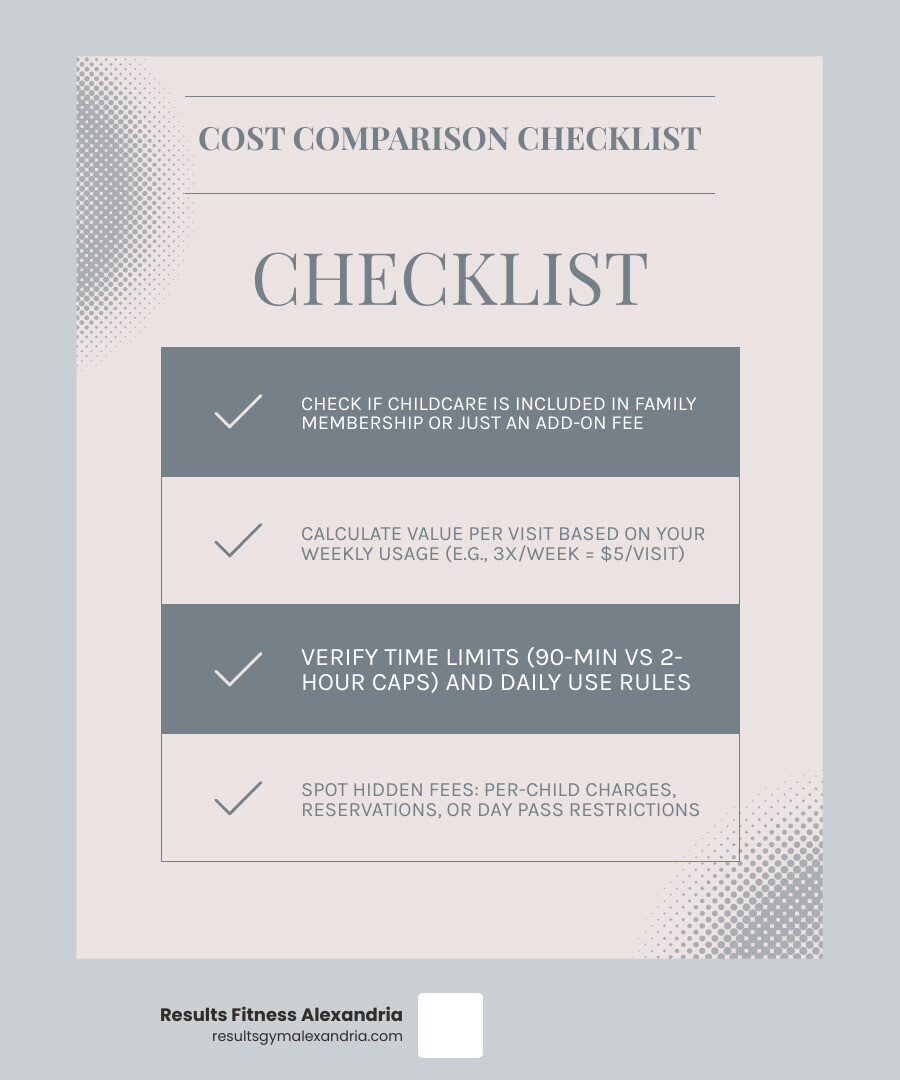
Membership requirements and the real cost of childcare gym access
Some facilities require a family membership to use childcare. Others allow childcare only with certain membership tiers. Some offer a day pass but limit childcare access for trial users.
Before you join, ask:
- Is childcare included in membership?
- Is it included only in a family plan?
- Is there an enrollment fee?
- Is childcare available with a 1-day pass or guest pass?
- Are there limits on how many visits we can use each week?
A family membership can be a great deal if you train several times per week. If you only plan to come occasionally, a cheaper base membership plus paid childcare might or might not make sense.
A simple way to judge value:
- Add total monthly membership and childcare fees
- Divide by how many visits you will actually use
- Compare that cost per workout to your alternatives
Common fees, time limits, and policies that affect value
This is where the fine print lives.
Across the industry, common usage policies include:
- 90-minute time limits per visit
- 2-hour time limits per visit
- Once-daily childcare use
- Maximum of two visits per day
- Advance reservation requirements
- Cancellation or no-show restrictions
For example, some programs cap care at 90 minutes once per day, while others allow up to 2 hours per visit and as many as two visits per day. That difference can completely change the value if you like longer workouts, personal training, or combining cardio with strength work.
Here is a simple comparison table:
| Cost factor | Lower-cost setup | Higher-cost setup |
|---|---|---|
| Childcare included | Yes | No, separate add-on |
| Visit length | 2 hours | 90 minutes or less |
| Daily usage | Flexible | Once per day only |
| Reservation policy | Easy drop-in | Advance booking required |
| Family pricing | Included in plan | Per child or per visit |
| Hidden fees | Few | Enrollment, late pickup, premium class fees |
Also watch for extra charges tied to specific classes. In some fitness settings, childcare is charged per class or per child. That may be fine for occasional use, but it adds up fast if you train regularly.
When included childcare is actually the better deal
Included childcare usually becomes the better value when:
- You work out at least 2 to 3 times per week
- You have more than one child
- You prefer predictable monthly budgeting
- You use a mix of gym floor workouts, classes, and training sessions
- You do not want to calculate every visit like a tax auditor
If you know you will use childcare consistently, included care often beats piecemeal pricing. It also reduces the mental friction of deciding whether each workout is “worth” the extra fee.
What to Look for Inside a Safe, High-Value Childcare Gym
Cost matters, but safety matters more. A cheaper option is not a bargain if it does not feel secure, clean, and well-run.
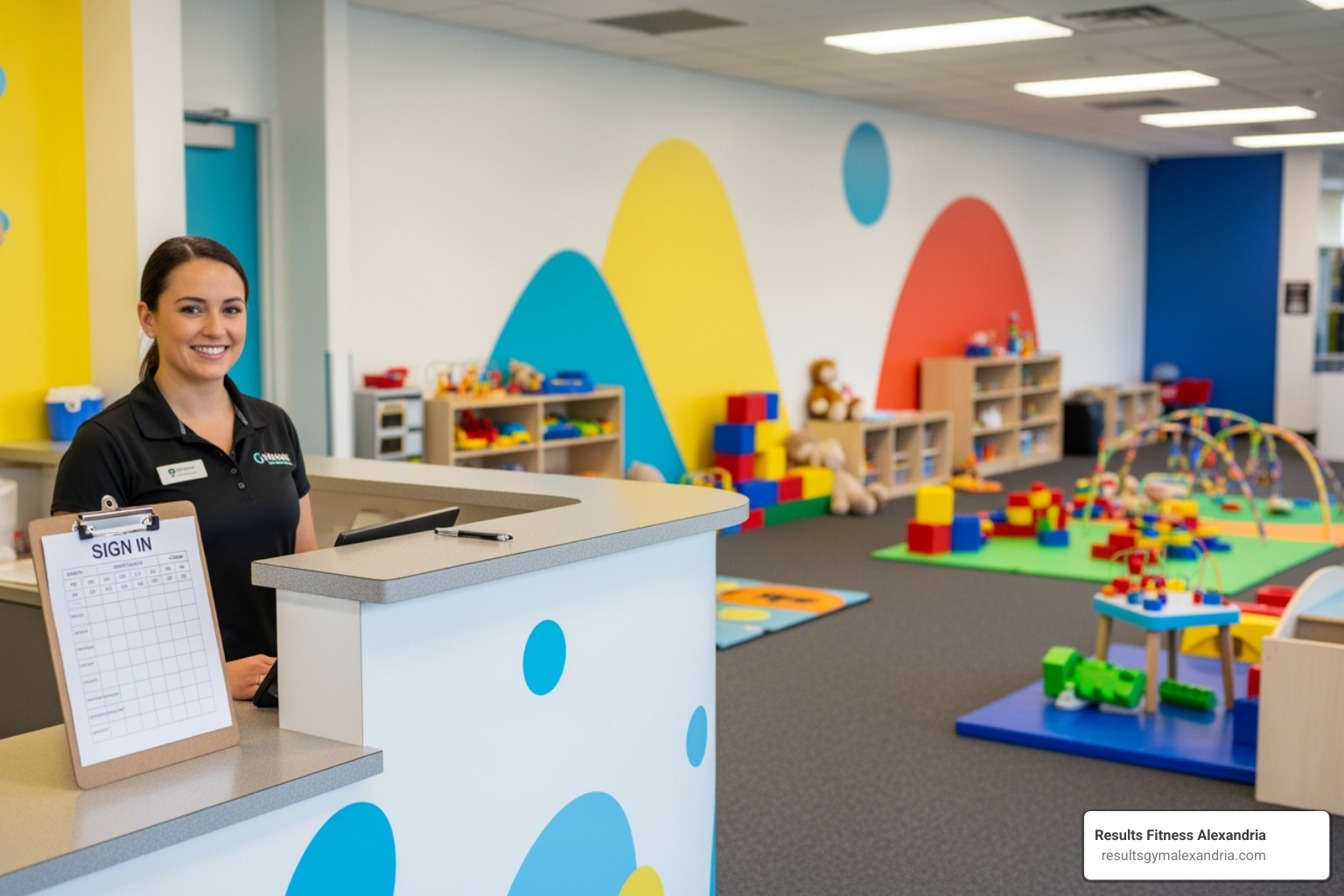
Childcare gym safety standards every parent should ask about
When touring a childcare gym, ask about:
- Staff training
- Background checks
- How children are grouped by age
- Staff visibility and room layout
- Emergency procedures
- Bathroom and diaper-changing procedures
- What happens if a child is upset or inconsolable
- Whether admission is limited when the room gets too full
Research across gym childcare programs shows several best practices keep coming up:
- Age-separated spaces
- Secure check-in and pickup procedures
- Frequent disinfecting of high-touch surfaces
- Routine deep cleaning during the day
- Supervision by trained staff rather than casual drop-in coverage
The American Academy of Pediatrics recommends that children in any group care setting be supervised by trained caregivers who follow consistent health and safety protocols. These principles apply just as much to short-term gym childcare as they do to full-day programs.
A clean room with clear sight lines tells us a lot. If we cannot quickly tell who is supervising whom, that is not ideal.
Check-in, pick-up, and parent requirements to know before your first visit
Many gyms use a formal check-in/check-out process. Common requirements include:
- Parent or guardian signs child in
- Parent remains on the premises
- Photo verification or account photo on file
- Pickup notes if another approved adult will check out the child
- Waiver or family account paperwork before first use
This process can feel a little formal the first time. Good. Formal is better than loose when children are involved.
Before your first visit, ask:
- Who is allowed to pick up my child?
- Do I need to bring photo ID?
- Can another parent on the account check out my child?
- What if I am in a training session and run a few minutes late?
- How will staff contact me if my child needs me?
You can also explore our own Amenities/Child Care/ page to see what family-friendly fitness support can look like.
Health, illness, and cleaning policies that protect families
A solid illness policy protects everybody.
One common standard in gym childcare is that children should be fever-free and symptom-free for at least 24 hours before returning. Many facilities also exclude children with active vomiting, diarrhea, contagious rashes, or other obvious illness symptoms.
Ask whether the facility has policies around:
- Fever
- Coughing and visible illness symptoms
- Vomiting or diarrhea
- Medication administration
- Runny noses and when they become an exclusion issue
- Cleaning schedules for toys and high-touch surfaces
Best practices we want to hear:
- High-touch surfaces disinfected frequently
- Toys cleaned regularly
- Deep cleaning performed daily
- Staff following illness exclusion rules consistently
A childcare gym does not need to feel like a hospital, but it should feel intentionally clean.
Best Amenities and Activities for Babies, Toddlers, and Big Kids
A strong childcare setup is not just babysitting in a corner with one tired stuffed giraffe. The best spaces are age-appropriate, organized, and designed to keep kids engaged for the full visit.
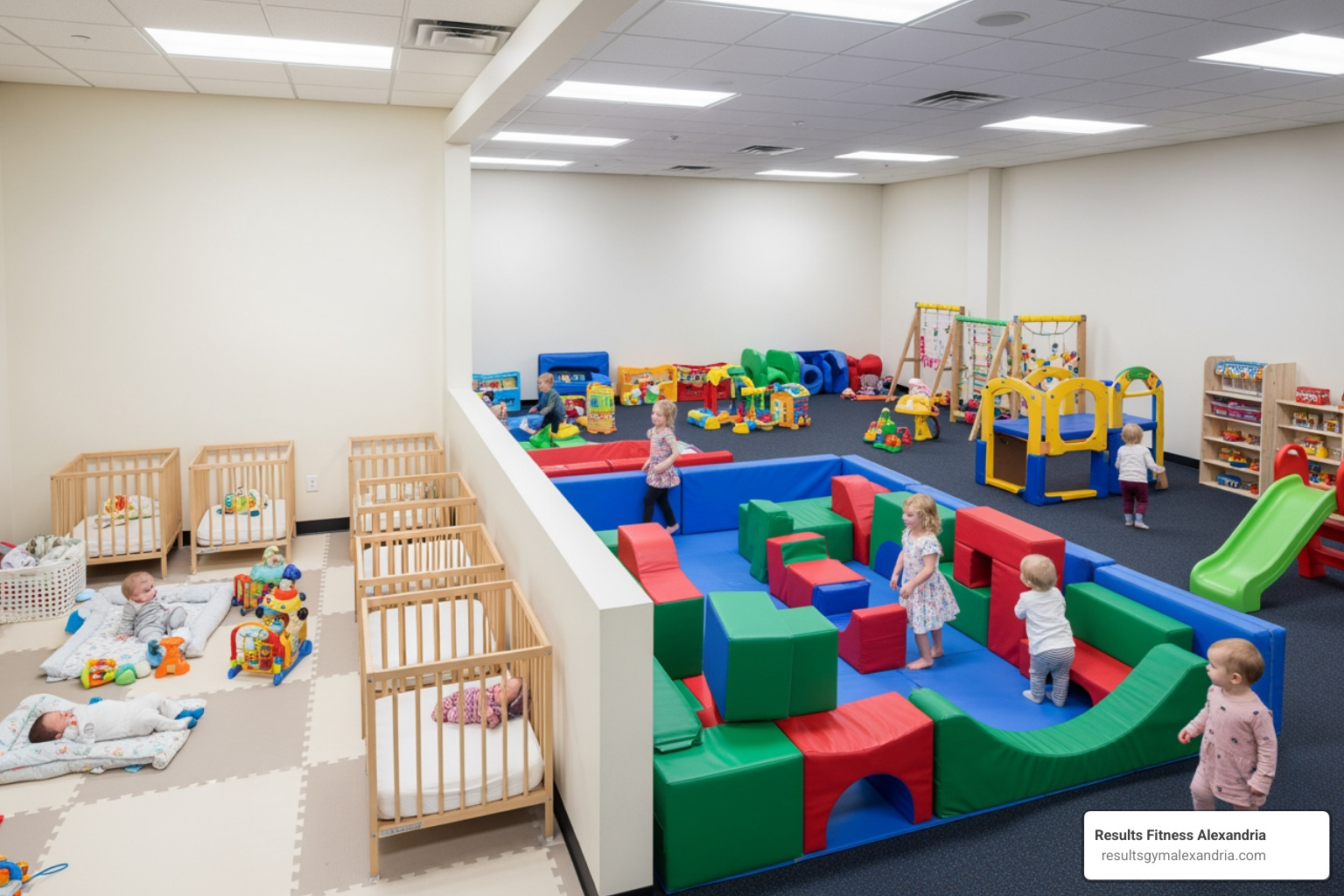
Childcare gym options for infants and toddlers
Some gym childcare programs accept babies as young as 6 weeks, 8 weeks, or 3 months. Others start at 6 months. Minimum ages vary a lot, so families with infants need to check carefully.
For babies and toddlers, common amenities include:
- Bouncers or infant seats
- Sensory toys
- Soft play equipment
- Diaper-changing stations
- Age-appropriate books
- Quiet play areas
Some programs require babies to be able to sit up independently before joining certain childcare rooms. That is especially common in boutique studio settings or smaller child watch setups.
If you have a very young child, ask specifically:
- What is the minimum age?
- Is there a separate infant area?
- How are bottles, diapers, and naps handled?
- Are babies mixed with active older children?
Activities older children usually get in a childcare gym
For toddlers, preschoolers, and school-age kids, common activities include:
- Arts and crafts
- Building toys
- Coloring
- Movement games
- Group play
- Simple scheduled activities
- Quiet homework or reading areas in some facilities
In larger kids’ spaces, we may also see climbing structures, open play zones, or activity-based stations. The best setups strike a balance: enough fun to keep children happy, but not so chaotic that everyone melts down by minute 37.
If your child does best with structured activity, ask whether the room follows a routine or just free play.
Why age-separated spaces matter for safety and engagement
Age-separated zones are one of the easiest ways to judge quality.
Why they matter:
- Infants need calmer spaces
- Toddlers need room to explore safely
- Older kids need more stimulating activities
- Staff can supervise more effectively when developmental needs are similar
- Children are less likely to be overwhelmed
A room that works for a 6-month-old and a 10-year-old at the same time is usually not truly designed for either one.
For parents trying to stay consistent with fitness, well-designed childcare spaces also make workouts and personal training sessions easier to complete without interruptions.
How Hours, Scheduling, and Fitness Services Affect Your Choice
A childcare gym can be wonderful on paper and still be useless if the childcare hours do not line up with your life.
How childcare gym hours vary by day and location
Hours vary a lot by facility. Common patterns include:
- Morning child watch blocks
- Evening child watch blocks on weekdays
- Shorter Saturday hours
- Sunday closure
- Reduced hours during holidays or summer
Some programs run broad fitness-center hours, while childcare is only available during limited windows. Others split the day into a morning block and an evening block, with a closure in the middle for cleaning or staffing.
That means “open until 9 p.m.” does not always mean childcare is available until 9 p.m.
Before joining, ask for the exact childcare schedule by day of week.
Finding a childcare gym that fits workouts and personal training
The best choice is not just the cheapest one. It is the one that matches how you actually train.
If you prefer:
- Strength training, make sure your visit cap gives you enough time to warm up, lift, and cool down
- Cardio, a shorter childcare window may work fine
- Personal training, confirm that childcare hours overlap with your appointment times
- Group exercise, check that class length plus changing time fits within the childcare limit
We recommend planning backward from your ideal workout routine. If you want help thinking through that, here is how gym childcare can help you train.
Why full-service fitness centers often offer more flexibility
Full-service fitness centers often work better for parents because they combine more than one training option under the same roof.
That can mean:
- Cardio and strength equipment
- Personal training
- Yoga
- Flexible workout lengths
- Childcare access tied to general facility use
That variety matters. If your child care window is 90 minutes to 2 hours, you want options that let you pivot. Maybe one day you lift. Another day you do a short cardio session. Another day you train with a coach.
For parents, flexibility is not a luxury. It is survival with sneakers.
How to Choose the Right Childcare Gym in Your Area
Choosing the right childcare gym is less about finding a “perfect” option and more about finding the one your family will actually use.
A simple checklist for touring any childcare gym
Bring this list with you when you tour:
- What ages are accepted?
- Is there a minimum age for infants?
- Is childcare included or an add-on?
- How long can my child stay per visit?
- How many times per day can we use it?
- Do I need a family membership?
- What are the childcare hours by day?
- Do parents have to stay in the building?
- What is the check-in and pickup process?
- Are children grouped by age?
- How often are toys and surfaces cleaned?
- What is the illness policy?
- What happens if my child cries and does not settle?
- Do I need reservations?
- Are there late pickup penalties?
Looking at a gym’s own childcare page can also help you compare the kinds of rules and age ranges parents should expect to review before joining.
What to do if your schedule is tight
If your schedule is packed, the answer is usually not “wait until life calms down.” We all know how that story ends.
Instead:
- Pick shorter workouts you can finish within the childcare cap
- Schedule training at the same time each week
- Use a simple plan instead of trying to do everything
- Choose a gym close to home, school, or work when possible
- Treat childcare gym visits like appointments, not optional extras
You may also like how gym childcare can help you train, especially if consistency has been the hardest part.
How family-friendly fitness supports long-term consistency
Family-friendly fitness helps parents stick with exercise because it removes the all-or-nothing trap.
Instead of thinking:
- “I need a perfect hour”
- “I need a babysitter”
- “I will start next month”
You can think:
- “I can get in today”
- “My child is nearby and supervised”
- “I can keep this routine going”
That is a huge difference.
We also share related ideas here:
- The Parents Guide To Cardio Classes With Built In Childcare/
- Stop Using Your Kids As An Excuse To Skip The Gym/
- Mommy And Me Exercise Classes/
- Mommy And Me Fitness Classes Near Me/
- From Diapers To Dumbbells With The Best Bootcamps For Busy Moms/
- Family Exercise Classes/
The right childcare gym supports regular workouts, better training consistency, and the ability to follow through on your fitness goals even during busy seasons.
Frequently Asked Questions About Childcare Gym Options
What age ranges do most childcare gym programs accept?
Most programs accept children somewhere within the range of 6 weeks to 12 years, but each facility sets its own rules. Some start at 6 weeks or 8 weeks, others at 3 months or 6 months. Older age cutoffs are commonly 6, 11, or 12 years depending on whether the gym has separate kids’ programs.
Always check your child’s exact age against the policy before joining.
Can I leave the building while my child is in a childcare gym?
Usually, no. A very common rule is that parents must remain on-site while their child is in care. That allows staff to contact you quickly if your child needs you and keeps the service focused on short-term child watch during workouts.
Is a childcare gym worth it if I only work out a few times a week?
Often, yes. If you work out 2 or 3 times a week, the convenience alone can make it worthwhile. The key is to calculate the real cost per visit and compare it with your other childcare options. If a gym offers a trial, use it. Results Fitness Alexandria offers a free 1-day pass, which is a smart way to test whether the setup fits your routine before you commit.
Conclusion
The right childcare gym should make your life easier, not more complicated. That means clear pricing, realistic time limits, safe supervision, age-appropriate spaces, and hours that line up with when you can actually work out.
At Results Fitness Alexandria, we believe family-friendly fitness should feel practical and welcoming for all fitness levels. If you want to explore a local option in Alexandria, Virginia, learn more here: child care at Results Fitness Alexandria.
And if you want to see whether our setup fits your routine before making any decisions, try our free 1-day pass. It is the easiest way to test the experience for yourself, because the best childcare gym is the one that helps you come back tomorrow.