Beyond the Basics: Your Expert Guide to TRX Suspension Training
Why TRX Suspension Training Works for Everyone
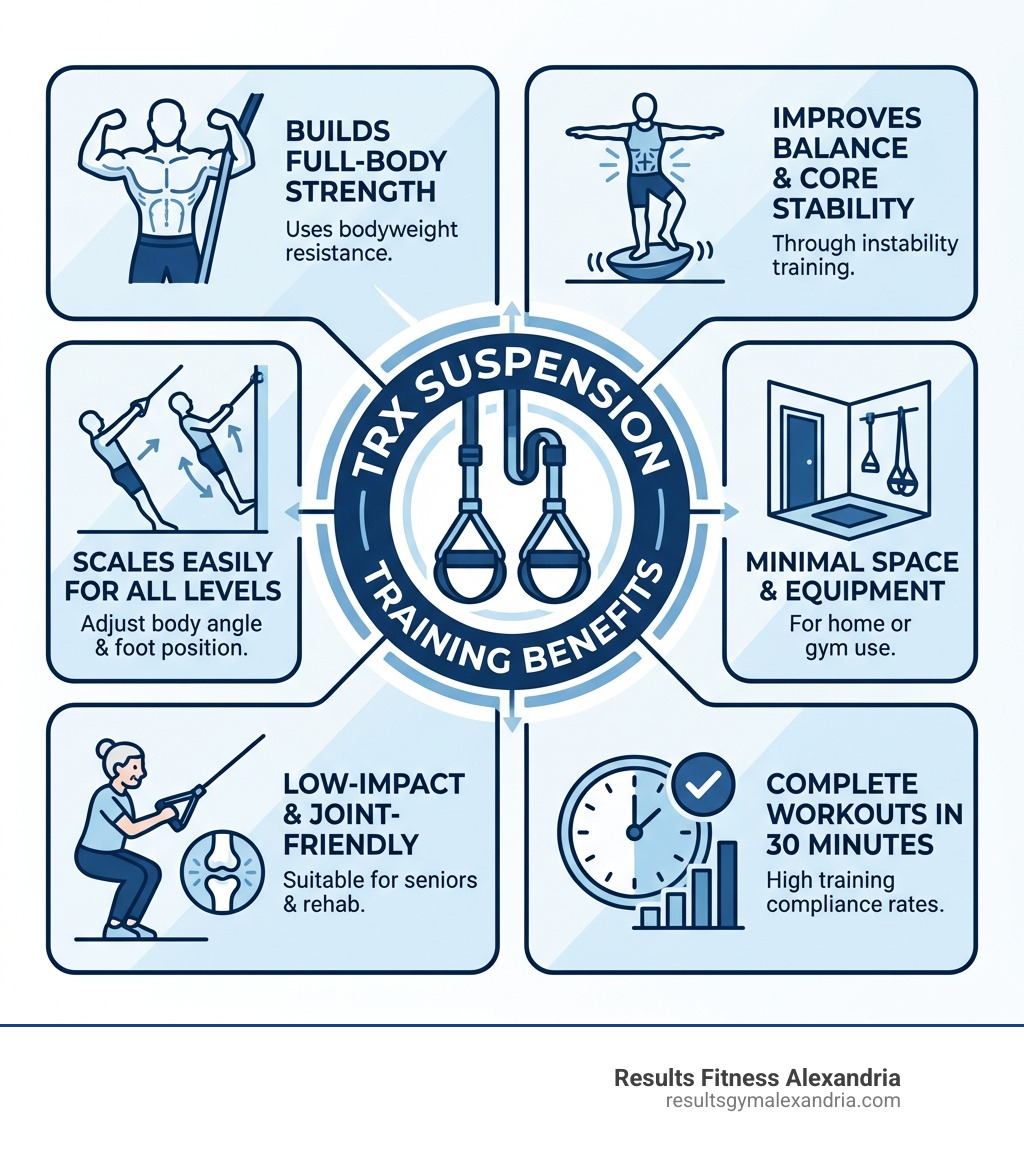
TRX suspension training is a bodyweight exercise system that uses two adjustable straps anchored to a stable point, allowing you to work against gravity to build strength, improve balance, and improve core stability across hundreds of exercises.
Quick Overview: What You Need to Know
- What it is: A strap-based training method invented by Navy SEAL Randy Hetrick using bodyweight and gravity as resistance
- Who it’s for: All fitness levels—beginners to advanced athletes, seniors, and people in physical therapy
- Key benefits: Full-body workout in 30 minutes, improves strength, flexibility, balance, and core stability with low joint impact
- How it scales: Adjust difficulty by changing body angle, foot position, or distance from anchor point
- Where to use it: Home, gym, or outdoors—requires minimal space and just one piece of equipment
- Cost: Around $200 for straps, plus optional app subscription for guided workouts
If you’ve struggled to find time for the gym or feel overwhelmed by complicated equipment, TRX offers a simple solution. You can get a complete workout in 30 minutes or less, right from your home or any small space.
The beauty of suspension training is its adaptability. Research shows that older adults achieved 85% training compliance over 12 weeks, with 100% reporting positive effects—proving that this system works for real people with busy lives, not just elite athletes.
I’m Jennifer Rapchak, Fitness Director at Results Fitness Alexandria, and I’ve spent over 14 years helping clients master effective training methods including TRX suspension training. My experience as a certified personal trainer and group fitness instructor has shown me how suspension training transforms bodies and builds confidence for people at every fitness level.
Key TRX suspension training vocabulary:
The Science and Origin of TRX Suspension Training
The story of TRX suspension training is as rugged as the workout itself. It wasn’t born in a high-tech lab but in the field of deployment. Randy Hetrick, a former Navy SEAL, created the first iteration of the TRX (Total-Body Resistance Exercise) using a jiu-jitsu belt and parachute webbing. He needed a way to keep his team in peak physical condition while deployed in remote locations where traditional gym equipment was non-existent.
What started as a makeshift solution for elite soldiers evolved into a global fitness phenomenon. The core of this system is gravity-based resistance. Instead of picking up a heavy plate or dumbbell, you use your own body weight as the “weight stack.” By leaning into or away from the anchor point, you create a load that your muscles must overcome.
At Results Fitness Alexandria, we advocate for this method because it aligns perfectly with the principles of functional fitness. The Benefits of Functional Fitness: Why It’s More Than Just a Workout lie in its ability to mimic real-world movements. Whether you are carrying groceries, picking up a grandchild, or skiing on vacation, TRX prepares your body for the multi-planar demands of daily life. You can learn more about the TRX origin story to see how a simple strap changed the fitness industry forever.
The Role of Core Engagement
One of our favorite phrases at Results Fitness is “All Core, All the Time.” This is the unofficial motto of TRX suspension training. Because the straps create an unstable environment, your body is forced to recruit stabilizing muscles that often remain dormant during machine-based exercises.
The primary driver here is the transverse abdominis—the deep “corset” muscle of your midsection. Every time you perform a TRX chest press or row, your core must fire to maintain a rigid, plank-like position. Without this engagement, your hips would sag or your back would arch, leading to poor form.
Proper spinal alignment and pelvic stability are not just “nice to have”; they are the foundation of safe movement. This is backed by Scientific research on core activation, which highlights how instability training increases the demand on the trunk muscles compared to traditional exercises on stable ground. By mastering the TRX, you aren’t just building “show” muscles; you’re building a “go” core that protects your spine.
How Gravity and Vector Angles Work
The “magic” of TRX is actually simple physics. We teach our members in Alexandria three primary principles to control their workout intensity:
- The Vector Principle: This refers to your body angle. The steeper your angle relative to the floor, the harder the exercise. For example, in a TRX Row, standing nearly upright is easy, while walking your feet forward so you are almost horizontal makes it incredibly challenging.
- The Pendulum Principle: This involves where your feet are in relation to the anchor point. If your feet are directly under the anchor, the exercise is neutral. Moving your feet past the anchor point (away from you) uses gravity to pull you back, increasing resistance.
- The Stability Principle: This is all about your base of support. A wide stance provides a stable base, making the move easier. Bringing your feet together, or even lifting one leg, creates more instability and forces your stabilizers to work harder.
Mastering the Seven Foundational Movements
TRX training is built on seven simple moves: Push, Pull, Squat, Lunge, Hinge, Plank, and Rotate. Once you master these, you can perform hundreds of variations.
To help you visualize where you’ll feel the burn, we’ve put together this table:
| Movement | Primary TRX Exercise | Target Muscle Groups |
|---|---|---|
| Push | Chest Press | Chest, Shoulders, Triceps, Core |
| Pull | Low Row | Upper Back, Biceps, Core |
| Squat | TRX Squat | Quads, Glutes, Hamstrings |
| Lunge | TRX Lunge | Glutes, Quads, Calves, Balance |
| Hinge | Hamstring Curl | Hamstrings, Glutes, Lower Back |
| Plank | TRX Plank | Core (Entire Midsection), Shoulders |
| Rotate | Power Pull | Obliques, Back, Core Stability |
These movements are the cornerstone of a healthy body. Understanding the 10 Benefits of Functional Fitness Exercises will help you see why we prioritize these patterns in our training sessions.
Push and Pull Patterns
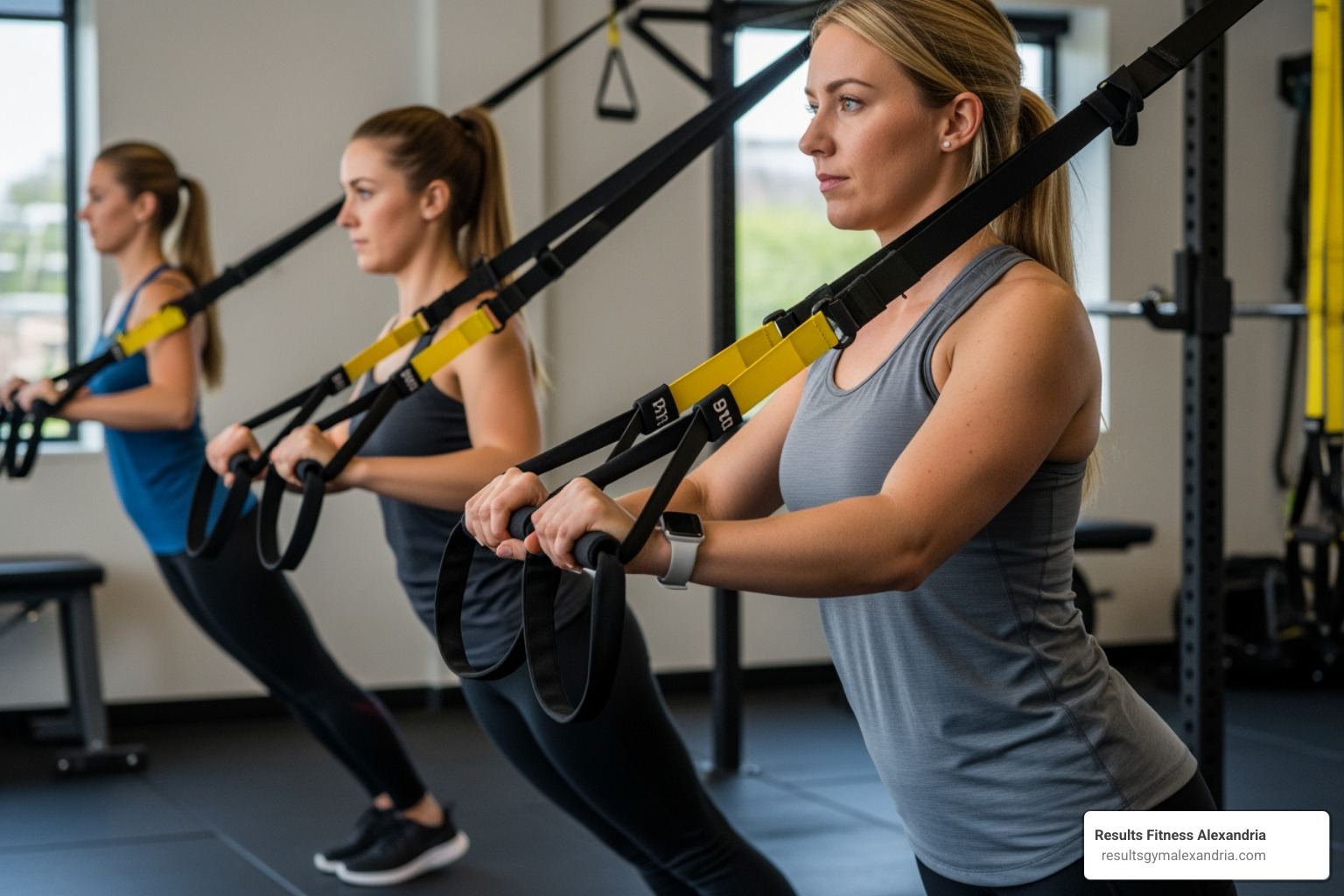
The TRX Chest Press (Push) and Low Row (Pull) are the bread and butter of upper body suspension training. In the Chest Press, you face away from the anchor point. It’s essentially a suspended push-up that allows for a greater range of motion and requires massive scapular stability.
The Low Row, facing the anchor, targets the “pulling” muscles of the back. It is excellent for correcting the “desk posture” many of our Alexandria clients struggle with. By focusing on scapular retraction (squeezing the shoulder blades), you build a strong, upright frame.
Squat, Lunge, and Hinge
Lower body mechanics are where the TRX truly shines as a teaching tool. For those with knee issues, the TRX Squat allows you to use the straps for support, helping you sit back into your heels and maintain proper form.
The Lunge and Hinge patterns focus on the posterior chain. The hinge, in particular, is vital for gluteal activation and hamstring health. Because the straps provide a “safety net,” you can explore deeper ranges of motion than you might with heavy free weights.
Plank and Rotate
The TRX Plank is arguably the most effective core exercise in existence. By placing your feet in the cradles, you remove the stability of the floor, forcing every muscle from your shoulders to your toes to engage.
Rotational movements, like the Power Pull, develop anti-rotational core strength. This is the ability to resist unwanted twisting, which is crucial for preventing back injuries. For our female members, our Strength Training for Women: Complete Guide further explains how these movements contribute to a toned, functional physique.
Scaling Your Workout: From Beginner to Advanced
One of the most common myths we hear in Alexandria is that TRX is “only for Navy SEALs.” That couldn’t be further from the truth. TRX is perhaps the most scalable tool in our gym.
Scaling relies on progressive overload—gradually increasing the stress placed on the body. We do this by manipulating your base of support and the angle of your body. If you’re just starting, check out our guide on Creating an Effective Workout Routine for Beginners.
Customizing TRX Suspension Training for Every Level
- Beginner: Use a wide stance for maximum stability. Keep your body at a shallow angle (more vertical). This reduces the amount of body weight you have to move.
- Intermediate: Move to a narrow stance (feet together). Increase your body angle to put more weight into the straps.
- Advanced: Try a single-leg stance or an offset foot position. This introduces a balance challenge that requires intense core focus. You can also increase the tempo or add “explosive” movements like jump squats.
Advanced Progressions and YBells
For those who have mastered the basics, we often integrate other tools like the TRX YBell. The YBell is a breakthrough 4-in-1 tool that combines a dumbbell, kettlebell, dual-grip med ball, and push-up stand.
By pairing the suspension trainer with YBells, we can create high-intensity metabolic conditioning circuits that torch calories and build lean muscle. Understanding The Science of Building Muscle involves knowing how to mix these modalities for maximum hypertrophy and strength gains.
Specialized Training: Rehab, Seniors, and Functional Fitness
TRX is a secret weapon for longevity. Because it is low-impact, it is exceptionally kind to joints while still being effective for muscle preservation.
Whether you are recovering from an injury or looking to stay active in your golden years, our TRX Suspension Training: A Comprehensive Guide provides a roadmap for success.
TRX for Older Adults and Longevity
The research on TRX for the 60+ demographic is incredibly encouraging. A landmark study (Gaedtke & Morat, 2015) found that:
- 85% training compliance was achieved, meaning participants actually stuck with the program.
- 91% of participants rated the training intensity as optimal.
- 73% of participants recognized strong improvements in flexibility.
- 100% of participants reported that the training induced positive effects on their daily lives.
For seniors in Alexandria, TRX is a game-changer for fall prevention. By improving proprioception (your body’s awareness of where it is in space) and balance, it builds the confidence needed to stay independent. The ability to hold onto the straps while performing a squat or lunge provides a level of security that traditional weights simply can’t match.
Safety and Best Practices for TRX Suspension Training
To get the most out of your session at Results Fitness or at home, follow these safety tips:
- Check your Anchor Point: Whether it’s a door, a beam, or a tree branch, ensure it can support at least double your body weight.
- Maintain Strap Tension: The straps should never go slack during an exercise. “Slack straps are sad straps”—keep them taut to ensure your muscles are doing the work.
- No Sawing: The TRX has a leveling loop. If you pull more on one side than the other, the straps will “saw” back and forth. This wears out the gear and unbalances your move. Keep equal pressure on both handles.
- Footwear Matters: Wear supportive athletic shoes with good grip. Training barefoot or in socks on a slippery floor is a recipe for a fall.
For more tips on making the most of your time, read our article on Maximizing Your Gym Sessions.
Frequently Asked Questions about TRX
Is TRX suitable for beginners?
Absolutely! As we’ve discussed, the intensity is entirely modifiable. By standing more upright, you reduce the load. We highly recommend working with a trainer for your first few sessions to ensure your “plank” is solid. Our Beginner Weight Training for Women guide is another great resource for those just starting their journey.
Can I use TRX for weight loss?
Yes. Because TRX engages so many muscle groups at once, it has a high metabolic demand. When used in a HIIT (High-Intensity Interval Training) format—short bursts of effort followed by brief rest—it becomes a calorie-burning powerhouse. Check out Functional Fitness for Weight Loss for more on this strategy.
What equipment do I need to start?
To start at home, you need the TRX Suspension Trainer (the straps) and an anchor. Most home kits come with a “Door Anchor” that slips over any sturdy door. If you want to take it to the next level, the TRX App offers over 2,000 workouts and daily live classes to keep you motivated.
Conclusion
TRX suspension training is more than just a set of yellow and black straps; it is a gateway to a stronger, more mobile, and more confident version of yourself. From its Navy SEAL origins to its proven benefits for seniors, it remains one of the most versatile tools in the fitness world.
At Results Fitness Alexandria, we pride ourselves on providing an environment where you can master these movements under the watchful eye of expert coaches. Whether you prefer the energy of group fitness classes or the personalized attention of one-on-one coaching, we have a program custom for you.
Ready to see what your body is truly capable of? We invite you to experience the Results Fitness difference. We offer a free 1-day pass to all fitness levels so you can try our amenities, including our TRX equipment, and meet our community.
Join a TRX movement class today! and start your journey toward functional strength and lifelong fitness. We can’t wait to see you at the gym!