
Pre workout fuel: Power Up with 3 Smart Strategies
Why Fueling Before You Sweat Matters
Pre workout fuel is the key to open uping your best performance in the gym. Here’s what you need to know:
Quick Answer: Optimal Pre-Workout Fueling
- 2-4 hours before: Eat a balanced meal with 500-600 calories (carbs, protein, some fat)
- 30-60 minutes before: Have a small snack with 200-300 calories (focus on easily digestible carbs and protein)
- Always: Stay hydrated with water throughout the day
- Best choices: Bananas, oatmeal, Greek yogurt, whole-grain toast, or a smoothie
Think of your body like a car. You wouldn’t start a long trip on an empty tank, right? The same goes for your workouts. Without proper fuel, you’re setting yourself up for early fatigue, poor performance, and maybe even that dreaded “bonking” feeling where your body just hits the wall.
Glycogen stores are your muscles’ primary energy source. Research shows that muscle glycogen can be depleted within just 1-2 hours of exercise. Once depleted, your body can only work at 50% of its maximum capacity. That’s like trying to run your favorite workout at half speed—frustrating and far from your goals.
But here’s the good news: even something as simple as 30-60 grams of carbohydrates consumed 30-60 minutes before training can prevent early fatigue and significantly increase your time to exhaustion. That means more reps, longer runs, and better results from every session you show up for.
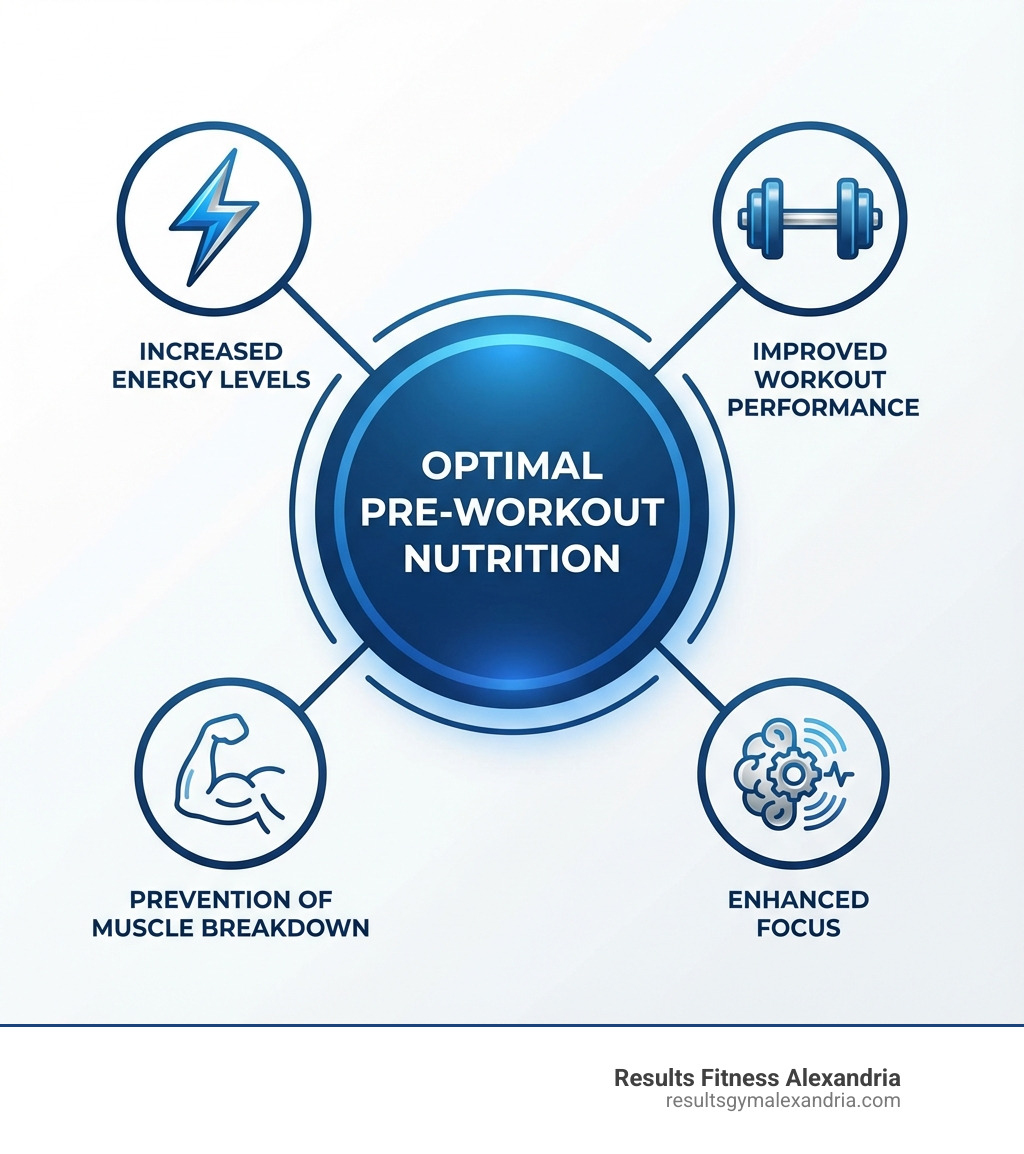
The right pre-workout nutrition provides your muscles with immediate energy, helps you maintain strength and focus throughout your session, and prevents your body from breaking down hard-earned muscle tissue for fuel. It’s not about complicated meal plans or expensive supplements—it’s about understanding what your body needs and when it needs it.
I’m Jennifer Rapchak, the Fitness Director at Results Fitness Alexandria, and I’ve spent over 14 years helping members optimize their training through smart nutrition strategies, including pre workout fuel choices that match their specific goals. Whether you’re tackling a high-intensity interval class or building strength through resistance training, the right fueling approach makes all the difference.
The ‘Big Three’ Macronutrients: Your Body’s Energy Sources
Just like a well-oiled machine needs the right kind of fuel, our bodies rely on a trio of essential nutrients—carbohydrates, protein, and fats—to power through workouts and recover effectively. These are our macronutrients, and each plays a distinct, yet interconnected, role in optimizing our pre workout fuel strategy. Understanding how they function will help us tailor our nutrition to meet the demands of any workout, from a brisk walk to an intense training session. The ratio in which we consume these macronutrients can depend on several factors, such as the duration, intensity, and type of exercise we’re planning.
Our muscles primarily use glucose for fuel. This glucose comes from the food we eat, and it’s stored in our muscles and liver as glycogen. When we exercise, our bodies tap into these glycogen stores. If these stores are low, our performance suffers. This highlights why knowing what to eat is important; fueling our body with the right nutrients prior to exercise will give us the energy and strength we need to perform better.
The Power of Carbohydrates

Carbohydrates are, without a doubt, the champions of pre workout fuel. They are our body’s primary energy source, especially during moderate to high-intensity exercise. When we consume carbohydrates, our body breaks them down into glucose, which is then used immediately for energy or stored as glycogen in the muscles and liver. These glycogen stores are critical, as they serve as our muscles’ main energy reserve. The International Society of Sports Nutrition (ISSN) emphasizes that glycogen is your muscles’ main source of energy during moderate to high intensity exercise.
Research consistently shows that carbohydrates increase glycogen stores and utilization while boosting carb oxidation during exercise. This is why even a small intake, like 30-60 grams of carbohydrates 30-60 minutes before training, can prevent early fatigue and increase time to exhaustion. For high-intensity and endurance exercises, such as a spin class or training for a half marathon, it’s crucial to ensure our glycogen stores are high so we can exert the required energy. Muscle glycogen stores can be depleted within 1-2 hours of intense activity, leading to a significant drop in performance, often referred to as “bonking” or “hitting the wall.”
When choosing carbohydrates for pre workout fuel, we consider two main types:
- Simple Carbs: These are quickly digested and provide a rapid burst of energy. Think of fruits like bananas, apples, or oranges, as well as honey or white bread. These are ideal for consumption closer to our workout time when we need fast-acting glucose.
- Complex Carbs: These are digested more slowly, offering a sustained, steady release of energy. Oatmeal, whole-grain toast, sweet potatoes, and brown rice are excellent examples. These are best consumed a few hours before a longer, more intense session to ensure a consistent energy supply.
For optimal results, especially for workouts longer than 60 minutes, focusing on carbohydrates is paramount.
The Role of Protein
While carbohydrates take center stage for immediate energy, protein plays a vital supporting role in our pre workout fuel strategy. Often called “the building blocks of life,” proteins are found in every cell of our body and are essential for repairing and making new cells. This is precisely why they are indispensable for muscle growth and recovery.
Eating protein prior to exercise has been shown to increase muscle protein synthesis. This is the process where amino acids, the building blocks of protein, are formed into muscle proteins, ultimately leading to muscle mass development. According to the ISSN, other benefits of eating protein before exercise may include:
- Increasing muscle mass
- Improving muscle recovery
- Increasing strength and lean body mass
- Enhancing muscle performance
While protein doesn’t directly provide us with “energy” in the same way carbohydrates do for our workouts, it helps prevent muscle breakdown during intense sessions and supports the repair process that begins even before our workout ends. This means we’re not just fueling our performance, but also protecting and building our muscles.
Good lean protein sources to include in our pre workout fuel include:
- Chicken breast
- Salmon
- Beans and lentils
- Tofu
- Low-fat yogurt or Greek yogurt
- Eggs
- Cottage cheese
- Nuts and peanut butter
Including a moderate amount of protein in our pre-workout meal or snack helps create an anabolic (muscle-building) environment, setting us up for better results.
Understanding Fats
Fats have often been misunderstood in nutrition, but they are crucial for overall health and can serve as an important component of our pre workout fuel strategy, especially for longer, lower-intensity activities. While glycogen is used for short and high-intensity exercise, fat is the main fuel source for longer and moderate to low-intensity exercise.
However, timing and quantity are key when it comes to fat intake before a workout. Fats take the longest to digest compared to carbohydrates and protein. Consuming too much fat too close to our workout can leave us feeling sluggish, cause gastrointestinal discomfort, or even divert blood flow from our working muscles to our digestive system.
For this reason, we generally recommend limiting significant fat intake right before exercise, especially for high-intensity sessions. If we’re having a larger meal a few hours before our workout, a moderate amount of healthy fats can contribute to satiety and provide sustained energy release.
Good sources of healthy fats include:
- Avocado
- Nuts and seeds
- Fatty fish (like salmon)
- Olive oil
Some studies have investigated the effects of fat intake on athletic performance, with most looking at high fat diets over a long period rather than immediately prior to exercise. For example, a 2021 review found that following a low carb, high fat diet could help improve body composition and increase maximal oxygen uptake when paired with high intensity interval training (HIIT). However, for immediate pre workout fuel, the emphasis shifts away from high-fat options due to their slow digestion. We save those delicious fats for meals further away from our training time.
The Golden Rules of Timing and Portions
When it comes to pre workout fuel, it’s not just about what we eat, but when and how much. Getting our meal timing right is crucial to ensure our body has access to energy without the discomfort of indigestion. The goal is to provide sustained energy, prevent gastrointestinal issues, and optimize our performance. Optimal fueling before a workout involves balancing these factors, as individual tolerance and workout type can greatly influence the best approach.
Large Meals: 2-4 Hours Before Your Workout
For workouts lasting more than 60 minutes, especially those involving high intensity or endurance, a well-rounded meal 2-4 hours prior is our golden standard. This timeframe allows for proper digestion time, ensuring that nutrients are absorbed and ready to fuel our muscles, while also preventing any stomach upset during our session.
These larger meals should typically range from 500 to 600 calories and be rich in carbohydrates, with a good amount of protein (aim for 15-20 grams), and some healthy fats. This balance provides a steady release of energy and supports muscle maintenance.
An ideal example of such a meal could be:
- Grilled chicken, sweet potato, and broccoli: This combination offers lean protein for muscle support, complex carbohydrates for sustained energy, and a touch of healthy fats and fiber.
This strategy ensures that our muscle glycogen stores are topped off, ready for the demands of a longer, more challenging workout.
Small Meals & Snacks: 30-60 Minutes Before Your Workout
Sometimes, our schedule only allows for a quick bite before hitting the gym, or we might need an extra boost after an overnight fast. This is where small meals and snacks come in handy. Consumed 30-60 minutes before our workout, these options focus on providing quick energy without weighing us down.
These snacks should generally be around 200-300 calories and primarily consist of easily digestible carbs (30-45 grams) with a moderate amount of protein (7-14 grams) and very little fat. This ensures rapid absorption and immediate energy availability.
Here are some ideal pre-workout snacks we recommend:
- Banana with peanut butter: The banana provides quick carbs, while a small amount of peanut butter offers protein and healthy fats.
- Greek yogurt with berries: A fantastic source of protein and simple carbohydrates from the fruit.
- Oatmeal: Instant oatmeal packets provide 19-27 grams of carbs and are quick to prepare.
- Whole-grain crackers with nonfat milk: Offers sustained energy from carbohydrates and helps replace electrolytes. Sixteen small whole-grain crackers (like Original Wheat Thins) and a cup of nonfat milk provide about 33 grams of carbohydrates and less than 5 grams of fat.
- Ricotta cheese on cinnamon raisin toast: Provides carbohydrates and calcium, essential for muscle contraction.
- Fruit smoothie: Blended fruits offer hydration, carbohydrates, and anti-inflammatory benefits.
- Fresh fruit: Apples, bananas, or oranges provide roughly 15-20 grams of easily digestible carbohydrates apiece.
- Sports drinks or fruit juice: For a very quick carb boost.
- Energy bars: Look for options with a good carb-to-protein ratio and low fat.
- Pretzels or rice crackers with jam: Simple, fast-digesting carbohydrates.
These options are designed to give us that immediate energy kick, preventing early fatigue and helping us power through our session.
Optimizing Your Pre Workout Fuel for Your Specific Goals
Just like we wouldn’t wear the same shoes for a marathon and a heavy lifting session, our pre workout fuel needs to be custom to our specific goals and the demands of our workout. The type and intensity of exercise, its duration, and even our individual tolerance to certain foods will dictate the best fueling strategy. It’s all about giving our body exactly what it needs, when it needs it, to perform at its peak.

Fueling for Strength Training vs. Cardio
The emphasis of our pre workout fuel can shift significantly depending on whether we’re hitting the weights or pounding the pavement.
Strength Training Needs:
For those of us hitting the gym for a strength session, we often have a little more flexibility with what we can eat. Since strength training typically involves shorter bursts of intense effort with rest periods, we’re less likely to experience gastrointestinal issues. Our pre-workout meal isn’t sloshing around during deadlift repeats! A balanced meal 2-3 hours prior, containing 20-30 grams of protein, 30-60 grams of carbs, and some fat, works well. The protein supports muscle protein synthesis and recovery, while carbs provide the necessary energy.
Cardio Needs:
Cardio workouts, especially those that are longer or more intense, tend to deplete our glycogen stores more rapidly. Therefore, the emphasis should be heavily on carbohydrates. If we’re planning a meal several hours before a cardio workout, we’ll still prioritize carbs. For high-intensity aerobic exercise or resistance training sessions that last longer than 60 minutes, pre-workout carb intake plays a significant role. The ISSN notes that high intensity exercise longer than 60 minutes may deplete our glycogen stores, making consistent carb intake crucial.
| Feature | Strength Training Pre-Workout Fuel | Cardio Pre-Workout Fuel |
|---|---|---|
| Primary Focus | Balanced carbs & protein; less concern about GI issues. | High carbohydrates to top off glycogen stores. |
| Timing 2-4 hrs | Balanced meal: 20-30g protein, 30-60g carbs, some fat. | High carb meal: Emphasize complex carbs. |
| Timing 30-60 min | Easily digestible carbs with some protein. | Easily digestible, fast-acting carbs. |
| Key Macronutrient | Protein (for muscle repair/growth) & Carbs (for energy). | Carbohydrates (primary fuel for endurance). |
| Mid-Workout Fuel | Generally not needed for typical sessions. | Essential for workouts > 60 min (simple carbs like applesauce). |
| GI Concern | Lower, more flexibility with food choices. | Higher, prioritize easy-to-digest foods to avoid discomfort. |
For cardio workouts that last 60 minutes or more—like a long training run—we might also need mid-workout fuel with simple carbs, such as an applesauce pouch or a sports gel, to keep those energy levels high.
Foods to Avoid Before a Workout
While focusing on what to eat is important, knowing what to avoid before a workout can be equally crucial for a comfortable and effective session. Our individual preferences and tolerances play a big role here, but there are some common culprits that can sabotage a solid workout by causing digestive distress or sluggishness.
Here are some foods we generally recommend limiting or avoiding as part of our pre workout fuel strategy:
- High-fat foods: Since fats take the longest to digest, consuming them right before exercise can leave us feeling heavy, bloated, and lethargic. They divert blood flow to the digestive system, away from our working muscles.
- High-fiber foods: While fiber is fantastic for digestive health normally, too much insoluble fiber before a workout can lead to gas, bloating, and urgent bathroom trips, especially during high-intensity or long-duration activities. Think cruciferous vegetables like broccoli or cauliflower, and some legumes.
- Spicy foods: These can cause heartburn, indigestion, and general discomfort, making it difficult to focus on our workout.
- Carbonated drinks: Even sugar-free options can cause stomach expansion due to excess gas, leading to uncomfortable bloating and burping during exercise.
The key is to listen to our body. If a certain food consistently causes issues, it’s best to save it for after our workout or at times further away from our training sessions.
The Critical Role of Hydration
Often overlooked but absolutely essential, hydration is a cornerstone of effective pre workout fuel. Without enough water and electrolytes, we risk poor performance, slow recovery, and even dehydration, which can manifest as weakness, fatigue, and dizziness. Proper hydration is critical for optimal health and maximal athletic performance; water plays a vital role in the functioning of our bodies, facilitating nutrient transport, temperature regulation, and muscle function.
Our muscles are roughly 75 percent water, making consistent hydration a priority. It’s not just about chugging water right before a workout; it’s a continuous effort throughout the day.
Here are our hydration recommendations:
- Throughout the day: Aim to drink water consistently. Adult males should aim for about 3.7 liters (approx. 15.5 cups) of total water daily, and adult females about 2.7 liters (approx. 11.5 cups).
- 2-3 hours before: The National Athletic Trainers Association (NATA) recommends having 500-600 milliliters (about 17-20 ounces) of water or a sports drink.
- 10-20 minutes before: NATA suggests another 200-300 milliliters (about 7-10 ounces) of water or a sports drink.
For longer or more intense workouts, especially in warmer conditions, replenishing electrolytes becomes important. Electrolytes like sodium, potassium, and magnesium are lost through sweat and are crucial for muscle contraction, nerve function, and maintaining fluid balance. Sports drinks can help, or we can get electrolytes from natural sources like fruits (bananas for potassium), leafy greens, and even a pinch of salt in our water if advised by a professional.
Staying well-hydrated ensures our body’s engine runs smoothly, helping us maintain energy, focus, and performance throughout our entire workout.
Enhancing Your Fueling Strategy with Supplements
While whole foods form the foundation of an effective pre workout fuel strategy, certain pre-workout supplements can offer an additional edge, helping to boost performance, focus, and recovery. Supplements are meant to supplement a solid diet, not replace it. For those looking to optimize their training, especially high-intensity or long-duration efforts, these additions can be beneficial.
Many multi-ingredient pre-workout supplements combine several of these compounds. Research has shown that these comprehensive formulations can provide significant benefits in improving time to exhaustion and general performance.
Caffeine
For many of us, caffeine is a familiar part of our morning ritual, and its benefits extend to our workouts too. As a pre workout fuel, caffeine is known to:
- Increase focus: It sharpens our mental alertness, helping us concentrate better during complex movements or long sessions.
- Provide an energy boost: Caffeine stimulates the central nervous system, reducing the perception of effort, making our workout feel less strenuous.
- Improve performance: Studies consistently show that caffeine can improve endurance performance, strength, and power output.
Research on caffeine and performance demonstrates its effectiveness in improving various aspects of exercise. We typically recommend consuming caffeine 30-60 minutes before a workout to allow for absorption.
Creatine
Creatine is one of the most extensively researched and effective supplements for enhancing exercise performance. For anyone aiming to increase strength and power, it’s a powerful ally in our pre workout fuel arsenal.
- Power output: Creatine helps regenerate ATP (adenosine triphosphate), our body’s primary energy currency, allowing for more explosive movements.
- Strength gains: Consistent creatine supplementation is linked to significant increases in maximal strength and power.
- Muscle mass: It can also contribute to increased lean muscle mass, especially when combined with resistance training.
Research consistently demonstrates that creatine is one of the best pre-workout supplements, showing consistent improvement in overall power and additional health benefits. While often taken daily, consuming it before a workout can ensure our muscles have readily available stores for high-intensity efforts.
Branched-Chain Amino Acids (BCAAs)
Branched-chain amino acids (BCAAs)—leucine, isoleucine, and valine—are essential amino acids that our body cannot produce on its own. They are particularly popular in the fitness community as part of a pre workout fuel strategy for their role in muscle health.
- Muscle repair: BCAAs contribute to muscle protein synthesis, helping to kickstart the repair process even before our workout is complete.
- Reduced soreness: Some research suggests that BCAAs can help decrease exercise-induced muscle soreness (DOMS).
- Increased time to exhaustion: Taken before a workout, BCAAs have been shown to increase time to muscle exhaustion, helping us push harder and longer.
While our bodies can use BCAAs for energy during prolonged exercise, their primary benefit as pre workout fuel lies in their muscle-sparing and recovery-supportive properties.
Conclusion: Fuel Your Way to Fitness Success
Navigating pre workout fuel might seem complex at first, but by understanding the basics, we can create a powerful strategy that lifts our fitness journey. We’ve learned that carbohydrates are our primary energy source, essential for topping off those vital glycogen stores. Protein supports muscle growth and recovery, and healthy fats offer sustained energy for longer, lower-intensity efforts.
The timing and composition of our meals matter: a larger, balanced meal 2-4 hours before intense activity, and a smaller, carb-focused snack 30-60 minutes prior. We also know what to avoid—those high-fat, high-fiber, or spicy foods that can cause discomfort. And let’s not forget the critical role of hydration, keeping our body’s engine running smoothly.
A successful pre workout fuel strategy is about consistency and listening to your body. Experiment with different foods and timings to find what works best for you and your specific workouts. What fuels a high-intensity interval training session might differ from what powers a steady-state cardio workout or a heavy lifting day.
At Results Fitness Alexandria, we believe a smart fitness plan includes both effective workouts and proper nutrition. A solid fueling strategy is your first step toward crushing your goals, whether you’re in a high-intensity class or working on your endurance. By prioritizing smart pre workout fuel, you’re not just preparing for a workout; you’re investing in better performance, faster recovery, and a stronger, healthier you.