
Core endurance training 2025: Unshakeable Core
Why Core Endurance Training Matters for Your Fitness Journey
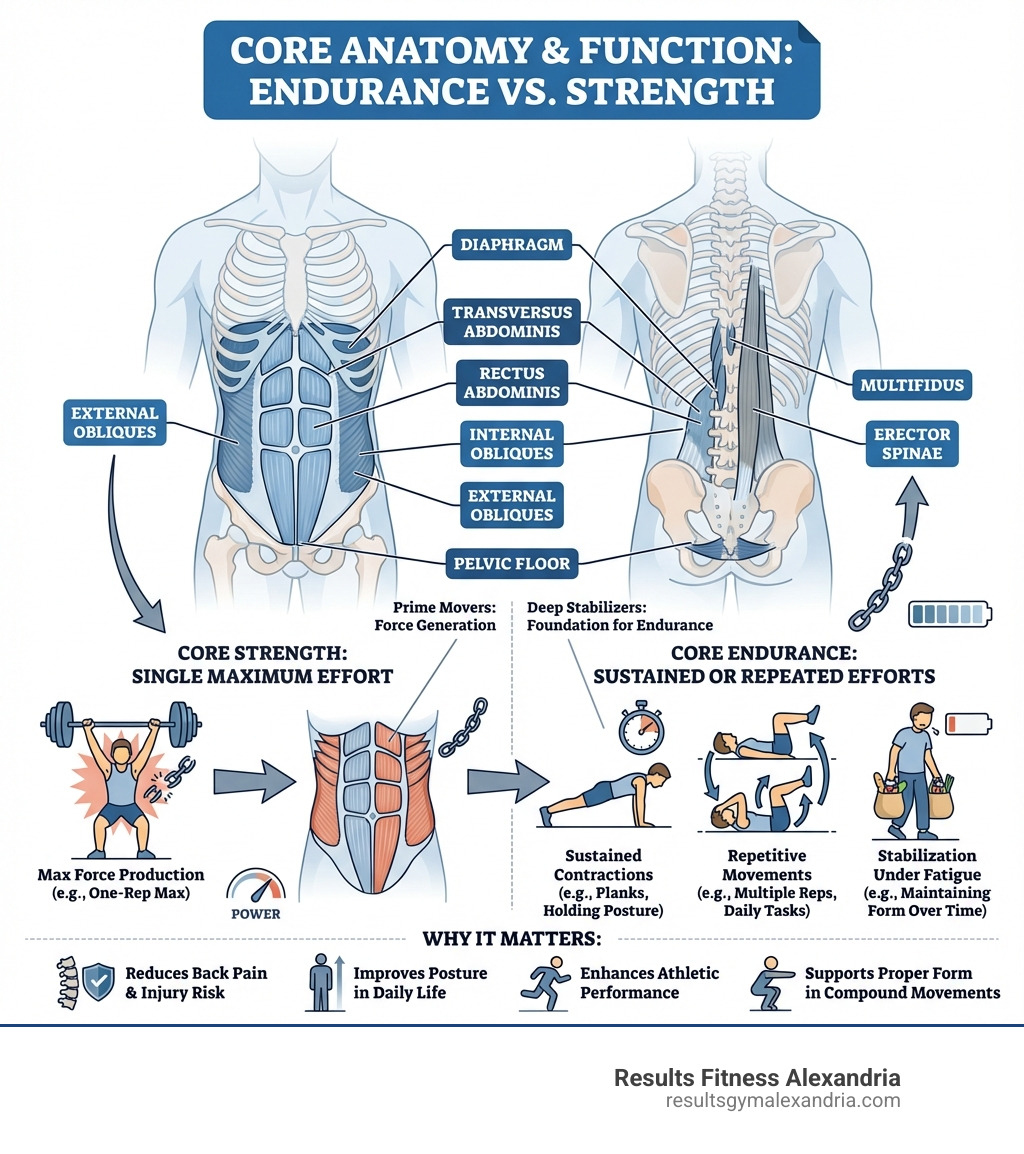
Core endurance training is the ability of your core muscles to sustain effort over time. Unlike core strength (a single maximum effort), endurance is about how long your muscles can keep going. This involves sustained holds like planks, repetitive movements like dead bugs, and maintaining stability as you get tired.
Why It Matters:
- Reduces lower back pain and injury risk
- Improves posture and balance
- Boosts athletic performance
- Supports proper form in heavy lifts like squats and deadlifts
Think about your daily life: standing for hours, carrying groceries, or lifting a child. These activities require endurance, not a one-rep max. Core endurance training builds this functional capacity.
Many people mistakenly focus on visible abs with endless crunches. True core endurance comes from training the deep stabilizing muscles you can’t see, like the transversus abdominis and multifidus. Research shows that core stability exercises are significantly better than general exercise for reducing chronic low back pain. A well-trained core protects your spine and transfers force efficiently through your body.
This guide will walk you through building lasting core endurance, from the muscles involved to the best exercises you can do anywhere.
I’m Jennifer Rapchak, Fitness Director at Results Fitness Gym. With over 14 years of experience and as a certified Les Mills CXWORX instructor, I’ve seen how proper core conditioning transforms not just workouts, but daily life.
Understanding Your Core: More Than Just Abs
Your core is more than just a six-pack; it’s a muscular corset that stabilizes your spine. Key muscles include:
- Transversus Abdominis (TVA): The deepest ab muscle, your body’s natural weight belt.
- Rectus Abdominis: The “six-pack” muscle used for flexing the spine.
- Internal and External Obliques: Muscles on your sides for twisting and bending.
- Erector Spinae & Multifidus: Muscles along the spine for back extension and stability.
Supporting muscles like the Pelvic Floor, Glutes, and Diaphragm are also vital for creating a stable cylinder of support. A strong, enduring core leads to improved posture, better balance, and significant injury prevention.
Let’s clarify the distinction between core strength and core endurance training:
| Feature | Core Strength | Core Endurance |
|---|---|---|
| Definition | Maximal force core can produce in one effort | Ability to sustain effort over long durations |
| Focus | Heavy lifting, maximal bracing | Sustained holds, repetitive movements |
| Training Style | Low reps, high intensity | High reps, longer holds, moderate intensity |
| Example | Bracing for a 1-rep max deadlift | Holding a plank for 2 minutes, 50 Russian twists |
| Goal | Max force production | Fatigue resistance, sustained stability |
Both are vital, but for daily life, core endurance training is often the unsung hero. To understand how these benefits extend to all aspects of your physical well-being, explore The Benefits of Functional Fitness: Why It’s More Than Just a Workout.
Why Core Endurance is Crucial for Performance
All forces are transmitted through your core. For athletes, this means better force transfer (more power), improved stability during movement, and reduced energy leaks. For endurance athletes, this translates to better posture and efficiency over long distances.
In daily life, core endurance makes lifting and carrying objects feel easier and safer. For desk workers, it helps maintain proper posture, preventing slouching and discomfort. Essentially, it makes everyday actions effortless and pain-free.
To dive deeper into how core training can specifically improve your posture, take a look at this Research on core training and posture.
The Link Between Core Endurance and Injury Prevention
One of the biggest benefits of core endurance training is preventing injuries, especially to the lower back. A weak core is a major contributor to chronic low back pain. Research from Ohio State University found that runners with weak deep core muscles are at a higher risk of developing low-back pain, highlighting the importance of endurance, not just strength.
Your core muscles stabilize your spine during movement. When they fatigue, your form degrades, and your spine becomes vulnerable. This is especially true during compound movements like squats and deadlifts, where your core must act as a rigid pillar to protect your back. A resilient core allows you to perform these powerful movements safely and effectively.
Understanding the risks associated with a weak core is the first step towards a healthier, more resilient body. If you’re just starting your fitness journey, building a strong core should be a priority in Creating an Effective Workout Routine for Beginners.
The Foundations of Effective Core Endurance Training
Effective core endurance training is built on smart, intentional principles.

1. Proper Breathing: Use your diaphragm by breathing deeply into your belly. This creates intra-abdominal pressure that stabilizes your spine. Avoid holding your breath during exercises.
2. Mind-Muscle Connection: Consciously engage your deep core muscles. Focus on tightening your transversus abdominis by imagining you’re bracing for a punch to the stomach. Control is key.
3. Maintaining a Neutral Spine: Avoid excessively arching or rounding your lower back during exercises. Your goal is to maintain your spine’s natural curves to keep it safe and stable.
4. Progressive Overload: To keep improving, you must continually challenge your core. Gradually increase the duration of holds, add more reps, or introduce more challenging variations over time.
The principle of progressive overload is fundamental to any fitness journey. Learn more about how to apply it effectively in The Power of Progressive Overload: How to Keep Getting Stronger.
Common Mistakes to Avoid
Train smarter by avoiding these common pitfalls in core endurance training.
- Arching the Lower Back: A classic sign of a fatigued core, especially in planks. Keep your spine neutral by engaging your abs and glutes.
- Holding Your Breath: This reduces stability and creates unnecessary tension. Breathe freely and deeply.
- Rushing Through Reps: Speed is not the goal; control is. Slow, deliberate movements are more effective than using momentum.
- Neck Strain: Avoid pulling on your head during exercises like crunches. Let your abs do the work.
- Using Momentum: Swinging your legs or jerking your body means your core isn’t properly engaged. Focus on controlled muscle contractions.
- Focusing Only on Crunches: A well-rounded routine challenges your core in all planes of motion, including anti-extension (planks), anti-rotation (Pallof press), and anti-lateral flexion (side planks).
By avoiding these common mistakes, we ensure our core endurance training is productive and safe. For a broader look at common errors in fitness, check out Top 5 Common Mistakes at Each Fitness Level and How to Avoid Them.
Building Your Foundation: Essential Core Endurance Exercises
Ready to build an unshakeable core? Here are some fantastic exercises to get you started.
Recommended Equipment:
- An exercise mat for comfort.
- Optional light weights (dumbbells, kettlebells) or resistance bands for progression.
How to Structure a Workout for Core Endurance:
Focus on sustained effort. Aim for 2-3 sets per exercise. For holds like planks, work from 30 seconds up to 2 minutes. For dynamic moves, aim for 12-15+ reps with pristine form. Keep rest periods short (around 30 seconds) to challenge your endurance. A dedicated core session can be 20-30 minutes, 2-3 times a week.
For personalized guidance on structuring workouts, especially for women, consider our Personal Training for Women: Tips.
Foundational Core Endurance Training Exercises
Focus on controlled movements and maintaining a neutral spine.
1. Plank (Forearm Plank)
- How to Perform: On your forearms and toes, form a straight line from head to heels. Brace your abs and glutes. Keep your gaze on the ground.
- Progression: Increase hold time. Once you can hold for 2 minutes, try lifting one arm or leg.
- For a visual guide, check out How to perform a plank correctly.
2. Side Plank
- How to Perform: Support your body on one forearm and the side of your foot, forming a straight line. Stack your hips and keep your core engaged.
- Progression: Increase hold time. Modify by bending your knees on the ground if needed.
3. Glute Bridge
- How to Perform: Lie on your back with knees bent and feet flat. Lift your hips until your body forms a straight line from shoulders to knees, squeezing your glutes.
- Progression: Aim for 12-15 reps. To increase difficulty, try a single-leg glute bridge.
4. Dead Bug

- How to Perform: Lie on your back with arms toward the ceiling and knees at 90 degrees. Slowly extend your opposite arm and leg toward the floor without letting your lower back arch.
- Progression: Aim for 12-15 reps per side. Add ankle or wrist weights for more challenge.
5. Bird-Dog
- How to Perform: On all fours, slowly extend your opposite arm and leg straight out, keeping your core braced and hips level.
- Progression: Hold the extended position for 5-10 seconds. Aim for 10-12 reps per side.
Dynamic and Advanced Core Endurance Training Exercises
Once you’ve mastered the basics, add these dynamic challenges.
1. Mountain Climbers
- How to Perform: In a high plank, drive one knee toward your chest, then quickly switch legs. For more core work, go slow and bring your knee to the opposite elbow.
2. Russian Twists
- How to Perform: Sit with knees bent, lean back with a straight back, and lift your feet. Twist your torso from side to side, tapping your hands to the floor.
3. Renegade Rows
- How to Perform: In a high plank with a dumbbell in each hand, row one dumbbell to your chest, keeping your hips as still as possible. Alternate sides.
4. Pallof Press
- How to Perform: Stand perpendicular to a resistance band or cable. Press the handle straight out from your chest, resisting the rotational pull from the side.
5. Farmer’s Carry (Single Arm)
- How to Perform: Hold a heavy weight in one hand and walk for a set distance, standing tall and resisting the urge to lean.
6. Turkish Get-up
- How to Perform: This complex movement takes you from lying on the floor to standing up, all while holding a weight overhead. Master the movement with no weight first.
Integrating these exercises will take your core endurance training to the next level. For more ideas, read Maximizing Results: Integrating Strength Training into Your Cardio Routine.
Assessing and Integrating Your Training
To improve your core endurance training, you need to measure your starting point.
How to Assess Your Core Endurance:
- Timed Planks: Hold a perfect plank for as long as you can. Note the time when your form breaks. This is your baseline.
- McGill’s Endurance Tests: Developed by Dr. Stuart McGill, these tests assess different core muscle groups: the Flexor Endurance Test (anterior core), Extensor Endurance Test (posterior core), and Side Bridge Test (lateral core). They can reveal imbalances between muscle groups.
- For more detailed information on these assessments, refer to Dr. McGill’s endurance test research.
Integrating Core Endurance Training into a Fitness Program:
- Warm-ups: Use light core activation exercises like dead bugs or bird-dogs to wake up your core.
- Between Sets: Perform a plank or another core exercise between sets of other movements like squats.
- Dedicated Sessions: Have a focused 20-30 minute core workout 1-2 times per week.
- Listen to Your Body: Rest when your core feels fatigued to avoid compromising form and risking injury.
A balanced fitness program is key. Learn more in How to Create a Balanced Fitness Routine Combining Cardio, Strength, and Flexibility.
Training Safely with Pre-existing Conditions
If you have back problems, osteoporosis, or other health concerns, approach core endurance training with care.
- Consult a Professional: Always talk to your doctor or physical therapist before starting a new exercise program. They can provide guidance specific to your condition.
- Use Modifications: Most core exercises can be modified. For example, perform planks on your knees or against a wall to reduce the load.
- Focus on Stabilization: Emphasize gentle, slow, and controlled movements that build deep core control without aggravating symptoms.
- Stop if it Hurts: Muscle fatigue is normal, but sharp pain is not. Stop any exercise that causes pain.
- Work with a Trainer: A certified personal trainer can provide personalized modifications and ensure you’re performing exercises safely. Learn about The Amazing Benefits of Working With a Personal Trainer.
Frequently Asked Questions about Core Endurance
Let’s tackle some common questions about core endurance training.
How often should I do core endurance training?
For most people, 2-4 times per week is ideal. This provides enough stimulus for adaptation while allowing for recovery. Always listen to your body; if your core is sore, take a rest day. Overtraining can increase injury risk.
For more insights into optimizing your workout schedule, explore How Often Should You Work Out Based on Your Goals?.
What’s the difference between core exercises for endurance vs. strength athletes?
While both need a strong core, the training focus differs.
-
For Endurance Athletes (runners, cyclists): The focus is on fatigue resistance to maintain posture and efficiency over long durations. Training involves higher reps and longer holds (e.g., 2-minute planks, high-rep Russian twists).
-
For Strength Athletes (powerlifters): The focus is on maximal stiffness and bracing to protect the spine during heavy, short-duration lifts. Training involves lower reps with higher intensity (e.g., weighted planks, heavy anti-rotation exercises).
There is overlap, but the training style is custom to the athlete’s specific demands.
Will core exercises help me lose belly fat?
No, core exercises alone will not burn belly fat. The idea of “spot reduction” is a myth. You cannot target fat loss from a specific body part by exercising it.
Fat loss is achieved primarily through a calorie deficit, meaning you burn more calories than you consume. This is best accomplished with:
- A balanced, calorie-controlled diet.
- A comprehensive exercise routine that includes both cardio and full-body strength training to burn calories and build metabolism-boosting muscle.
While core exercises build a stronger, more functional midsection, they must be paired with proper nutrition and overall exercise for fat loss. For more on this topic, read Cardio vs. Strength Training for Weight Loss: Which Is Better?.
Build an Unshakeable Core
We’ve covered the anatomy of your core, its role in performance, and the principles of effective core endurance training. From foundational planks to dynamic Turkish Get-ups, you now have the tools to build a resilient midsection.
The benefits are profound:
- Reduced back pain
- Improved posture and balance
- Improved athletic performance
- A lower risk of injury
Consistency is your most important tool. Start with the basics, focus on perfect form, and progress gradually. By investing in core endurance training, you’re not just building stronger abs; you’re building a more capable, resilient, and pain-free version of yourself.
At Results Fitness Alexandria, we believe in empowering you to achieve your fitness goals. Our expert trainers and diverse amenities are here to support you on your journey to a stronger core and better overall health.
Ready to put these principles into practice? Explore our cardio and functional training amenities and let us help you build the enduring core you deserve!